Recovery
Ultrahuman Ring AIR Review: The Smart Ring With No Monthly Bill
Ultrahuman Ring AIR review for UK buyers: £199 with no subscription, 4 to 6 day battery, sizing advice, accuracy evidence and a two-year cost check vs Oura.

By Jacob Chambers, Founder & Lead Reviewer · Updated 11 November 2026
We may earn a commission from qualifying purchases made through links on this page, at no extra cost to you. This never affects our ratings.
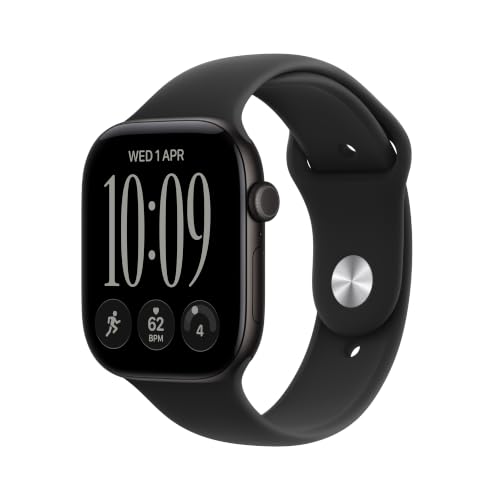
The Apple Watch Series 12 is the first Apple Watch that takes recovery seriously, and for an iPhone owner who trains three to five times a week it's now the smartwatch to buy. A redesigned heart sensor reads HRV as often as every five minutes, a new Readiness app turns that into a morning score, and the aluminium case finally gets glass that should survive a barbell knurl. The battery hasn't moved, though: 24 hours, same as last year, against the 12 days a Garmin Venu 4 manages.
That one number decides who should buy it. If you charge your phone nightly and won't resent doing the same for a watch, very little at around £419 for the 46mm does as much. If you want to forget where the charger is for a week, nothing Apple sells will suit you, and you can stop reading at the Garmin vs Apple Watch comparison.
Check the Apple Watch Series 12 price on Amazonaround £419How we review
This review is based on Apple's published UK specifications and comparison pages, the Amazon UK listing, launch coverage from established tech outlets and peer-reviewed research on wrist heart rate sensors. We haven't run our own long term test of this watch, which only went on sale on 18 September 2026, so we treat Apple's figures as claims and say so where nobody independent has checked them yet.
Buy the Series 12 if you own an iPhone, train regularly, and want one device that handles runs, gym sessions, sleep, contactless payments and messages without a subscription. The Readiness score is aimed squarely at people who'd otherwise be weighing up a WHOOP band, and our WHOOP vs Apple Watch comparison shows how quickly a one-off purchase beats an annual membership on cost.
It's the wrong watch for three groups. Android users can't pair it at all. Ultra runners and multi-day hikers will outlast its 10 hour GPS rating before lunch on day two. And anyone who owns a Series 11 and is happy with it has little reason to move, because the screen, battery and case are the same.
Less than the launch event suggested, and almost all of it sits on the back of the watch. Apple's comparison page gives both generations 24 hours of battery, 38 hours in Low Power Mode, a 2,000 nit display and a 9.7mm case. The 46mm aluminium model has actually gained weight, going from 37.8g to 39.5g.
The new parts are the sensing system and the chip. Apple fitted larger green LEDs and updated optical and electrical sensors, paired them with the S11 chip, and used the extra efficiency to sample far more often: heart rate every five seconds in the background and HRV as often as every five minutes. Aluminium cases also move from Ion-X glass to Ceramic Shield 2, which matters more than it sounds if your watch regularly meets kettlebells, pull-up bars or gym lockers.
| Case sizes | 42 mm and 46 mm; aluminium, titanium or ceramic |
|---|---|
| Dimensions and weight | 46 x 40 x 9.7 mm, 39.5 g (42mm aluminium GPS: 32.2 g) |
| Display | Always-On Retina LTPO3, 416 x 496 pixels, 2,000 nits peak, 1 nit minimum |
| Front glass | Ceramic Shield 2 (aluminium); sapphire crystal (titanium, ceramic) |
| Chip and storage | S11, 64 GB |
| Battery | Up to 24 hours normal use, 38 hours Low Power Mode, 10 hours outdoor workout |
| Charging | About 80 percent in 30 minutes; 15 minutes for up to 12 hours |
| Heart sensing | Background heart rate every 5 seconds, HRV as often as every 5 minutes, ECG |
| Other sensors | Blood oxygen, wrist temperature, always-on altimeter, compass, 6 m depth gauge |
| GPS | Precision L1 (GPS, GLONASS, Galileo, QZSS, BeiDou) |
| Water and dust | 50 m water resistance (ISO 22810), IP6X |
| Requires | iPhone 11 or later with iOS 27 |
All figures come from Apple's UK technical specifications.
Apple says the Series 12 has "the most accurate heart rate sensing in a wearable". That line comes from a study Apple ran itself in July and August 2026, and nobody independent has published a validation of the new sensor, so treat it as marketing until someone does.
What we can say is that Apple started from a strong position. A 2022 lab study put 30 people through a maximal treadmill test wearing an Apple Watch Series 6 and found a mean absolute error of 1.16 to 1.48 beats per minute against an ECG, across moderate and vigorous intensities (Ho and colleagues, 2022). For zone 2 runs and steady bike sessions, wrist readings from a recent Apple Watch are good enough to train by.
There's a caveat, and it applies to every brand. Researchers reviewing this kind of validation work have pointed out that studies often use inconsistent statistics and don't always test devices in the setting people actually use them (methodological shortcomings of wrist-worn heart rate monitor validations). A treadmill ramp test is kinder to an optical sensor than a set of heavy cleans with a flexed wrist. If you do short intervals or lift a lot and want clean data, pair a chest strap from our heart rate monitor guide; the watch accepts Bluetooth straps.
The HRV change is the bigger deal for recovery. Apple says the new sensor reads HRV 24 times more often than the Series 11 did. Sampling as often as every five minutes gives the Vitals app and the Readiness score far more data to work with, and it's the reason Apple restricts Readiness to the Series 12 and Ultra 4.
Readiness is Apple's answer to Garmin's Training Readiness and WHOOP's Recovery. Each morning the watch produces one score from your recent activity, overnight vitals and sleep, and it adjusts as the day goes on. Apple hasn't published how it weights those inputs, and it labels the whole thing as wellness rather than medical data.
Is it as useful as Garmin's version? Not yet, for structured training. Garmin blends HRV Status, sleep, recovery time and training load into its figure, so the number connects to everything else the watch tracks. Apple's score is a prompt: go hard, go easy or rest. For someone lifting three times a week and running at the weekend that's enough, and it costs nothing extra, which is the whole argument against a WHOOP membership.
Sleep score carries over from last year. It grades each night on duration, bedtime consistency, awakenings and time in each sleep stage. With a 24 hour battery you have to plan around it: wear the watch overnight, then charge while you shower. Apple says five minutes on the puck covers up to 10 hours of sleep tracking, which rescues the nights you forget.
The Series 12 uses single-band L1 GPS with the usual five satellite systems. On open roads and in parks that's fine. Among tall buildings or under heavy tree cover, dual-frequency watches hold a cleaner line, and Apple keeps that for the Ultra; our Apple Watch Ultra 3 review covers the older Ultra, which has it.
The Workout app is still the friendliest in the business. You get heart rate zones, Pacer, custom interval workouts and Training Load, and the screen is large and bright enough to read mid-rep. Workout Buddy adds spoken coaching, though it needs an Apple Intelligence iPhone nearby (or a cellular watch) and Bluetooth headphones. What's missing is the deeper analysis: Garmin's HRV Status compares each night against a baseline built over weeks, and its pricier watches carry full topographic maps, whereas the Apple Watch leans on Apple Maps.
Twenty-four hours. Apple quoted the same figure for the Series 11, and its test profile includes only a 60 minute workout and six hours of sleep tracking, so a long Sunday run plus a full night will run it closer to the wire than the headline suggests.
The 10 hour outdoor workout rating covers a marathon comfortably and most people's longest bike ride. It doesn't cover a 100km ultra or a two-day hike. For comparison, Garmin rates the 45mm Venu 4 at up to 12 days in smartwatch mode and around 19 hours of full-accuracy GPS. That's a different category of endurance, and more frequent HRV sampling doesn't close it.
Fast charging is the mitigation, and it's a good one. Thirty minutes gets you to roughly 80 percent, so the routine becomes a top-up at your desk or while you wash, with no overnight gap in the data. You'll still pack a charger for every weekend away.
Ceramic Shield 2 is the practical upgrade for gym use. Apple claims it's tougher than any other smartwatch glass and 60 percent tougher than the Ion-X on the Series 11 aluminium; those are Apple's numbers, with no independent drop or scratch testing to back them up at the time of writing. Titanium and the new ceramic cases use sapphire crystal instead, at a much higher price.
Water resistance is 50m with a 6m depth gauge and water temperature sensor, which suits pool and open-water swimming. Apple says it isn't for scuba or water-skiing.
The cheapest sensible alternative is last year's watch. The Apple Watch Series 11 (42mm GPS) is around £319 on Amazon at the time of writing, £50 less than the 42mm Series 12, with the same battery, brightness, ECG and blood oxygen. You give up Readiness, the high-frequency sensor and Ceramic Shield 2. If recovery scores don't interest you, take the saving.
Below that, the Apple Watch SE 3 costs about half as much and still does sleep score, GPS and the full Workout app, but it drops ECG and blood oxygen and lasts 18 hours.
Outside Apple, the Venu 4 is the closest Garmin in spirit: a good-looking health watch with ECG and a battery measured in days, and it works with Android. Fitbit owners weighing a switch should read Fitbit vs Apple Watch first, since the trade is a week of battery for a far more capable watch.
See today's Apple Watch Series 12 priceOnly if you care about recovery data. The Series 12 adds the Readiness app, HRV sampling as often as every five minutes, background heart rate every five seconds, the S11 chip and tougher Ceramic Shield 2 glass. Battery life, screen brightness, case thickness and GPS are unchanged on Apple's own comparison page, so a Series 11 owner who mostly uses notifications and workouts gains very little.
Apple rates it at up to 24 hours of normal use, 38 hours in Low Power Mode and up to 10 hours of outdoor workout tracking with GPS and heart rate. That's the same as the Series 11. Fast charging reaches about 80 percent in 30 minutes, and Apple says 15 minutes gives up to 12 hours of normal use.
It's a single daily score, set each morning from your recent activity, overnight vitals and sleep, which then adjusts through the day. Apple limits the Readiness app to the Series 12 and Ultra 4, because it leans on the new sensor's more frequent HRV readings. Apple describes it as a wellness feature and it isn't a medical measurement.
No. Apple lists an iPhone 11 or later running iOS 27 or later as the requirement, and there's no way to set the watch up from an Android phone. If you don't own an iPhone, look at a Garmin, which pairs with either platform.
Apple claims the most accurate heart rate sensing in a wearable, based on its own study, and no independent validation of the Series 12 sensor has been published yet. Older Apple Watches have done well in lab tests: a 2022 study found the Series 6 within about 1.5 beats per minute of an ECG during a treadmill test. Wrist sensors of every brand still struggle more with short, hard intervals than steady efforts.
The 46mm has the bigger screen and weighs 39.5g in aluminium against 32.2g for the 42mm. Apple quotes the same battery figures for both. At the time of writing the 42mm costs about £50 less on Amazon, so pick on wrist size: Apple lists the 42mm for 130 to 200mm wrists and the 46mm for 140 to 245mm.
Ultrahuman Ring AIR review for UK buyers: £199 with no subscription, 4 to 6 day battery, sizing advice, accuracy evidence and a two-year cost check vs Oura.
Oura Ring 5 review for UK buyers: 40% thinner titanium ring, 6 to 9 day battery, sleep accuracy evidence, sizing kit and the real cost of the membership.
Garmin vs WHOOP for UK buyers: two-year cost, GPS, Body Battery and Training Readiness against WHOOP recovery, sleep accuracy research, battery and who should pick which.
How to build your own sauna in the UK: indoor or garden, sizing, timber, insulation, ventilation, heater sizing, Part P electrics and planning rules.
Best Exercise is a participant in the Amazon EU Associates Programme, an affiliate advertising programme designed to provide a means for sites to earn advertising fees by advertising and linking to Amazon.co.uk. As an Amazon Associate we earn from qualifying purchases. This comes at no extra cost to you and never influences our independent reviews or rankings.