Rowing Machines
Magnetic Rowing Machine: How It Works, Pros, Cons and What to Buy
What a magnetic rowing machine is, how eddy-current resistance works, the real pros and cons versus air and water, and what to check before you buy one.

By Paul Kendrick, Cardio & Endurance Editor · Updated 26 October 2026
An air rowing machine is a rower that uses a spinning fan for resistance, so the harder you pull, the more it pushes back. It's the type you'll find in almost every gym, rowing club, CrossFit box and HYROX race, mostly because of one machine: the Concept2 RowErg.
They're also loud, long and more expensive than most home rowers. This guide explains how fan resistance actually works, what the damper lever does (and doesn't do), the honest trade-offs, and what to check before you spend £400 to £1,000 on one.
Inside the plastic cage at the front of an air rower sits a flywheel with fins on it. A chain or strap connects it to the handle. Each time you drive back with your legs, the chain spins the flywheel, and the fins have to shove air out of the way. That push against the air is your resistance.
The physics is what makes air rowers feel different. Air drag grows steeply with speed: the force rises with roughly the square of the flywheel's speed, and the power needed to keep it spinning rises with the cube. Concept2's monitor uses exactly that cube relationship to turn your pace into watts. In practical terms, going a bit faster costs a lot more effort. To row twice as fast you'd need around eight times the power, which is why knocking 5 seconds off your 500m split feels so brutal.
So there's no fixed "level" you're working against. A gentle pull spins the fan slowly and feels light; a hard drive spins it fast and the fan fights back. The machine scales with you whether you're a beginner on a 2:40 split or an ex-rower holding 1:45.
The lever on the side of the fan cage, numbered 1 to 10 on a Concept2, is the damper. It opens or closes vents that control how much air reaches the flywheel. More air means more drag on each stroke; less air lets the flywheel keep spinning freely.
Concept2's own guide to damper setting and drag factor compares it to gears on a bike. Low numbers feel like a sleek racing shell that you accelerate quickly. High numbers feel like a heavy rowing boat: each stroke is slower and grindier, and you need more force to get it moving.
That's the bit people miss. The damper isn't an intensity setting. Damper 10 doesn't give you a harder workout than damper 4 any more than top gear on a bike makes a ride harder. You can row an easy session at 10 or a lung-busting one at 3. Your effort sets the intensity.
Damper numbers don't mean the same thing on every machine. A RowErg in a cold, dusty garage with a fan full of lint will feel different at 5 from a fresh one in a warm gym. So the PM5 measures something more useful: how quickly the flywheel slows down between strokes. That's the drag factor.
It then uses that figure to work out how much work you did on your next stroke. This self-calibration is why your split and watts stay honest whatever the damper says.
What setting should you row at?
Concept2 recommends starting on a damper of 3 to 5. On a typical, clean RowErg that tends to land at a drag factor of roughly 110 to 130, which is where most people row their steady sessions. Lower settings suit aerobic work; higher ones make each stroke more of a strength effort. If you're lighter, newer or rowing long distances, go lower before you go higher.
Cranking the damper to 10 is the classic beginner habit, and it usually backfires. The heavy feel tempts you to yank with your arms, your stroke rate drops to the high teens, and your lower back takes the strain. If you're new, sort out your rowing technique at 3 to 5 first. Our guide to rowing machine resistance levels covers settings for intervals and steady rows in more detail.
Walk into a CrossFit box or a HYROX station and you'll see a row of black RowErgs (Concept2 dropped the "Model D" name, but it's the same machine). That isn't just brand loyalty.
Because the PM5 corrects for drag factor, a 2,000m time on one RowErg is directly comparable with a 2,000m time on any other, in Leeds or in Lisbon. That's what makes the Concept2 online logbook, indoor rowing championships and competition standards work at all. British Rowing, schools and clubs use the same machine for testing.
Comparable doesn't mean lab-perfect. A 2021 study comparing rowing power meters found a Concept2 Model D reported mean power 11 to 15% lower than a custom reference system, and it smoothed out stroke-to-stroke variation. That matters to sports scientists, not to you. Every RowErg makes the same calculation, so your numbers still line up with everyone else's.
The other reason is durability. RowErgs run for a decade or more with chain oil and the occasional wipe of the rail, and second-hand ones sell for close to retail. Our Concept2 Model D review goes into the detail.
Check the Concept2 RowErg price on Amazonaround £990Noise is the big one. An air rower is the loudest type of rowing machine, full stop. The fan makes a rising whoosh on every stroke, louder the harder you go, and the chain and seat rollers add their own noise. Over a sprint it'll drown out a TV in the same room. For a garage or ground-floor gym that's fine; for an upstairs flat at 6am, think hard.
They also take serious floor space. A Concept2 is about 2.4m long and needs room behind and around it, though it splits in two or stands upright for storage. Some cheaper air rowers fold, but you still need the full length while you're using it.
And they cost more. Decent air rowers start around £400, and a Concept2 sits at roughly £990, while perfectly good magnetic rowers start at about half that. The fan also moves air at you, which some people like on a hot day and others find irritating.
| Air | Magnetic | Water | |
|---|---|---|---|
| Resistance | Fan, rises with effort | Magnets, set by a dial | Paddle in a tank, rises with effort |
| Feel | Lively, closest to a racing shell | Smooth but flatter | Heavy, smooth "catch" |
| Noise | Loudest (fan whoosh) | Quietest | Gentle swoosh |
| Ceiling | Unlimited | Capped by top level | Effectively unlimited |
| Data | Comparable on a Concept2 | Varies, rarely comparable | Varies |
| Typical UK price | £400 to £1,000 | £200 to £800 | £300 to £1,200 |
Pick air if you want to train seriously, track splits, prepare for HYROX or compare your times with other people. Pick magnetic if noise is a deal-breaker or the budget is tight. Water is the middle ground for people who want something that looks good in a living room. Our full comparison of which type of rowing machine is best goes further.
A damper you can adjust. Most proper air rowers have one; some budget machines don't, which leaves you with a single feel. Better still, a monitor that shows drag factor, though at the moment that's mostly a Concept2 feature.
Monitor accuracy and connectivity. Cheap monitors can be generous or stingy with distance and calories, and their figures won't match a PM5. If you care about comparing times, that rules a lot out. Bluetooth FTMS support opens up apps like Kinomap.
Rail length and seat height. Taller rowers (around 6ft 2in and up) need a long rail so they don't run off the end at full extension. A higher seat is easier to get on and off if your knees or hips complain.
User weight limit. Look for 130kg or more as a sign of a solid frame. Many air rowers go to 150kg.
Storage. Check whether it folds or stands upright, and measure the space for both positions. If it lives in a spare room, transport wheels make a big difference.
Chain or strap. Chains are the norm on air rowers and last well if you oil them. Straps run quieter but can wear faster.
The Concept2 RowErg is the benchmark. If your budget stretches to around £990, it's the one to buy, and it'll hold its value if you ever sell it.
If that's too much, the Xterra ERG780 gives you fan resistance, a 1 to 10 damper, a 150kg limit and Bluetooth FTMS for around £449, and the rail folds up for storage. You lose the PM5's comparable data and the Concept2's resale value. Read our Xterra ERG780 review for the full picture.
Check the Xterra ERG780 price on Amazonaround £449Cheaper still, the Yosuda R2 air rower comes in around £400 with a 158kg limit. The Bluefin Blade Air pairs a fan with a magnetic brake, so it's a hybrid rather than a pure air rower. Prices change often, so check the current listing before you buy.
An air rowing machine uses a fan-style flywheel for resistance. When you pull the handle, a chain spins the fan, and the air it pushes against creates the drag you feel. There's no resistance knob in the usual sense: the harder you pull, the faster the fan spins and the more it resists, so the machine always matches your effort.
Concept2 recommends starting at 3 to 5 on its 1 to 10 damper. On a typical clean RowErg that usually gives a drag factor somewhere around 110 to 130. Higher settings feel heavier and slower, but they don't make the workout harder by themselves; your effort does that.
Yes, they're the loudest type of rower. The fan makes a whoosh on every drive that gets louder the harder you pull, and the chain and seat add some mechanical noise. They're fine in a garage or ground-floor room, but in a flat or a shared house you'll want a thick mat and some thought about timing.
For serious training, usually yes. Air resistance has no ceiling, feels closer to a boat, and on a Concept2 the numbers compare directly with every other RowErg. A magnetic rower is quieter, often cheaper and better for early morning sessions or upstairs rooms, so it can be the better pick for home use.
Because every Concept2 RowErg calculates your work the same way. The PM5 monitor measures how quickly the flywheel slows between strokes and uses that to correct for damper setting and machine condition, so a 500m split on one RowErg means the same on any other. That makes times fair to compare across gyms and competitions.
What a magnetic rowing machine is, how eddy-current resistance works, the real pros and cons versus air and water, and what to check before you buy one.
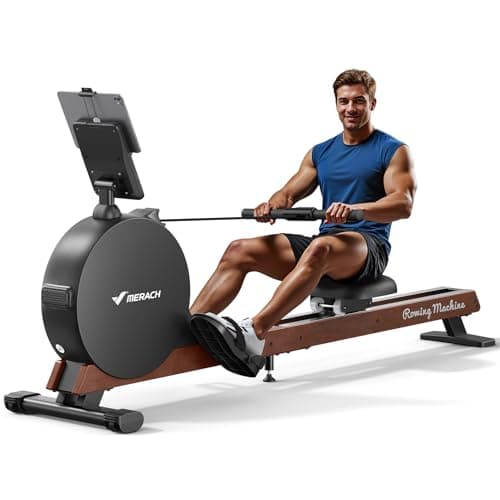
Our MERACH 60kg Magnetic Rowing Machine review: what the 60kg claim really means, the 16 handlebar levels, app, wood frame, noise and who it suits.
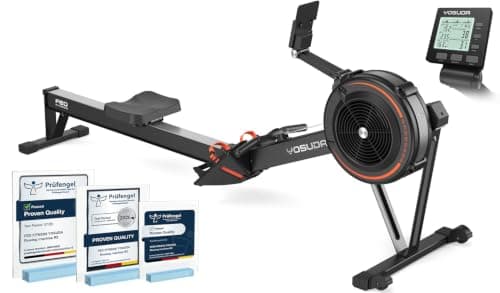
Our YOSUDA R2 air rowing machine review covers the 32-blade fan, 10-level damper, self-powered monitor, 158kg limit and how it compares with a Concept2.
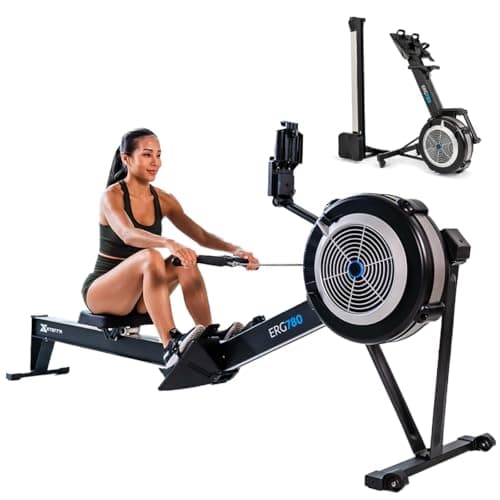
Our Xterra ERG780 air rower review covers the 10-level damper, Bluetooth FTMS app support, noise, monitor accuracy, folding storage and how it compares with a Concept2.
Best Exercise is a participant in the Amazon EU Associates Programme, an affiliate advertising programme designed to provide a means for sites to earn advertising fees by advertising and linking to Amazon.co.uk. As an Amazon Associate we earn from qualifying purchases. This comes at no extra cost to you and never influences our independent reviews or rankings.