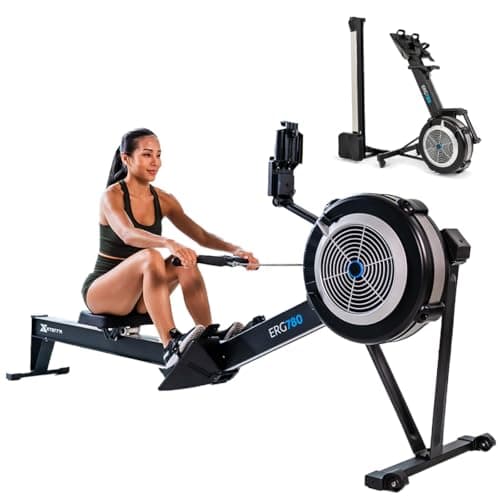
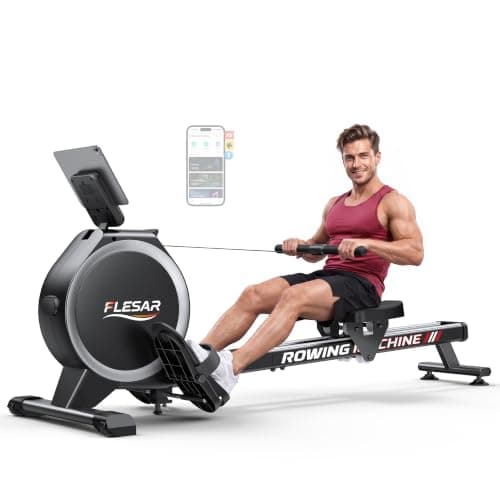
The Xterra ERG780 is a folding air rower at £499, and that one sentence explains most of its appeal. You get fan resistance that responds to how hard you pull, a manual damper with 10 levels, Bluetooth FTMS for XTERRA+ and Kinomap, and a 150kg user limit, in a frame that stands upright when you're done. My verdict: it's a sensible buy for home rowers who want the air feel without spending close to £1,000, as long as you accept it's louder than a magnetic machine and its monitor is not a PM5.
How we review
This review is built on desk research: Xterra's Amazon UK listing and published specifications, the patterns that show up repeatedly in owner feedback, and published research on rowing ergometers. We haven't tested the ERG780 hands-on, so we've avoided claims we can't support and flagged where information is missing.
Who the Xterra ERG780 is for
This machine makes the most sense for a specific buyer: someone who has rowed on a Concept2 at the gym, likes how air resistance feels, and wants that at home without the price or the permanent floor space. The folding frame matters a lot here. A Concept2 splits into two halves for storage, which works, but the ERG780 simply tips up on its wheels and that's easier to do every day.
It's also a good fit if you train with apps. FTMS support means the rower sends its data in a standard format, so Kinomap's video routes and XTERRA+ classes can read your strokes and watts without a dongle.
Who should skip it? Anyone in a flat with light sleepers downstairs, for a start. And if you plan to log times for online rankings or compare your 2k with friends on gym Concept2s, you'll want the real thing, because only a PM5's numbers are the shared currency. Our Concept2 Model D review covers that machine in full.
Air resistance that scales with your effort, so it suits beginners and fitter rowers alike
Roughly half the price of a Concept2 RowErg
Folds vertically with transport wheels for everyday storage
Bluetooth FTMS with named XTERRA+ and Kinomap support
150kg max user weight is high for a folding rower
Built-in tablet holder and adjustable backlit LCD
Cons
Loud, as every air rower is, and noticeably more so than magnetic or water machines
LCD figures aren't comparable with a Concept2 PM5, and there's no drag factor readout listed
New listing, so long-term durability and parts support are unproven in the UK
Still needs about 2.4 metres of floor length to row
Resistance: the 10-level damper versus a Concept2
The ERG780 uses a fan flywheel, and like every air rower its resistance comes mostly from you. Pull harder and the fan spins faster, pushing more air, so the load climbs. That's why air rowers suit mixed households so well: a beginner and a fit club rower can share one without either feeling short-changed.
The 10-level manual damper sits on top of that. It's a vent that controls how much air gets into the fan housing, and the Concept2 works the same way with its own 1 to 10 lever. So on paper the two machines are set up identically. In practice there's one meaningful difference: the PM5 shows a drag factor, a number that tells you what the damper setting actually means on that specific machine, accounting for dust and air temperature. Xterra's listing makes no mention of a drag factor, so on the ERG780 a "5" is just a position on a lever.
Does that matter for home fitness? Mostly not. Many people crank the damper to 10 thinking it means a harder workout, when it mainly makes each stroke slower and heavier on the lower back. Our rowing machine resistance levels guide explains why the middle of the range, roughly 3 to 6 for most adults, is usually where you'll train best.
Monitor and accuracy
The backlit LCD covers time, distance, calories, strokes, strokes per minute, watts and heart rate, and it's adjustable so you can angle it from the seat. That's a complete set for general training. Heart rate depends on a paired chest strap; the listing doesn't say a strap is included, so budget for one if you want it.
Accuracy deserves an honest caveat, and it applies to every rower, including the benchmark. A 2021 study in Frontiers in Physiology compared several rowing power meters against a lab reference system and found the Concept2 Model D under-read mean power by about 11 to 15% (Holt et al., 2021). If the industry standard is off by that much against lab equipment, you shouldn't expect the ERG780's watts, metres or calories to line up with a PM5 either. The figures are useful for tracking your own progress on the same machine. Comparing them with anyone else's numbers isn't.
Noise, footprint and storage
Here's the trade-off nobody selling air rowers likes to dwell on: they're loud. Expect a steady whoosh on every drive that gets louder as you pull harder, and the higher your stroke rate the more continuous it becomes. If you want quieter alternatives, magnetic rowers are close to silent and water rowers sit somewhere in between. Our best foldable rowing machines guide includes several of each.
Xterra ERG780 key specs
Resistance type
Air (fan flywheel)
Damper
10 manual levels
Console
Adjustable backlit LCD
Metrics
Time, distance, calories, strokes, SPM, watts, heart rate
Connectivity
Bluetooth, FTMS (XTERRA+ and Kinomap)
Max user weight
150 kg
Dimensions in use
240 x 64 x 112 cm
Machine weight
Approx 26 kg
Storage
Folds vertically, front transport wheels
Extras
Padded seat, adjustable footplates, tablet holder
Price
£499 (Amazon UK, October 2026)
At 240 x 64 cm in use, the ERG780 is a full-length rower; the Concept2 Model D is about the same length. Folded, it stands upright and only needs a patch of floor about the size of its footplate area plus wheels. At roughly 26kg it's manageable for one adult to tip and roll, though you'll want to clear the area before you do it.
Comfort and build
The listing describes a large padded seat, a non-slip handle and adjustable footplates. Those are the right things to get right, because seat comfort is the most common complaint on budget rowers once sessions pass 20 minutes. The 150kg user rating suggests a frame engineered with some margin. Bear in mind the ERG780 is a recent listing on Amazon UK, so there isn't a multi-year track record of owners reporting how the rail, seat rollers and fan bearings hold up. Concept2 has decades of that, which is a large part of what its extra £490 buys.
Technique matters more than the machine, whichever you buy. A scoping review of low back pain in rowers found prolonged ergometer use was one of the clearer risk factors in the literature (Athy et al., 2023), so it pays to learn the legs, body, arms sequence properly before piling on long sessions. Our rowing machine technique guide walks through it.
Value against Concept2 and magnetic rowers
Against the Concept2 RowErg at roughly £990, the ERG780 offers the same resistance principle, a similar damper, app connectivity and folding storage for about half the money. You give up the PM5, standardised data, a long durability record and strong resale value. For general fitness, that's a fair trade for many people.
Against magnetic rowers in the £250 to £400 bracket, the case is about feel and noise. Magnetic machines are quieter and usually more compact, but their fixed resistance levels don't respond to effort the way a fan does, and hard sprint intervals tend to feel flat on them. If you want to row hard, the ERG780 is the better tool. If you want to row while the baby sleeps, it isn't. For two or three 30-minute sessions a week, which would cover a good chunk of the NHS's recommended 150 minutes of moderate activity, either type gets the job done; it's the noise and the feel that should decide it.
No, and at £499 against roughly £990 it isn't trying to be. The ERG780 gives you the same basic air-resistance feel and a 1 to 10 damper, and it folds, which a Concept2 doesn't. What you lose is the PM5 monitor's drag factor readout, its standardised data that rowers compare across machines and decades, and the Concept2's proven resale value and parts support.
How loud is the Xterra ERG780?
It's an air rower, so it's loud. The fan makes a whoosh on every drive that rises with how hard you pull, and the seat rolling on the rail adds some noise too. It's fine in a garage or a ground-floor room, but in an upstairs flat you'll want a thick mat and some consideration for the people below.
Does the Xterra ERG780 fold?
Yes. The rail folds up so the machine stands vertically, and front transport wheels let you roll it into a corner. In use it measures 240 x 64 cm, so you need about the same floor length as a Concept2 while you're rowing.
What apps work with the Xterra ERG780?
The listing confirms Bluetooth with FTMS support and names XTERRA+ and Kinomap. FTMS is an open fitness machine standard, so other FTMS-compatible rowing apps may also connect, but Xterra only promises those two.
What is the maximum user weight on the Xterra ERG780?
Xterra rates it to 150kg, which is generous for a folding rower and well above many budget magnetic machines that top out around 100 to 120kg.
What does the damper setting actually change?
The 10 levels change how much air reaches the fan. A higher setting feels heavier and slower, like rowing a big boat; a lower one feels lighter and quicker. It doesn't set your workload, your effort does that, so most people get a better session around the middle of the range than at 10.
The best foldable rowing machines in the UK for 2026, compared on folded footprint, rail length and weight limit. Picks from JLL, DMASUN, YPOO, Viavito and MERACH for every budget.
An honest JLL water rowing machine review of the dual resistance rower: the 60 degree tank, 16 magnetic levels, 130cm rail, 150kg capacity, SunnyFit app and who it suits.
An honest MERACH R15 Pro review: 40kg peak electromagnetic resistance, 16 levels adjusted from the handlebar, a 130cm rail, 158kg capacity and who this £300 rower suits.
An honest Flesar rowing machine review: 16 magnetic levels, Kinomap and FitShow support, dual rails, a 160kg limit and the short 101cm rail that tall rowers need to know about.
Best Exercise is a participant in the Amazon EU Associates Programme, an affiliate advertising programme designed to provide a means for sites to earn advertising fees by advertising and linking to Amazon.co.uk. As an Amazon Associate we earn from qualifying purchases. This comes at no extra cost to you and never influences our independent reviews or rankings.