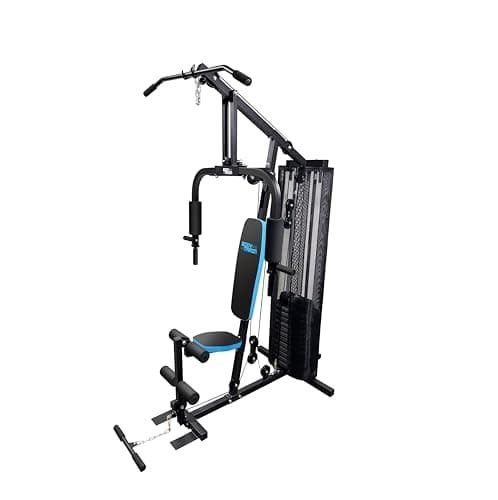
Home Gym
BodyTrain Advanced Single Station Multi Gym Review: 72kg for Under £300
Our BodyTrain multi gym review: the 72kg shrouded stack, 12.5lb jumps, stations, 213cm height, lifetime frame warranty and £283.99 price against rivals.

By Jack Atkins, Home Gym Equipment Specialist · Updated 3 November 2026
A wall mounted cable machine is a cable and pulley station that bolts to a solid wall instead of standing on its own frame, and for a garage or spare room it's usually the cheapest way to get proper cable training into a small space. The catch is the wall. A unit like this needs solid brick, block or concrete (or genuinely load-bearing studs, if the manual permits it), never plasterboard on its own. Get the fixings right and a £200 wall unit gives you pulldowns, rows, pushdowns, face pulls and curls in under a square metre of floor.
Here's how they work, what to check and where they fall short against a free-standing cable machine.
How we put this together
We haven't installed or tested these machines ourselves. This guide draws on manufacturer listings and spec sheets, the patterns that keep coming up in owner reviews, and our existing research for the best cable machines in the UK. Prices were checked on Amazon UK in November 2026 and move often.
Strip one down and there are only a few parts. One or two vertical rails fix to the wall at the top and bottom. A carriage slides up and down each rail and locks with a pop pin or knob, and the pulley hangs off that carriage. A cable runs from your handle, over the pulley and down to the resistance.
That resistance comes in two flavours. Plate-loaded units have a loading sleeve on the end of the cable, and you slide your own discs onto it. Stack units carry a built-in column of plates and a selector pin, which is quicker between sets but heavier and pricier.
Then there's single versus dual. A single-column unit is effectively a wall-mounted lat tower: brilliant for pulldowns, rows and pushdowns, but you can't do a standing crossover fly because there's only one cable. Dual units have two rails (or two arms on one track), so you can work each side independently. The Strongway wall mounted crossover sits in between, with one double-bar track and adjustable pulley arms that swing out for width.
This is where most of the bad experiences in owner reviews come from, so it gets more space than anything else.
Solid masonry (brick, dense concrete block, poured concrete) is the target. Use the bolts the manual specifies, or upgrade to heavier sleeve anchors or resin-set studs if the supplied fixings look thin, which owners of budget units mention a lot. Drill into the brick itself, not the mortar joints.
Lightweight aerated block (the grey, slightly crumbly stuff in many newer UK houses) needs fixings rated for it. Standard plugs can work loose over time under repeated pulling.
Timber stud walls are a maybe. Some manufacturers allow lag or coach screws straight into the centre of the studs; plenty don't. If your unit's manual only mentions masonry, take it at its word.
Plasterboard alone is a hard no. It isn't structural, and no cavity fixing will hold a cable station being pulled on at 60kg for 40 reps a session.
Read the load rating properly
A listing that says "250kg" or "300kg" is describing the steel, not your wall. The real limit is whichever is weakest out of the frame, the bolts and the masonry they sit in. If you're unsure what's behind your plaster, a cheap stud and cable detector and a pilot hole will tell you. If it's still unclear, pay a tradesperson for an hour.
Height matters too. Most wall units are about 190cm to 201cm tall, so a standard 2.4m room is fine, but a garage with low beams may not be.
A 1:1 pulley moves the weight the same distance as your hand. Load 40kg and you feel roughly 40kg (minus a little friction). It's the better choice for heavy pulldowns and rows, and you need fewer plates to get a hard set.
A 2:1 setup routes the cable through an extra pulley so the weight travels half as far as the handle. You feel about half the load, but you get double the cable travel, which matters for long-range moves like a cable fly or a lateral raise. The trade-off is that strong lifters can run out of plates on rows.
Budget listings often don't state the ratio at all. If it's missing, check the manual or ask the seller before you order.
More positions means finer control over the line of pull. The SPORTNOW wall mount lists 15, the XS Sports 17 and the Strongway 18. Anything over about 12 is plenty for most people; what matters more is how the carriage locks.
Knob or pop-pin carriages on linear bushings glide and lock cleanly. Cheaper kits with a fixed top pulley and a fixed low pulley (two positions, no carriage) are fine for pulldowns, rows and pushdowns, and less useful for anything at chest or shoulder height.
With an adjustable carriage you can cover most of the upper body and a fair bit of the lower:
Swapping handles makes a real difference to how these feel, and our lat pulldown attachment guide explains which bars and grips are worth adding.
Is cable work as good as free weights for building strength and muscle? Close enough that it shouldn't stop you. A 2023 meta-analysis of 13 studies found no meaningful difference in strength or hypertrophy between free-weight and machine training when compared directly, with gains tending to be specific to whichever kit you trained on. Two or three cable sessions a week easily covers the NHS advice to train all major muscle groups on at least two days a week.
If you rent, or your only spare wall is plasterboard, a free-standing machine is the honest answer. The Bells of Steel cable tower is a strong standalone column, and the TOUSAINS CR63 folds away and needs no drilling at all.
Roughly, at November 2026 Amazon UK prices:
Remember the plates. A plate-loaded machine with nothing on it is just a frame, and a modest set of weight plates can add £60 to £150.
The Strongway Wall Mounted Cable Crossover is the one we'd point most people at. It runs a double-bar track with 18 positions set by a knob, linear bushing carriages, pulley arms that adjust for width, and a 250kg home-use rating for the frame. It takes both 25mm and 50mm Olympic plates and measures 63 by 74 by 201cm.
Check the Strongway wall mounted crossover on Amazonaround £210If you mainly want pulldowns and rows for less, the Gorilla Sports wall-mounted lat tower is a long-running budget option at 191cm tall, 102cm wide and 75cm deep at the top. Its claimed 300kg maximum is a steel figure, so the wall rule above applies in full.
Check the Gorilla Sports lat tower on Amazonaround £120The SPORTNOW wall mount that dominates the shopping results is a reasonable mid-point (15 positions, 2.5cm plate bar, up to 50kg per side), but stock was down to the last unit when we checked, and its 1-inch bar won't take Olympic plates without adaptors.
For more on fitting cable kit into a wider setup, see our home gym hub.
No. Plasterboard on its own will pull out under the load of a cable machine, because every rep yanks on the fixings. You need solid brick, block or concrete, or in some cases a timber stud wall where the bolts go straight into the studs and the manufacturer explicitly allows it. If you can't find solid fixing points behind the board, buy a free-standing machine instead.
Neither is better across the board. A 1:1 pulley means the handle moves the same distance as the weight and you feel the full load, which suits heavy pulldowns and rows. A 2:1 pulley halves the felt resistance and doubles the cable travel, which gives a longer, smoother pull for flyes, raises and single-arm work. Most wall units at the budget end are plate-loaded, so check the listing or manual for the ratio before you buy.
Basic pulley kits with a loading pin start around £45 to £80. Plate-loaded wall rails with adjustable carriages, such as the Strongway and SPORTNOW units, sit around £170 to £220. Wall stations with a built-in plate stack or dual columns run from about £150 for compact models up to £500 to £700 for bigger 17-position units. You'll also need plates if the machine is plate-loaded.
Most project roughly 50cm to 75cm from the wall. The Strongway lists 63 by 74cm and the SPORTNOW lists 62 by 60cm, both at around 200cm tall. Add room in front for yourself and the cable path, so plan on a clear zone of about 2m deep for rows and presses.
For most exercises, yes. Bolted to sound masonry it barely moves, and it takes up a fraction of the floor. You lose some things: most budget wall units are plate-loaded rather than pin-selected, many have a single column so true crossovers aren't possible, and you can't take it with you as easily if you move house.
Our BodyTrain multi gym review: the 72kg shrouded stack, 12.5lb jumps, stations, 213cm height, lifetime frame warranty and £283.99 price against rivals.
What a cable crossover machine is, how it differs from a functional trainer, what 177kg stacks really mean, the ceiling height you need and UK price bands.
Every common cable machine attachment explained: D-handles, rope, straight and EZ bars, V-bar, ankle straps and more, with exercises, the 4 to buy first and prices.
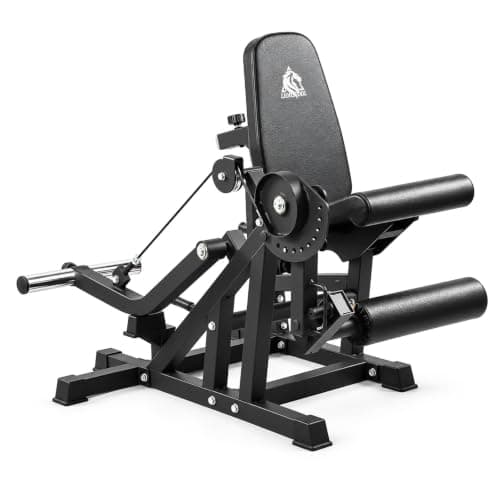
LIONSCOOL leg extension machine review: the V4.0's cable system, 400lb capacity, lying leg curl, 1.65m footprint and what the £429.99 price really buys you.
Best Exercise is a participant in the Amazon EU Associates Programme, an affiliate advertising programme designed to provide a means for sites to earn advertising fees by advertising and linking to Amazon.co.uk. As an Amazon Associate we earn from qualifying purchases. This comes at no extra cost to you and never influences our independent reviews or rankings.