Treadmills
Non-Electric Treadmill: Manual vs Curved, Pros, Cons and Who Should Buy
Non-electric treadmills explained: cheap flat manual models vs £2,000+ curved self-powered machines, how each compares with motorised ones, and who should buy.

By Paul Kendrick, Cardio & Endurance Editor · Updated 7 October 2026
Yes, you can put a treadmill on carpet, and plenty of people in the UK do because that's what's in the spare room. The catch is that you should put a firm treadmill mat between the machine and the carpet, and on thick or deep-pile carpet it's close to non-negotiable. Carpet can feed fibres and dust towards the motor and block its airflow, it lets the frame sit unevenly, it builds static, and it takes permanent dents and lube or rubber stains from the machine. A £20 to £50 mat fixes most of that.
Below is what goes wrong on carpet, how to pick the right mat size, thickness and material, and the extra steps for walking pads and upstairs rooms.
None of these issues will wreck a treadmill overnight. They add up over months, which is why people often don't link a noisy motor or a dented carpet back to the floor it's standing on.
Motor airflow and fibres. Most treadmills cool the motor with air drawn in from vents near the floor. Long carpet pile closes that gap, and the belt and motor fan pull loose fibres, pet hair and dust into the motor housing. ProForm's own owner's manuals tell you not to place the treadmill on any surface that blocks air openings and to put a mat under it to protect the floor or carpet (ProForm 490GS owner's manual). That advice applies to most motorised treadmills, not just one brand.
Uneven footing. Carpet compresses unevenly, so one foot of the frame sinks further than another. You'll feel it as a slight rock at the front or a belt that keeps drifting to one side, which then means more belt adjustments.
Indentation. A home treadmill weighs anywhere from about 25kg (a walking pad) to over 130kg for a big folding machine, and the force spikes every time your foot lands. All of that goes through four to six small feet. Expect deep dents that may never fully recover, which matters if you rent.
Lube and rubber marks. Treadmills need silicone lubricant under the belt, and some of it creeps out at the edges and drips. Rubber feet and rear rollers can also leave dark marks on light carpet. Neither is easy to get out of wool or nylon pile.
Static. A moving belt, rubber-soled trainers and synthetic carpet in a centrally heated house is a reliable recipe for static shocks, and in rare cases static can upset the console electronics.
Not all carpet is equally bad. The type you've got decides how much the mat has to do.
| Carpet type | Can a treadmill go on it? | What to use |
|---|---|---|
| Low pile / loop (short, tight, like office or hallway carpet) | Yes, with a mat for protection and stability | 4mm to 6mm PVC or rubber mat |
| Medium pile (most bedroom and lounge carpet) | Yes, with a firm mat | 6mm mat as a minimum |
| Deep pile, shag or saxony with thick underlay | Only with a firm, dense mat, and you may need a board | 6mm to 10mm rubber, or a plywood base under the mat |
On very soft carpet with a thick underlay, even a good mat can sink into the pile at the feet. If the treadmill still rocks after you've fitted the mat, put a sheet of 12mm to 18mm plywood under it, cut a few centimetres smaller than the mat, so the machine sits on something that can't compress.
Measure first, then buy. A mat that's too small leaves the rear feet or rollers hanging off the edge, which is worse than no mat because the machine then sits at a slight angle.
As a rough guide, walking pads need roughly 150 x 75cm, typical folding treadmills need 180 x 80cm, and big non-folding machines need 200 x 100cm or more.
For most people on carpet, 6mm is the right thickness. It's dense enough to spread the load of each foot and flat enough that the treadmill doesn't wobble, and nearly every budget mat on Amazon UK comes in 6mm.
Thinner mats around 4mm are fine on hard floors or tight loop carpet but do less to stop the feet pressing through on medium or deep pile. They also do little for noise.
At 10mm and above you start getting real vibration and noise reduction, which is why they make sense upstairs. The trade-off is that a thick mat is only good if it's dense. A thick, soft mat lets the feet sink unevenly and the deck rocks, which is the exact problem you were trying to fix. If you want thickness, buy rubber.
Material matters more than most listings let on.
PVC (vinyl) is what the majority of cheap treadmill mats are made from, and NordicTrack's own large equipment mat is vinyl too (NordicTrack UK floor mat). It's firm, waterproof, easy to wipe and cheap. Its weak points are a plastic smell for the first week or two and a tendency to curl at the corners when it's been folded in the box. Lay it flat in a warm room for a day before the treadmill goes on.
Rubber is the premium option. It's heavier, grips the carpet better, absorbs more vibration and resists dents from the feet. It costs more, it can smell strongly at first, and a large rubber mat is heavy to move. For upstairs rooms it's worth paying for.
EVA foam (the interlocking jigsaw tiles) is the one we'd avoid directly under a treadmill on carpet. It's light and soft, which is fine for floor exercises, but the feet of a heavy treadmill compress it into permanent dents and the joins between tiles can separate under the vibration. If you've got a home gym floor already, check our guide to the best gym flooring in the UK for heavier-duty options.
We haven't tested these mats ourselves; we picked them from Amazon UK listings by size, thickness and current stock, and both were in stock when we checked. Check the material on the listing before you buy, as sellers don't always state it clearly.
For walking pads and compact treadmills: the HAPBEAR Treadmill Mat (152 x 76cm, 6mm) was around £27 at the time of writing. At 152 x 76cm it covers a footprint up to roughly 137 x 61cm with our 15cm margin, which suits most walking pads and smaller folding treadmills. The listing claims it's non-slip and waterproof.
For full-size treadmills: the THAILE Treadmill Mat (200 x 100cm, 6mm) was about £47. It covers a footprint up to roughly 185 x 85cm, enough for most full-size folding machines and many non-folding ones, and the seller pitches it specifically as a carpet protector.
If you own a NordicTrack, the brand sells its own large equipment floor mat at 216 x 107cm in vinyl, which is bigger than either of the above if you've got a long deck.
Don't buy too small
An easy mistake is buying a mat that's a few centimetres short. The rear rollers end up half on the mat and half on carpet, and the deck tilts. If your measurement is borderline, size up.
Walking pads are the treadmills people most often put on carpet, usually under a desk in a bedroom or home office, and they're the ones that suffer most. The whole machine sits only a few centimetres off the floor, so the motor housing is close to the pile. On medium or thick carpet the gap all but disappears; fluff gets drawn in, cooling suffers, and the thin frame can flex where the carpet is uneven.
Put a flat, firm mat under a walking pad every time. A 6mm PVC or rubber mat is plenty, and you'll also notice the belt runs straighter. Our guides to the best walking pads in the UK and fold-flat treadmills note the footprint of each model, which saves you guessing the mat size.
Carpet already absorbs some sound, but footfall noise travels through the floor joists rather than the air, so a carpeted upstairs room can still sound like a drum to the people below. A mat helps; it isn't a cure.
What makes the biggest difference upstairs, in rough order:
If you're in a flat, check your lease too. Some forbid running machines outright, and a mat won't help you argue that one.
A dry UK winter with the heating on is peak static season. The belt, your trainers and synthetic carpet all contribute, and you'll know about it the first time you touch the metal handrail.
Make sure the treadmill is plugged straight into an earthed wall socket rather than an extension lead, which most manuals ask for anyway. A rubber or PVC mat helps a little because it separates the machine from the carpet. Running a humidifier, or simply not drying washing on radiators in a closed room, also helps more than people expect. If your treadmill's manual mentions a grounding wire or anti-static measures, follow it to the letter.
Once the mat is down and the treadmill is on top, level it before your first session.
A treadmill on carpet often needs re-levelling after the first week as the pile and mat settle under the weight, so check it again then.
Every manufacturer words this slightly differently, and the manual is what matters if you ever need a warranty claim. Look for three things: the minimum clearance around the machine, whether it says anything about carpet or blocked air vents, and whether it asks for a mat. If your manual tells you not to use the treadmill on deep-pile carpet at all, take that seriously; it's the kind of detail a warranty assessor will check.
While you've got the manual out, look up the lubrication schedule. Carpet fluff and a dry belt are a bad mix, and our guide on how to lubricate a treadmill walks you through it.
On short, tight-loop carpet you can get away with it for a while, but it's a poor trade. A mat costs £15 to £50 and stops carpet fibres and dust being drawn towards the motor, keeps the frame level, and catches silicone lube drips and rubber marks. On deep pile or shag carpet, always use a firm mat.
Measure your treadmill's footprint (length and width at the widest points, including the feet and any rear rollers), then add around 15cm to each measurement. A walking pad usually needs something around 150 x 75cm. A full-size folding treadmill normally needs 180 x 80cm or larger, and big non-folding machines often need 200 x 100cm or more.
For most homes, 6mm is the sweet spot on carpet because it's firm enough to spread the load of the feet without wobbling. Go for 10mm or more if the treadmill is upstairs or in a flat and you want to cut thud and vibration, but make sure the mat is dense rubber rather than soft foam, or the machine can rock.
Yes, but walking pads sit very low, so the motor housing is only a few centimetres off the floor. On thick carpet that gap shrinks, airflow suffers and fluff gets pulled into the motor area. A flat, firm mat under a walking pad matters more than it does under a big treadmill with a raised deck.
It can. The weight of a 60kg to 130kg machine plus a runner leaves deep dents where the feet sit, and lubricant or rubber from the belt and rollers can stain or mark the pile. A mat spreads the load and acts as a barrier, so dents are shallower and spills land on something you can wipe.
They can, especially on synthetic carpet in a dry, centrally heated room. The moving belt and your trainers build up charge, and nylon carpet adds to it. A rubber or PVC mat helps a little, but the bigger fixes are plugging the treadmill into an earthed socket, keeping the room less dry and following any grounding advice in your manual.
Non-electric treadmills explained: cheap flat manual models vs £2,000+ curved self-powered machines, how each compares with motorised ones, and who should buy.
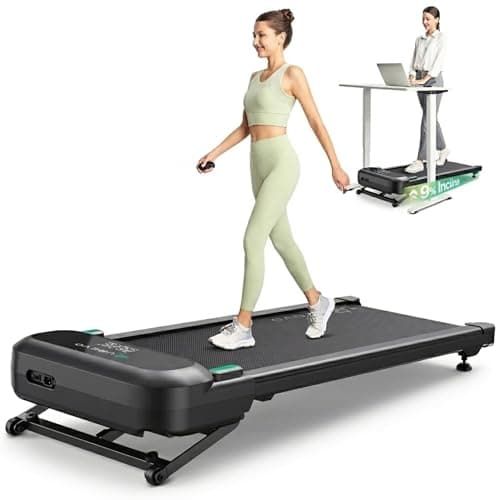
Our honest UREVO SpaceWalk 5L walking pad review: 9% auto incline, dual brushless motor, 136kg limit and a narrow 40x100cm deck, for £349.99 on Amazon UK.
Walking pad vs treadmill compared on deck size, top speed, motor, incline, weight limit, storage and UK price, with a clear verdict on which one to buy.
What a curved treadmill is, how the self-powered slat belt works, what research says about calorie burn vs motorised treadmills, and whether one suits you.
Best Exercise is a participant in the Amazon EU Associates Programme, an affiliate advertising programme designed to provide a means for sites to earn advertising fees by advertising and linking to Amazon.co.uk. As an Amazon Associate we earn from qualifying purchases. This comes at no extra cost to you and never influences our independent reviews or rankings.