Treadmills
Are Walking Pads Worth It? An Honest UK Verdict
Are walking pads worth it? Who they suit, the step and calorie gains from treadmill desk research, cost per use, noise, spec limits and when to buy a treadmill.

By Paul Kendrick, Cardio & Endurance Editor · Updated 15 October 2026
We may earn a commission from qualifying purchases made through links on this page, at no extra cost to you. This never affects our ratings.
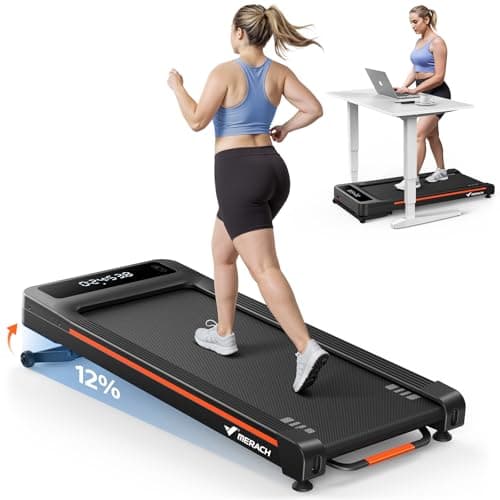
The MERACH Heavy Duty Walking Pad is a sensible buy at £239.99 if you specifically want incline walking in a compact, desk-friendly machine and you're happy with a 6km/h ceiling. Its 0 to 12% auto incline, 42cm belt and 400lb (about 181kg) user limit are unusual at this price, and together they make it a better fit for heavier users and hill-walking fans than most flat walking pads. What it isn't, despite the listing's talk of sprints and marathon training, is any kind of running machine; it also doesn't fold, and there's no handrail to steady yourself when the front end tilts up.
That last pairing (steep incline, nothing to hold) is the trade-off that decides whether this is right for you. Read the "who shouldn't buy" section before ordering.
How we review
We haven't had this walking pad in for hands-on testing. This review is based on MERACH's published specifications, the Amazon UK listing, recurring patterns in owner feedback, and comparison with the walking pads and incline treadmills we've already covered. Where the listing makes claims we think are overstated, we say so.
It's easy to confuse this with the MERACH Performance treadmill, which shares the 3.5HP brushless motor branding. They're different machines for different jobs. The Performance is a full folding treadmill with an 18% incline, a wider 46cm belt and running speeds, priced at roughly two and a half times as much. This walking pad is a low-profile deck with no console upright, controlled from a handheld remote, built to sit on the floor or slide under a standing desk.
The headline feature is the motorised incline. Most walking pads, including the KingSmith WalkingPad C2, are completely flat. A few budget models offer a fixed manual tilt of a few percent. MERACH gives you an auto incline from 0 to 12% that you change from the remote mid-walk, which turns a gentle desk stroll into something closer to a hill walk without raising your speed.
Check price on AmazonThe 6km/h top speed is the single most important number on this listing, and it's the one the marketing works hardest to blur. Six kilometres an hour is about 3.7mph. For most adults that's a brisk walk; taller people with a long stride can reach it without breaking into a jog at all. The listing's mention of "sprint" sessions and "marathon training" doesn't describe what this hardware can do, and anyone buying it to run will be disappointed within the first session.
We don't think that's a reason to mark it down heavily, because the speed range is the same 6km/h ceiling you get on the KingSmith C2 and most rivals. It's simply what a walking pad is. Our issue is with the copy, not the machine.
Incline is how a walking pad stops being a gentle step counter and becomes a workout. Walking uphill costs more energy than walking on the flat at the same speed, so you can raise your effort without having to walk faster, which matters on a machine that tops out at 6km/h and especially if you're working at a desk.
There's decent evidence that slow incline walking can match brisk flat walking for effort while being kinder to the joints. A study of adults with obesity in Medicine & Science in Sports & Exercise found that walking at 0.75 m/s (2.7km/h) up a 6 degree incline produced similar, moderate-intensity metabolic rates to level walking at twice that speed, while cutting peak knee extension and adduction moments by around 19% and 26%. Six degrees is roughly a 10.5% gradient, so it's within this pad's range. For heavier users (which the 400lb rating clearly targets) that combination of slow speed, real effort and lower knee load is the strongest argument for this machine.
The 12% ceiling also lets you do the viral 12-3-30 workout (12% incline, 3mph, 30 minutes), since 3mph is about 4.8km/h. A small lab study of the 12-3-30 found that, compared with self-paced running matched for total energy burned, it took longer and burned energy at a lower rate, but drew a higher share of energy from fat. In plain terms: it's a slower way to burn the same calories, not a shortcut, though it's one many people find easier to stick with than running.
The weakness here is the lack of a handrail. On a flat walking pad you rarely need one. At 12% the front of the deck is noticeably raised and your posture shifts forward; owners who are unsteady, older, or recovering from injury may not feel safe there without something to grab. If you plan to walk on it mostly at the top of the incline range, an incline treadmill with handrails is the safer choice.
MERACH lists a 400lb (about 181kg) maximum user weight, which is the other standout spec. Many walking pads sit at 100kg to 120kg, and heavier buyers often find themselves shut out of the category entirely. A higher rating doesn't guarantee the deck will last longer at any given weight, but it does suggest a stiffer frame and a motor specified with more headroom. At roughly 31kg the machine has some heft to it, which helps it stay planted.
The 42cm belt is narrower than a full treadmill but in line with most compact pads. It's fine for walking in a straight line; it's less forgiving if you drift while reading a screen at a desk. MERACH describes a six-layer belt with cushioning. We'd treat the cushioning claim as "softer than a pavement" rather than anything comparable to a gym treadmill's suspension, because low-profile decks have very little room for it.
| Speed range | Up to 6 km/h (walking only) |
|---|---|
| Incline | 0 to 12%, motorised, via remote |
| Motor | 3.5HP brushless (likely a peak rating) |
| Max user weight | 400 lb (about 181 kg) |
| Belt width | 42 cm (16.5 in) |
| Belt construction | 6-layer with cushioning |
| Frame size | 128 x 57 x 16 cm (per listing) |
| Package size | 131 x 64.5 x 20 cm |
| Machine weight | About 31 kg |
| Folding | No (anti-fold deck), transport wheels |
| Handrail | None |
| Claimed noise | 25 dB |
The 3.5HP figure is high for a walking pad, and it's almost certainly a peak rating rather than continuous output; MERACH doesn't make the distinction clear. In practice, for walking at up to 6km/h, power isn't the limiting factor. What a stronger brushless motor does buy you is less strain when lifting a heavier user up an incline and, in theory, quieter running than the brushed motors on cheaper pads.
On noise, the claimed 25dB is about as loud as a whisper. No motorised treadmill is that quiet once a person is walking on it. Footfalls on the belt, and the vibration through a hard floor, will be louder than the motor itself. Owner feedback on walking pads in general points the same way: quiet enough for video calls if you keep your pace steady, not quiet enough to ignore if someone is sleeping in the flat below. A dense rubber mat underneath is worth the extra £20 to £30.
MERACH sells the rigid deck as a feature ("anti-fold"), and there's a fair case for it. A hinge is a weak point and a source of creaks, and a one-piece deck should feel more solid underfoot, especially on an incline. The cost is storage. At 128 x 57 x 16cm you need a long, flat space: under a bed or sofa with at least 16cm of clearance, or stood on its end against a wall. The transport wheels mean one person can move it, though tipping 31kg up onto its end isn't effortless.
If your plan is to tuck it away in a small flat every evening, a folding pad like the KingSmith C2 is easier to live with. If it's going to stay under a standing desk most of the time, the lack of a fold barely matters.
For desk use, the deck height of 16cm will raise you by that much, so a standing desk needs to go up to match. The incline complicates things slightly, since the front of the deck lifts as the gradient rises and your hands move further from the keyboard. Most people will find 0 to 5% workable while typing and save the steeper settings for calls or breaks. Our guide to using a walking pad under a desk covers desk height, typing speed and how to build up time without giving yourself sore feet.
For context on step targets, the big Lancet Public Health meta-analysis of 15 cohorts found mortality risk kept falling as daily steps rose, levelling off at about 6,000 to 8,000 steps for adults aged 60 and over and 8,000 to 10,000 for younger adults. An hour a day at a slow desk pace can add several thousand steps, and the NHS physical activity guidelines count brisk walking towards the 150 minutes of moderate activity adults should aim for each week.
See today's price on AmazonIf you want to jog or run, look elsewhere; nothing about this machine supports it. The same goes for anyone who needs a handrail for balance, because 12% with nothing to hold isn't sensible for unsteady walkers. Small-flat dwellers who must fold and hide the pad daily will also be happier with a hinged model, and if quiet matters above all (a top-floor flat, a light-sleeping household) a flat pad running slowly on a thick mat will be easier on the neighbours.
The KingSmith WalkingPad C2 is the obvious flat, folding alternative: lighter, easier to store and from a more established walking pad brand, but with no incline and a much lower weight limit. Our best walking pad UK guide compares more compact options. If incline is the main draw and you'd like handrails and running speeds too, the MERACH Performance and the picks in our best incline treadmill UK guide cost more but solve both of this pad's biggest weaknesses.
No. The top speed is 6km/h, which is a brisk walk for most adults and nowhere near a run. The listing's references to sprinting and marathon training don't match the hardware. If you want to jog or run, you need a full treadmill such as the MERACH Performance, which reaches proper running speeds.
No. MERACH calls it an anti-fold design, meaning the deck is one rigid piece rather than hinging in half. It does have transport wheels, so you can tip it up and roll it to a wall or under a bed with enough clearance, but at about 128cm long it takes more floor space when stored than a folding pad.
Yes, and it's one of the few walking pads that can. The 12-3-30 calls for 12 percent incline at 3mph (about 4.8km/h) for 30 minutes, and this machine reaches 12 percent with a 6km/h ceiling. The catch is that it has no handrail, so you need to be steady on your feet walking uphill without holding on.
MERACH lists a maximum user weight of 400lb, which is roughly 181kg. That's much higher than most walking pads, which commonly sit around 100kg to 120kg. Treat any listed limit as the absolute ceiling rather than a comfortable everyday load.
It's quiet for a motorised machine, but the 25dB claim shouldn't be taken at face value. That figure likely reflects the motor alone in ideal conditions. Your footfalls on the belt, and the deck sitting on a hard floor, add noise that neighbours below a flat can hear. A rubber mat helps more than anything else.
Are walking pads worth it? Who they suit, the step and calorie gains from treadmill desk research, cost per use, noise, spec limits and when to buy a treadmill.
Can you run on a walking pad? Mostly no: most cap at 6km/h with short belts and no rails. Which 2-in-1 pads allow a light jog, and when to buy a real treadmill.
Most walking pads take 100 to 120kg, mid-range models 120 to 136kg and heavy-duty pads 150 to 180kg. What the limit covers and how much headroom to leave.
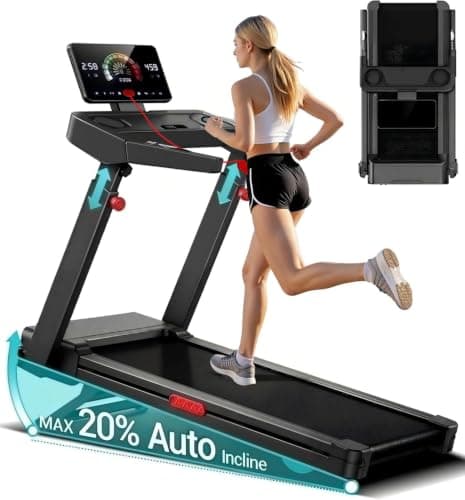
An honest CURSOR FITNESS treadmill review: 2 to 20% auto incline, 14km/h, a 40 x 107cm belt and a 180kg rating for £240, plus the claims we'd treat with care.
Best Exercise is a participant in the Amazon EU Associates Programme, an affiliate advertising programme designed to provide a means for sites to earn advertising fees by advertising and linking to Amazon.co.uk. As an Amazon Associate we earn from qualifying purchases. This comes at no extra cost to you and never influences our independent reviews or rankings.