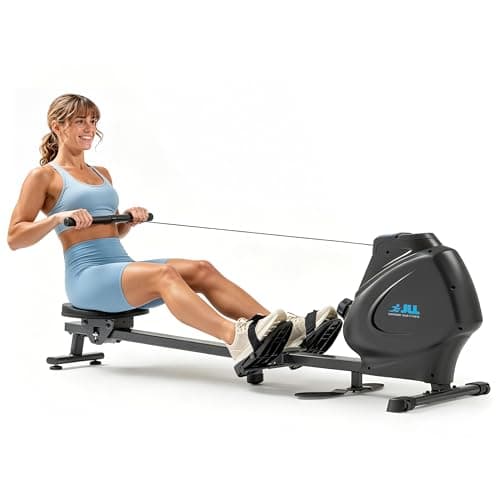
Rowing Machines
JLL Folding Magnetic Rowing Machine Review: A Rower You Can Also Stand On
An honest JLL folding magnetic rowing machine review: 16 magnetic levels, standing footplates, SunnyFit app, 130kg limit, light flywheel and who it suits.

By Paul Kendrick, Cardio & Endurance Editor · Updated 31 October 2026
A realistic rowing machine before and after looks like this: within 30 days you'll be fitter and your 500m split will be faster, by 60 days your resting heart rate and a 2k test should show clear improvement, and by 90 days you can expect a visible change in your body only if you've paired the rowing with a calorie deficit. Rowing is a brilliant way to get fitter. It isn't magic, and the dramatic transformation photos you see on social media usually leave out the diet, the lighting and how long it really took.
This guide sets out what research and basic physiology say about each stage, a 12-week plan you can follow on any rower, and the honest numbers to track so you can see your own before and after rather than someone else's.
The first month is mostly your heart, lungs and nervous system adapting. Your body gets more efficient at delivering oxygen to working muscles, and you get much better at the stroke itself, which means you move the flywheel faster for the same effort.
By the end of the second month, the aerobic improvements are measurable rather than just felt. A 2023 trial in post-menopausal women had participants row three times a week for 30 minutes at 60 to 80% of peak heart rate; their workload rose and heart rate at a given power fell after just six weeks, and by ten weeks peak oxygen uptake, stroke volume and heart rate recovery had all improved.
That matches what you should see at home. Your resting heart rate, taken first thing in the morning, will often be a few beats lower than when you started. Your heart rate will also drop faster after a hard interval, which is a decent sign of improving fitness. If you've been doing some harder sessions, a timed 2k should be noticeably quicker than your baseline.
Posture tends to improve here too. Hours of good-form rowing strengthen the upper back and the muscles that hold your spine upright, although rowing with a rounded back does the opposite, so form matters more than mileage.
At 12 weeks the gains in aerobic fitness are substantial, and this is where body composition can start to show. In a 2022 study, men with obesity (with and without type 2 diabetes) and lean men did eight weeks of supervised HIIT on rowing and cycling ergometers, three sessions a week. VO2max rose by roughly 8 to 15%, total fat mass fell and lean mass increased in every group, with adherence above 95% and no injuries reported.
Note what that study didn't show: dramatic weight loss from exercise alone. Fat loss comes down to energy balance. Rowing burns a useful amount, but it's easy to eat back. As a rough guide, losing 1kg of body fat means a cumulative deficit of around 7,000 to 7,700 calories (a widely used approximation, not an exact rule), so four 30-minute rows a week won't do it unless your diet is also in check.
What you can expect at 90 days, consistently:
Calorie figures vary hugely by body weight and effort, so treat these as approximate. Harvard Health's table, based on the Compendium of Physical Activities, puts 30 minutes of stationary rowing at the following:
| Body weight | Moderate effort (30 min) | Vigorous effort (30 min) |
|---|---|---|
| About 57kg (125lb) | 210 kcal | 255 kcal |
| About 70kg (155lb) | 252 kcal | 369 kcal |
| About 84kg (185lb) | 294 kcal | 440 kcal |
The calorie readout on a rower's monitor is an estimate too. Use it to compare your own sessions against each other, not as a figure to plan your diet around.
This plan assumes you're new to rowing or returning after a long break. "Easy" means you could hold a conversation in short sentences; "hard" means you couldn't. Split targets are relative to your own baseline from a 2k test in week one, because a fixed number would be wrong for most people.
| Weeks | Sessions per week | Session length | What to do |
|---|---|---|---|
| 1 to 2 | 3 | 15 to 20 min | Easy steady rowing at 20 to 22 strokes per minute. Focus on technique. Do a 2k baseline test at the end of week 1. |
| 3 to 4 | 3 to 4 | 20 to 25 min | Two easy rows plus one session of 6 x 1 min harder, 1 min easy. Easy pace 15 to 20 seconds per 500m slower than your 2k pace. |
| 5 to 8 | 4 | 25 to 30 min | Two or three steady rows, one interval day (for example 5 x 500m with 2 min rest, aiming for your 2k split or a touch faster). Retest 2k in week 8. |
| 9 to 12 | 4 to 5 | 30 to 40 min | Three steady rows (one can stretch to 40 min), one or two interval days. Try 4 x 1,000m at 2 to 4 seconds slower than your new 2k split. Retest 2k in week 12. |
If you want structured interval sessions to slot into weeks 5 to 12, our rowing machine HIIT workout has several. Wen and colleagues' 2019 meta-analysis of 53 trials found that while even short HIIT blocks improve VO2max, longer intervals and programmes of 4 to 12 weeks produced larger effects, which is why the plan lengthens the work intervals as you go.
Can you row every day?
You can, as long as most days are easy. Daily easy rowing is a great base builder. Daily hard rowing piles fatigue on your legs and lower back, technique slips, and that's when sore backs start. Keep hard sessions to two or three a week, at least a day apart.
Photos are fine, but they're unreliable: lighting, angle and time of day change everything. These four numbers tell you far more.
Pulling with your arms first. The most common fault, and it caps your power. Drive with the legs, then swing the back, then draw the arms. A rower that measures watts properly makes this obvious, because your numbers jump once the sequence is right.
Cranking the damper to 10. A high damper or resistance setting feels harder but usually slows you down and loads your lower back. Most people row best at around 3 to 5 on an air rower.
Doing every session flat out. Hard every time leaves you too tired to improve, and you'll stop showing up. Around 75 to 80% of your rowing should be easy.
Ignoring diet. No rowing plan outruns a calorie surplus. If fat loss is your goal, the food side matters more than the rowing side.
Never testing. If you don't record a baseline 2k, you'll have no idea whether the plan is working. Test in week one, even if the number embarrasses you.
Any rower with an accurate monitor that shows split, distance and stroke rate will do. Air rowers like the Concept2 Model D are the benchmark because their numbers are comparable worldwide, which makes your 2k results meaningful. If your budget is tighter, a magnetic machine such as the Merach rowing machine is quieter and still fine for steady rowing, though its split figures won't line up with a Concept2's. For a wider look at whether rowing suits you, read are rowing machines good for you.
Check the Concept2 Model D price on AmazonMost people feel fitter within 2 to 4 weeks of rowing three times a week, because your heart and breathing adapt quickly and your technique improves. Measurable changes in aerobic fitness usually show by 6 to 8 weeks. Visible fat loss depends on your diet and typically takes 8 to 12 weeks or longer to notice in the mirror.
It can change how fit you are in 30 days, and your 500m split will almost certainly drop. A visible body change in a month is less likely unless you're also in a steady calorie deficit. Expect to lose perhaps 1 to 3kg in a month if your diet supports it, some of which will be water rather than fat.
Rowing every day at an easy pace is fine for most healthy people once they've built up to it, and it'll improve your aerobic fitness quickly. Rowing hard every day isn't a good idea: your legs and lower back need recovery, and fatigue makes technique slip, which is how sore backs start. Keep most daily sessions easy and limit hard interval days to two or three a week.
Roughly 210 to 294 calories at a moderate effort and 255 to 440 at a vigorous effort, depending on your body weight, according to Harvard Health figures for people weighing about 57kg to 84kg. Treat any number on a rower's monitor as an estimate, and remember your actual burn depends on how hard you pull.
Rowing works your core and burns a useful number of calories, but you can't spot-reduce belly fat. A flatter stomach comes from overall fat loss, which is driven by a calorie deficit over weeks and months. Rowing helps you create that deficit while building fitness, which is why it pairs so well with sensible eating.
Yes, 20 minutes a day adds up to 140 minutes a week, which is close to the NHS target of 150 minutes of moderate activity. Done consistently with a mix of steady rows and one or two interval sessions, 20 minutes is enough to improve your fitness noticeably over 8 to 12 weeks.
An honest JLL folding magnetic rowing machine review: 16 magnetic levels, standing footplates, SunnyFit app, 130kg limit, light flywheel and who it suits.
What an air rowing machine is, how fan resistance and the damper really work, why gyms use them, the downsides (noise, size) and what to look for before you buy.
What a magnetic rowing machine is, how eddy-current resistance works, the real pros and cons versus air and water, and what to check before you buy one.
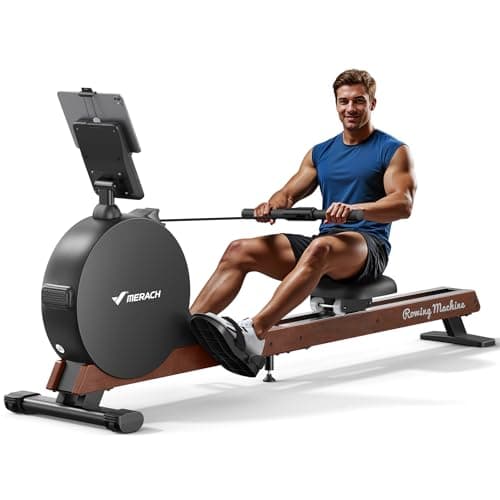
Our MERACH 60kg Magnetic Rowing Machine review: what the 60kg claim really means, the 16 handlebar levels, app, wood frame, noise and who it suits.
Best Exercise is a participant in the Amazon EU Associates Programme, an affiliate advertising programme designed to provide a means for sites to earn advertising fees by advertising and linking to Amazon.co.uk. As an Amazon Associate we earn from qualifying purchases. This comes at no extra cost to you and never influences our independent reviews or rankings.