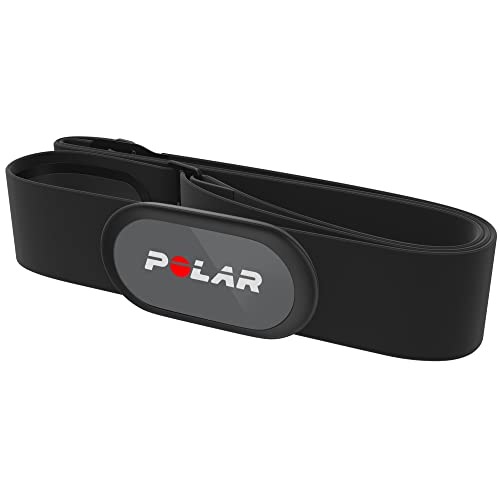
The Polar H9 is the chest strap we'd point most people towards first. At around £36 on Amazon UK it reads heart rate from electrodes on your chest, broadcasts over Bluetooth and ANT+, and runs for hundreds of hours on a coin cell, which covers what a runner, cyclist or gym user actually needs from a sensor. The H10 costs about £20 more and is better in three specific ways (memory, a second Bluetooth link and a grippier strap). If none of those matter to you, buy the H9 and spend the change on a spare battery and a strap wash.
If you already know you want offline recording, HRV work or the most proven strap Polar makes, skip ahead to our Polar H10 review. For a head to head spec breakdown, see Polar H10 vs H9.
How we review
This is a research-based review. We haven't tested an H9 hands-on; we've worked from Polar's published specifications and comparison guide, peer-reviewed research on Polar's chest strap technology, the Amazon UK listing and recurring owner feedback. Where Polar doesn't publish a figure, we say so.
Anyone who trains by heart rate zones and pairs a sensor to one thing at a time: a Garmin or Polar watch, a bike computer, a phone app, or Zwift. That's the majority of people buying a chest strap, and for them the H9 does the same core job as the H10.
It's also a sensible first strap. Polar's own comparison guide frames the H9 as the model for people getting started with heart rate tracking, and the price makes it low risk if you're not yet sure you'll wear a strap every session.
Look elsewhere if you hate chest straps (an armband like the COROS Heart Rate Monitor or Polar Verity Sense is more comfortable), if you want to record a session with no watch or phone on you, or if you plan to run HRV analysis in apps like Kubios. The H10 is the better tool for that last group, for reasons we'll come to.
Pros
Electrode (ECG-style) measurement, so it tracks fast changes in effort far better than wrist optical sensors
Bluetooth and ANT+ together, which covers Garmin, Wahoo, Zwift, Apple Watch and most gym kit
CR2025 coin cell rated at up to 400 hours, about a year of daily hour-long sessions
Soft strap is machine washable once you unclip the pod
Firmware updates through Polar Flow, same as the H10
Roughly £20 cheaper than the H10 on Amazon UK
Cons
No internal memory, so it records nothing unless a device is connected
Only one Bluetooth connection at a time
Soft strap lacks the H10 Pro Strap's silicone grip dots, so it can slide more on some torsos
Like any chest strap, readings can spike for the first few minutes until the electrodes are damp
Polar makes no HRV claim for it, and we found no independent validation study of the H9 itself
Design and the soft strap
The H9 comes in two parts: a small sensor pod that clips onto two studs, and a textile strap with electrode areas on the inside. Polar lists the total weight at 60g, with the pod accounting for 21g, and quotes an operating range of minus 10 to 50°C. You dampen the electrodes, fasten the strap just below your chest muscles, clip the pod on and it starts broadcasting.
Polar calls it a machine-washable soft strap, and the pod detaches so you can wash the band. Do that regularly. Dried sweat is what wears out electrode areas on any chest strap, and a worn strap is the usual cause of erratic readings that a fresh battery won't fix.
The strap is also the main thing separating the H9 from the H10. The H10 ships with Polar's Pro Strap, which has silicone dots to stop it slipping and is part of why Polar positions the H10 for hard intervals. Some retailers selling the Pro Strap on its own list it as compatible with the H9, so you could upgrade later, but Polar's H9 page doesn't say so; treat that as a retailer claim and check before ordering.
Polar H9 key specs
Measurement
Electrical heart rate (ECG) via chest strap electrodes
Connectivity
Bluetooth Low Energy and ANT+ (Polar's page also lists 5kHz)
Simultaneous Bluetooth connections
1 (Polar lists dual Bluetooth for the H10 only)
Internal memory
None
Battery
CR2025 coin cell, user replaceable, up to 400 hours
Water resistance
WR30 (30m)
Firmware
Updateable via Polar Flow
Weight
60g total, 21g sensor only
Strap
Machine-washable soft strap; Amazon UK M-XXL listing says 66 to 95cm chest
Price
£36.09 on Amazon UK at the time of writing; H10 around £56
How accurate is the Polar H9?
Accurate enough for zone training, and a clear step up from the sensor on your wrist. The reason is the method rather than the badge: an electrode strap picks up the electrical signal of each heartbeat, while a watch shines light into your skin and estimates pulse from blood flow, which lags behind sharp rises in effort and gets confused by arm movement during lifting or rowing.
Polar is careful with its wording. Its H10, H9 and Verity Sense guide describes the H9 as giving "highly reliable" readings and calls the H10 the most accurate sensor in Polar's history. The H9 product page claims accurate ECG tracking that isn't thrown off by temperature, sweat or skin pigmentation. We'd read that as: same principle, but the H10's strap is better at keeping clean contact when you're moving hard.
The independent research sits with the H10. A Swiss Federal Institute of Sport study had ten healthy adults wear an H10 alongside a medical Holter ECG through five activities of rising intensity; the H10 correctly detected 99.6% of beat to beat intervals overall and held 99.4% during the hardest efforts, when the Holter dropped to 89.8% (Gilgen-Ammann et al., 2019). That doesn't transfer automatically to the H9, and we couldn't find an equivalent study of the cheaper strap. It's the main reason we'd steer anyone doing serious HRV or research-style logging towards the H10, while saying plainly that Polar hasn't claimed the H9 can't do it; Polar simply doesn't publish an HRV claim for it.
In practice, most accuracy complaints about chest straps come down to setup. Dry electrodes in cold weather, a strap worn too loose, or synthetic tops that build static all cause spikes in the first few minutes. Wet the electrode pads before you put the strap on, and if readings stay jumpy once you're sweating, replace the strap before you blame the pod.
The H9 broadcasts on Bluetooth and ANT+ at the same time. Bluetooth is limited to one connection, which sounds restrictive until you realise ANT+ devices don't count towards it: a Garmin Edge or Forerunner can listen over ANT+ while Zwift on your phone or laptop takes the Bluetooth slot. Where it bites is an all-Bluetooth setup, say an Apple Watch plus a Peloton-style app, where the H10's second connection earns its £20.
There's no memory, so the H9 is purely a live sensor. Leave your watch in the changing room and you get nothing. For team sports or martial arts where you can't wear a watch, that's a real reason to pay for the H10's onboard recording.
Battery life is rated at up to 400 hours on a CR2025 coin cell, which Polar equates to more than a year of training for an hour every day. Pair the sensor with Polar Flow at least once, even if you mostly use another brand's watch, because that's how it gets firmware updates.
Polar H9 vs H10 and the alternatives
Polar H10 (around £56). Same measurement method, plus internal memory for one session, two Bluetooth connections and the Pro Strap. It's also the strap with the validation research behind it. Worth the extra if you want HRV, offline recording or a watch and app connected over Bluetooth at once. See the Polar H10 on Amazon, or read the full Polar H10 review.
Polar Verity Sense. An optical armband rather than a chest strap, with its own memory and a goggle clip for swimming. Better for comfort and swimming, less sharp than a strap for sprints. Our Polar Verity Sense review goes into it.
COROS Heart Rate Monitor (around £69). An upper arm optical band that's comfortable for long steady sessions but costs nearly double the H9 and, like all optical sensors, lags in short hard efforts. See our COROS Heart Rate Monitor review.
Yes. It's an electrode chest strap that reads the electrical signal of each heartbeat, the same principle as the H10, so it follows sprints and intervals far more closely than a wrist sensor. Polar describes the H9 as highly reliable and reserves its 'most accurate' claim for the H10, whose Pro Strap is designed to cut interference and slipping. We couldn't find a published validation study of the H9 specifically.
What's the difference between the Polar H9 and H10?
The H10 adds internal memory for one training session, two simultaneous Bluetooth connections and the Pro Strap with silicone grip dots. The H9 has none of those, but it shares the measurement method, Bluetooth plus ANT+, the CR2025 battery rated at around 400 hours and firmware updates via Polar Flow. On Amazon UK the H9 costs about £36 against roughly £56 for the H10.
Does the Polar H9 work with Garmin, Zwift and Apple Watch?
It broadcasts on Bluetooth and ANT+, so Garmin watches and bike computers can read it over ANT+, and apps like Zwift or an Apple Watch can pair over Bluetooth. Only one Bluetooth device can connect at a time, but an ANT+ device can listen at the same moment, so a Garmin plus Zwift on a phone works.
Can the Polar H9 measure HRV?
Polar doesn't publish an HRV claim for the H9, though its product page lists compatibility with Polar's Orthostatic Test, which is built around heart rate variability. If HRV tracking is the main reason you're buying, the H10 is the safer choice, because it's the strap researchers have actually validated for beat to beat (RR interval) accuracy.
What battery does the Polar H9 use?
A CR2025 coin cell, rated at up to 400 hours of training. It isn't rechargeable; you open the cover and swap the cell, which costs a couple of pounds. Unclip the pod from the strap after every session so a damp strap doesn't keep it running.
What size is the Polar H9 strap?
The Amazon UK listing for ASIN B08411DQ96 is the M-XXL soft strap, which the listing says fits chests from 66 to 95cm. Polar's own H9 page doesn't publish a size range, so if you're near either end of that, check the listing before buying.
How Apple Watch estimates VO2 max (Cardio Fitness), where to find it in the Health app, how accurate it is against lab tests, how to raise it and how it compares to Garmin.
Fitbit Charge 6 vs Inspire 3 compared: built-in GPS, ECG, Google Wallet, battery, size and price. Our clear verdict on which tracker suits you in the UK.
Fitbit Charge 6 vs Versa 4 compared on screen, ECG, heart rate broadcast, calls, battery, GPS and price, with a clear verdict on which one UK buyers should pick.
Fitbit Versa 4 vs Sense 2 compared: same design, GPS and 6+ day battery, but the Sense 2 adds ECG and a cEDA stress sensor. Which is worth the extra £45?
Best Exercise is a participant in the Amazon EU Associates Programme, an affiliate advertising programme designed to provide a means for sites to earn advertising fees by advertising and linking to Amazon.co.uk. As an Amazon Associate we earn from qualifying purchases. This comes at no extra cost to you and never influences our independent reviews or rankings.