Rowing Machines
Xterra ERG780 Review: A Folding Air Rower at Half Concept2 Money
Our Xterra ERG780 air rower review covers the 10-level damper, Bluetooth FTMS app support, noise, monitor accuracy, folding storage and how it compares with a Concept2.

By Paul Kendrick, Cardio & Endurance Editor · Updated 13 August 2026
We may earn a commission from qualifying purchases made through links on this page, at no extra cost to you. This never affects our ratings.
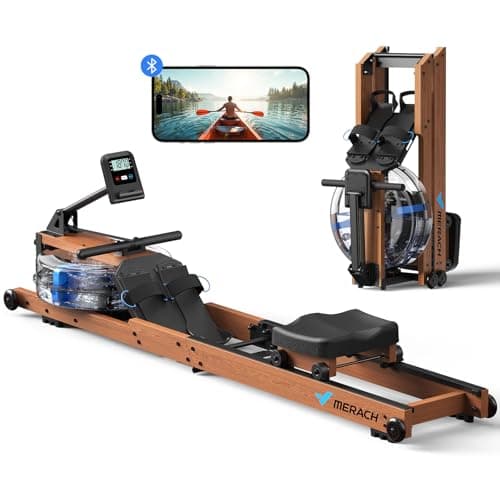
Wooden water rowers have a problem, and it isn't performance. A WaterRower Classic is a beautiful thing that costs between £900 and £1,400 and, at 210cm long, dominates whatever room it stands in. MERACH's answer is a solid wood water rower that folds 180 degrees, stands upright against a wall, and sells for around £350.
That's an aggressive price for the category, and the specification is more interesting than the number suggests.
How we review
This review draws on MERACH's published specifications, recurring themes in verified owner reviews on Amazon UK, and comparison with the other wooden water rowers we have covered. We have not run a long-term hands-on test of this machine, so nothing here is presented as a first-hand impression. Specifications and prices were correct at the time of writing.
Anyone who wants the water rowing stroke and the look of wood in a living room, but doesn't have a spare 2 metres of floor permanently available. The 180 degree fold and the bottom wheels are the reason to choose this over a fixed-frame wooden rower, and they're the reason it works in a flat.
Skip it if you're training seriously against a Concept2 benchmark, because the monitor here won't give you the split, stroke rate and pace data that sort of training needs. Our Concept2 Model D review covers that end of the market.
Most wooden rowers stand upright, and a few claim to fold. This one does both properly: a 180 degree hinge, operable with one hand, and wheels on the base so you tip it and roll rather than lift. MERACH's own description compares it to moving a large suitcase, which is about right for a machine of roughly 24kg before the tank is filled.
Filled, it's heavier and you'll want to drain it if you're moving house, but for day-to-day tidying the wheels do the work. In use it occupies 185cm by 71cm, so allow around 2.4m of clear length once your own reach is factored in.
| Resistance | Water, paddle-driven, self-scaling with effort |
|---|---|
| Frame | Solid wood |
| Dimensions in use | 185 x 71 x 44 cm |
| Fold | 180 degrees, one-handed, wheeled base |
| User capacity | 180kg (400lb) |
| Machine weight | Around 24kg before filling |
| Monitor | Distance, time, calories, Bluetooth sync |
| Assembly | 98% pre-assembled, around 10 minutes |
| Warranty | 1 year |
| Price | Around £350 at the time of writing |
Water resistance works by making you fight paddles through a tank, so the harder and faster you pull, the more drag you meet. There's no resistance dial, and there doesn't need to be: a light warm-up stroke is light, a flat-out effort is heavy, and the transition between them is smooth rather than stepped. Interval work suits it particularly well because the machine responds instantly to a change of effort.
The trade-off is data. Without published drag factors, you can't calibrate this machine against another one the way Concept2 users do. If your training involves comparing today's 2k against last month's, that matters. If it involves 25 minutes of steady work while a podcast plays, it doesn't.
Rowing itself remains one of the better cardiovascular options available at home. Research comparing heart rate responses found the seated position and the volume of muscle recruited during rowing produce a lower heart rate than treadmill running at the same relative intensity (PubMed), and EMG work on rowers has mapped how heavily the trapezius, latissimus dorsi, biceps and leg muscles contribute on an ergometer (PubMed). Training studies in older adults have shown meaningful cardiorespiratory adaptations from indoor rowing programmes (PMC).
A dedicated screen shows distance, time and calories, with a Bluetooth receiver pushing sessions to your phone or tablet. That covers the basics and nothing more. There's no 500m split, no stroke rate, no watts, which are the three numbers a rower actually trains by once past the beginner stage.
Calorie readouts on any rowing machine should be treated as a rough index rather than a measurement, and that goes double for a unit without a calibrated drag figure. Use it to compare this week against last week on the same machine, and ignore it entirely as an input to a diet.
If you want proper metrics, the honest answer is that no wooden rower at £350 delivers them and you should be looking at an air rower with a decent computer instead.
Water tanks need looking after. Purification tablets every few months keep the water clear, and neglecting that is how tanks end up cloudy and slightly grim. Wood needs nothing beyond an occasional wipe, though direct sunlight over years will lighten it.
The noise is a whoosh on every stroke rather than the fan roar of an air rower, which most people prefer and which still carries through a floor. Upstairs flats, take note.
A year's warranty is short. WaterRower backs its frames for five, and while the MERACH is a third of the price, a longer cover would settle nerves about a seal that has to hold water for a decade.
At around £350 it sits above the budget magnetic rowers and well below the WaterRower Classic. The nearest comparisons are the TOPIOM Water Rower and the YOSUDA wooden rower, both of which trade on the same idea. What separates the MERACH is the fold: TOPIOM and most rivals store upright but don't hinge flat.
For a full picture of the category, our best water rowing machine guide and the wider best rowing machine guide cover what the extra money buys as you climb.
For the money, yes. You get a solid wood frame, a proper water tank with paddle-driven resistance, a 180kg user capacity and a one-handed 180 degree fold, at around £350 rather than the £900 to £1,400 a WaterRower costs. The compromises are the monitor, which shows distance, time and calories and little else, and a resistance system MERACH describes in general terms rather than with published drag figures.
The machine is 185cm long, 71cm wide and 44cm tall in use, so allow roughly 2.4m of clear length once you account for your own leg drive and the handle. Folded and stood upright it occupies a footprint closer to a narrow bookcase, and the bottom wheels mean you can roll it out of the way rather than lifting 24kg of oak.
MERACH specifies aerospace-grade sealing rated for upright storage, and owners storing it vertically have not flagged leaking as a recurring problem. Water rowers do need the tank treating with purification tablets every few months regardless of brand, otherwise the water goes cloudy, which is a maintenance job rather than a fault.
Water resistance is self-scaling: pull harder and the paddles meet more drag, so the machine responds to your effort rather than to a dial. That feels closer to rowing on water and it makes intervals more natural. Magnetic rowers give repeatable, quantifiable resistance levels and run near silent, which matters in a flat or a shared house. The whoosh of a water tank is pleasant to most people and irritating to some.
MERACH ships it 98% pre-assembled and quotes around 10 minutes, which is realistic for a water rower where the frame arrives in one piece. Filling the tank takes longer than bolting the machine together, and you will want the supplied siphon and a bucket rather than trying to pour.
It is one of the better options, because the seated position and the amount of muscle involved mean your heart rate sits lower than running at the same relative effort, and there is no impact through the knees or hips. Technique matters more than on a bike, so spend the first few sessions learning to drive with the legs before the arms rather than chasing numbers.
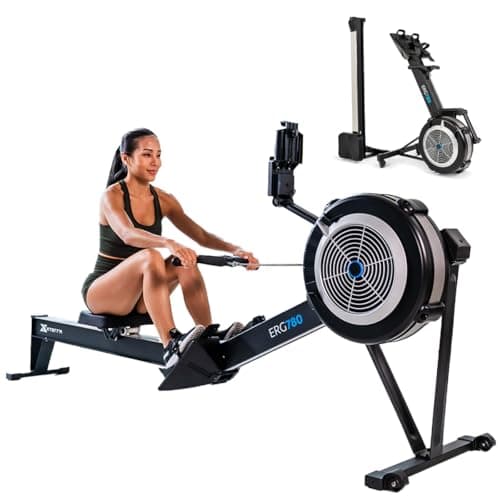
Our Xterra ERG780 air rower review covers the 10-level damper, Bluetooth FTMS app support, noise, monitor accuracy, folding storage and how it compares with a Concept2.
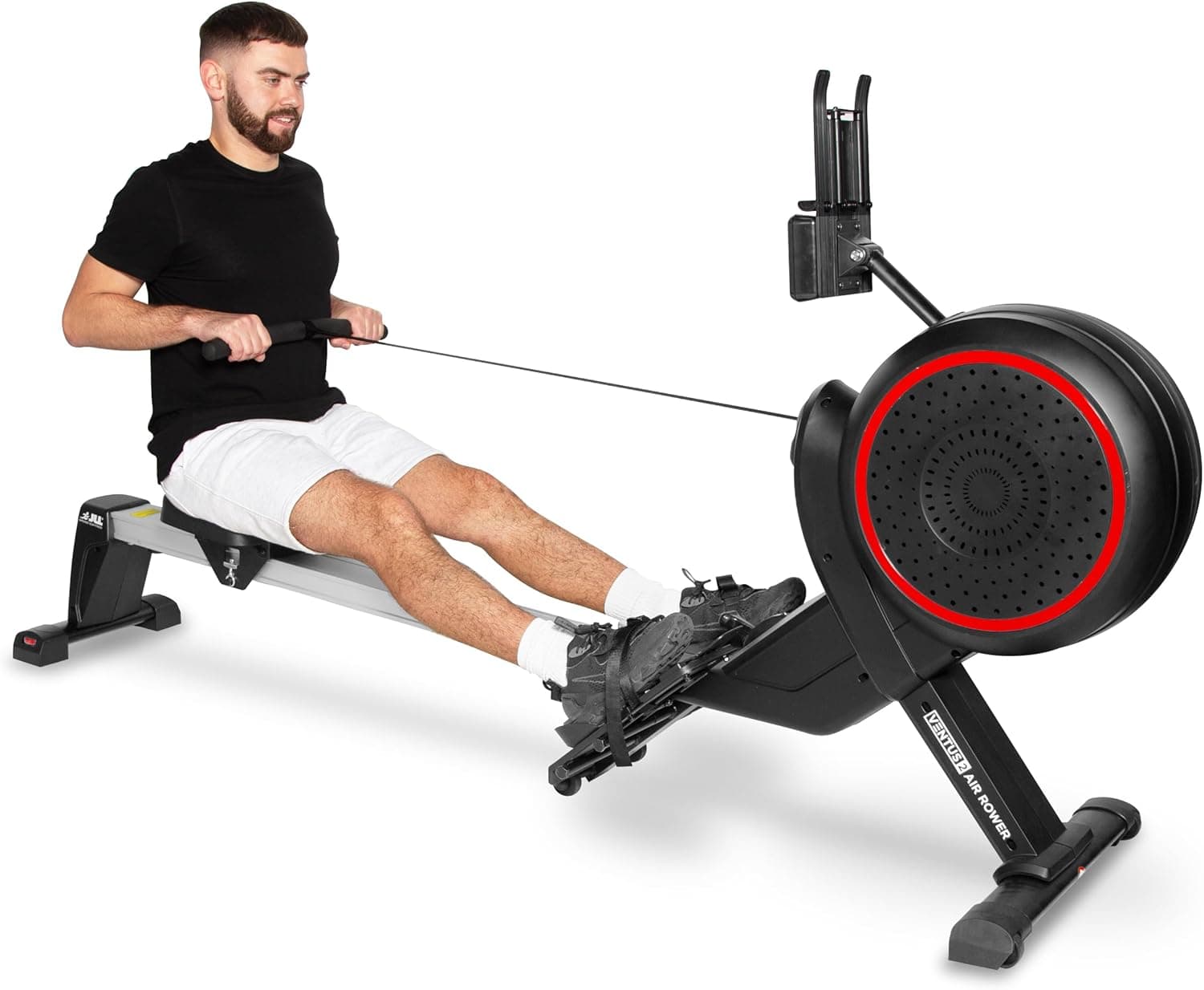
The best foldable rowing machines in the UK for 2026, compared on folded footprint, rail length and weight limit. Picks from JLL, DMASUN, YPOO, Viavito and MERACH for every budget.
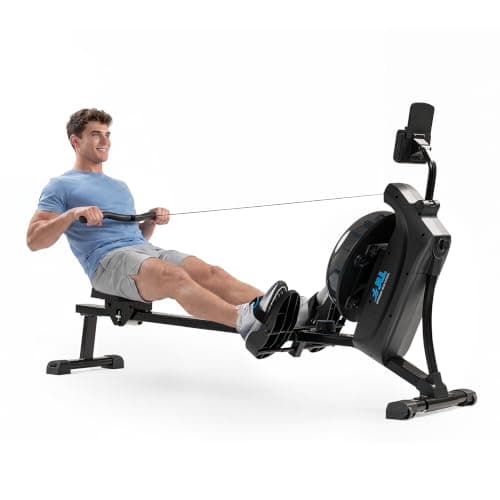
An honest JLL water rowing machine review of the dual resistance rower: the 60 degree tank, 16 magnetic levels, 130cm rail, 150kg capacity, SunnyFit app and who it suits.
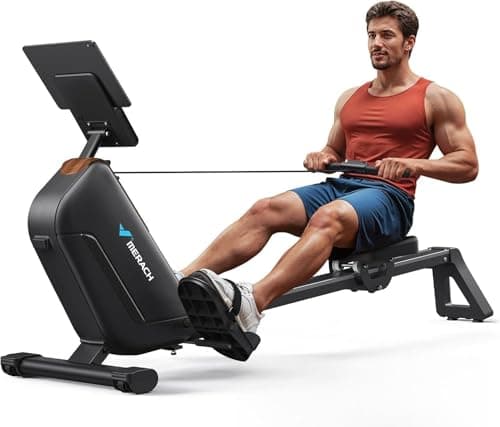
An honest MERACH R15 Pro review: 40kg peak electromagnetic resistance, 16 levels adjusted from the handlebar, a 130cm rail, 158kg capacity and who this £300 rower suits.
Best Exercise is a participant in the Amazon EU Associates Programme, an affiliate advertising programme designed to provide a means for sites to earn advertising fees by advertising and linking to Amazon.co.uk. As an Amazon Associate we earn from qualifying purchases. This comes at no extra cost to you and never influences our independent reviews or rankings.