Home Gym
Cambered Bar Explained: Squat, Bench and Swiss Bar Types
What a cambered bar is, the three main types (cambered squat bar, bowed bench bar, cambered Swiss bar), what each one does, how much they weigh and how to buy one.

By Jack Atkins, Home Gym Equipment Specialist · Updated 14 October 2026
A landmine attachment is a pivoting sleeve that anchors one end of a barbell to the floor or a rack, so you can press, row, squat and rotate with the other end on a fixed arc. For most home gyms it's the cheapest piece of kit that adds a dozen new exercises, and it costs £15 to £40 for a decent one. If you own a power rack, check whether the maker sells a landmine for it first; if you don't, a plate-post insert or a floor platform does the job.
Below: the three types you'll find on Amazon UK, how to check fit before you order, the safety bits people skip, and the exercises worth doing with one.
A barbell loaded at one end and pinned at the other moves in an arc rather than a straight line. That arc is the whole point. When you press, the bar travels up and forward, so your arm stays in front of your body instead of going fully overhead, which is why people with grumpy shoulders tend to tolerate the landmine press better than a strict overhead press.
The pivot also takes part of the weight, so you can load single-arm and single-leg work without balancing a full barbell. And because the bar end can swing side to side, you get rotational movements (landmine rotations, sometimes called "rainbows") that are awkward to load any other way.
The attachment itself is just a tube on a swivel. It's the part that holds the bar end still while letting it rotate, and the better ones spin 360 degrees so the bar can follow your body in any direction.
This bolts or pins to the upright of a power rack or squat stand. It's the most stable option by a distance because the rack's weight anchors it, and the bar end sits at a fixed height a few inches off the floor.
The catch is fit. Rack uprights come in different tube sizes (common ones are 50mm x 50mm and 60mm x 60mm) with 25mm or so holes, and a landmine built for one brand won't necessarily pin into another. Your safest bet is the rack manufacturer's own attachment. If you're still choosing a rack, our best squat rack UK roundup and reviews like the GYM MASTER GM3 power rack review cover which models accept add-ons.
This is a short post with a swivelling sleeve on top. You drop it into the centre hole of a weight plate lying flat on the floor, or onto a plate-storage peg, and the plate holds it down. Heavier plate, steadier landmine; a 20kg Olympic plate works far better than a 10kg one.
It's the most flexible type if you don't have a rack, or if your rack won't take a branded attachment. The Yes4All insert below fits 5cm Olympic plate holes and is listed as compatible with both 2.5cm and 5cm barbells.
Check Yes4All plate post insert on Amazon£22.46These sit straight on the floor with no rack or plate needed. Flat platforms are a base plate with a swivel post welded on; ball-style units (often sold as a "barbell bomb") are a weighted, rubber-coated block with a socket you push the bar into.
They're the easiest to move around and store, and they're the cheapest. They're also the least stable, since nothing heavy pins them down, so they creep on smooth floors and suit moderate loads better than heavy rows. Put one on a rubber mat or against a heavy object and they behave much better.
The Yes4All platform is a flat base with a full 360 degree swivel, listed as fitting both 2.5cm standard and 5cm Olympic bars.
Check Yes4All T-bar row platform on Amazon£15.21The DASKING unit is the ball-style design with a rubber, non-slip base, but note its listing says it fits a 2 inch Olympic bar, so skip it if you train with a 1 inch standard bar.
Check DASKING landmine attachment on Amazon£16.99| Type | Needs | Stability | Best for | Typical price |
|---|---|---|---|---|
| Rack-mounted sleeve | Compatible power rack | Highest | Heavy rows, squats, presses | Varies by rack brand |
| Plate-post insert | A heavy plate (ideally 20kg) | Good | Racks without a branded add-on, or no rack | £20 to £35 |
| Floor platform / ball | Floor space, ideally a mat | Moderate | Small spaces, lighter work, portability | £15 to £30 |
Prices are what we've seen on Amazon UK in October 2026 and will move.
Bar diameter comes first. Olympic barbells have 50mm (2 inch) sleeves, while standard or "spinlock" bars have 25mm (1 inch) ends. Plenty of attachments take both, often with an insert or a narrower inner tube, but some only take one. If you're not sure which bar you have, our guide to how much a barbell weighs explains how to tell standard and Olympic bars apart.
Then check rack hole size, if you're going rack-mounted. Measure the upright (outside dimensions) and the hole diameter, and compare them with the listing. "Fits most racks" isn't a measurement.
Look for a real swivel. A 360 degree swivel lets the bar follow you for rotations and lets you set up at any angle around the base. A sleeve that only hinges up and down is fine for presses and rows but can't do rotational work.
A few smaller things matter more than they look:
You can do landmine rows by gripping the bar sleeve itself or by looping a V-handle (the close-grip handle from a cable machine) underneath the bar. It works, but the V-handle slides and the sleeve is thick to hold.
A dedicated landmine row handle slots over the bar sleeve and locks on, giving you several grip positions. The GYM MASTER handle below is listed for both standard and Olympic barbells and has multiple grips, so you can switch between a neutral close grip for a classic T-bar row and a wider grip that shifts more work onto your upper back.
Check GYM MASTER landmine row handle on Amazon£39.99It's the most expensive bit of kit on this page and the least essential. Buy the attachment first, train with a V-handle for a few weeks, and only add the handle if rows become a staple.
The old trick is to wedge the bar end into the corner of a room. Don't make it your permanent setup. Under load the bar end can kick out of the corner, and even when it doesn't, a steel bar end grinding against plaster and skirting board leaves a mess that costs more to fix than a £15 platform.
Protect the floor too. A loaded bar end pivoting on laminate or wood will dent it, and floor-type landmines slide on smooth surfaces. A rubber gym mat or horse-stall mat under the base solves both problems, and it's worth having anyway if you're building out a home gym.
Some sensible habits:
The NHS recommends muscle-strengthening work on at least two days a week, covering the legs, hips, back, chest, shoulders, arms and abdomen. A landmine covers nearly all of that with one bar and a few plates.
The headline exercise. Half-kneeling, one arm, pressing up and forward along the arc. It builds the front of the shoulders and the upper chest with less shoulder strain than overhead pressing. Our landmine press guide has the full step-by-step.
Straddle the bar or stand beside it and row the plate end towards your hip, one arm at a time, or face it and pull with both hands using a V-handle or T-bar handle. It's one of the easiest ways to load a heavy back exercise at home without a cable stack. See the landmine row guide for setup and cues.
Hold the end of the bar at your chest, like a goblet squat, and sit down. The bar's angle nudges you into an upright position, so it's a friendly squat for beginners and anyone with a cranky lower back. The landmine squat guide covers foot position and depth.
Landmine rotations (bar held at arm's length, swung side to side under control) train the obliques and hips through rotation. Reverse lunges and single-leg Romanian deadlifts holding the bar end also work well, since the pivot steadies the load.
Single-arm and single-leg work tends to feel like the "lighter" option, but it isn't a lesser one: a 2025 meta-analysis of nine randomised trials in 225 athletes found unilateral and bilateral training produced similar improvements in strength, jumping and sprinting. Mixing both is a reasonable default.
A simple session that uses all of this: landmine squat 3 x 10, landmine row 3 x 10 per arm, half-kneeling landmine press 3 x 8 per arm, rotations 2 x 8 per side. Rest 60 to 90 seconds between sets.
If you have a power rack, buy the maker's own landmine attachment, because a fit that's guaranteed beats any universal claim. If you don't, the Yes4All plate-post insert in a 20kg plate is the steadiest cheap option, and the Yes4All floor platform is the pick for tight spaces and a smaller budget. Add a row handle later, once you know you'll use it.
A landmine attachment is a swivelling sleeve that holds one end of a barbell in place so the other end can move freely in an arc. You load plates on the free end and use it for presses, rows, squats and rotational work. It turns a normal barbell into a guided, joint-friendly training tool that takes up very little floor space.
Only if the sleeve matches your bar. Olympic bars have 50mm (2 inch) sleeves and standard bars have 25mm (1 inch) ends. Many plate-post inserts and platforms are sized for both, but some portable floor units only take a 2 inch Olympic bar, so check the listing before you buy.
Yes. A floor platform or a portable ball-style landmine sits on the floor and needs no rack at all. A plate-post insert also works without a rack if you slide it into a heavy weight plate lying flat. Rack-mounted versions are the most stable, but they are not the only option.
It works in a pinch on a concrete garage floor with a towel wrapped round the bar end, but it is a poor long-term setup. The bar end can slip out of the corner under load, and it will gouge plaster, skirting boards and flooring. A cheap floor platform costs less than repairing a wall.
You do not need one, because you can loop a close-grip V-handle or a cable row handle under the bar. A dedicated T-bar row handle slots over the sleeve and gives you neutral, wide and close grips, which makes heavy rows more comfortable and lets you change the angle you pull from.
Less than you would on the same barbell lift, because you only hold one end and part of the load is supported by the pivot. Most people start presses with the empty bar or a 5kg plate, rows and squats with 10kg to 20kg of plates, and build from there. Check the attachment's stated load limit too, as budget floor units are designed for lighter work.
What a cambered bar is, the three main types (cambered squat bar, bowed bench bar, cambered Swiss bar), what each one does, how much they weigh and how to buy one.
What a safety squat bar is, how much it weighs, how it changes your squat compared with a straight bar, who it suits and what to check before buying one in the UK.
What a Swiss bar (football or multi-grip bar) is, how much it weighs, why the neutral grip suits sore shoulders, the best exercises and what to check when buying.
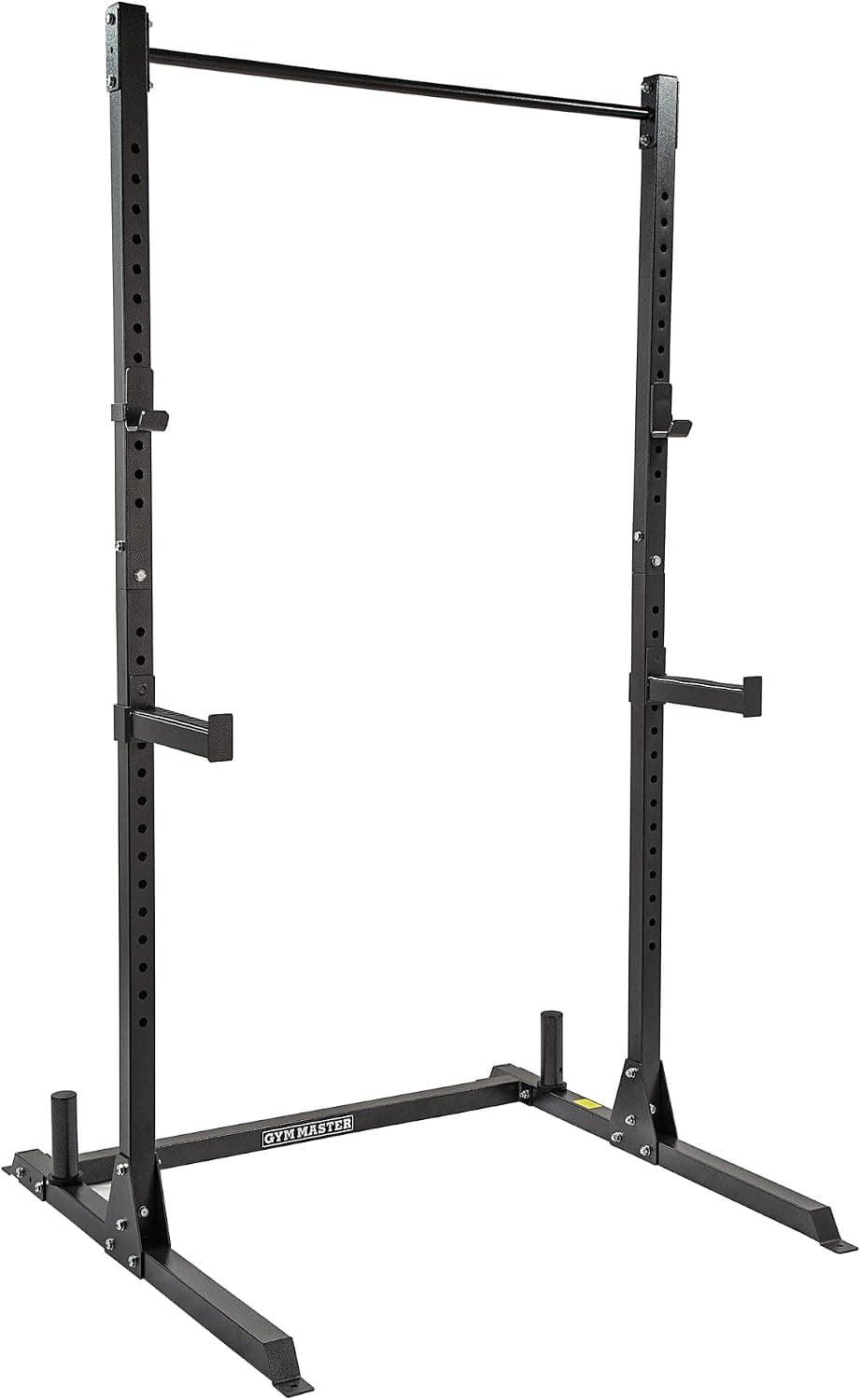
The best squat racks in the UK for 2026, compared on weight rating, height range and spotters. Cheap squat stands, half racks and a full cage for home gyms at every budget.
Best Exercise is a participant in the Amazon EU Associates Programme, an affiliate advertising programme designed to provide a means for sites to earn advertising fees by advertising and linking to Amazon.co.uk. As an Amazon Associate we earn from qualifying purchases. This comes at no extra cost to you and never influences our independent reviews or rankings.