Home Gym
Are Vibration Plates Worth It? What the Research Actually Shows
Are vibration plates worth it? Yes for balance, bone health support and low-impact warm-ups; no for weight loss or replacing strength training. The evidence.

By Paul Kendrick, Cardio & Endurance Editor · Updated 16 August 2026
We may earn a commission from qualifying purchases made through links on this page, at no extra cost to you. This never affects our ratings.
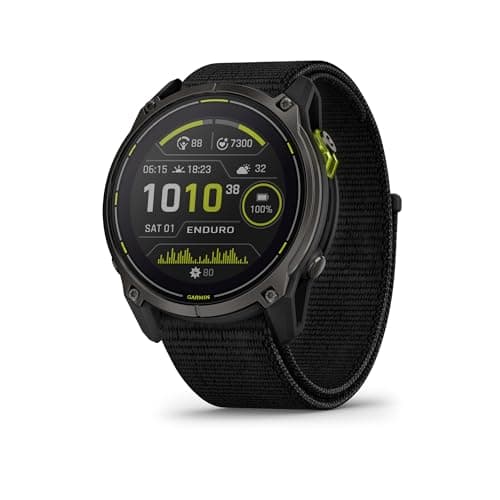
Garmin built the Enduro 3 for a specific and quite small group of people: those who spend so long moving outdoors that charging a watch becomes a logistical problem. Everything about it follows from that. The 51mm case is titanium-bezelled but uses a lightweight build and a nylon strap to come in at 63 grams, lighter than most 47mm watches. The screen is a memory-in-pixel panel rather than the AMOLED that everyone else has moved to. Solar charging runs across the whole lens rather than a thin ring.
The result is a battery figure that reads like a typo. Up to 90 days in smartwatch mode with solar, and 320 hours of GPS tracking with solar, according to Garmin's UK product page. Those are best-case numbers assuming three hours a day in 50,000 lux conditions, which describes a Mediterranean summer rather than Manchester in February. Even discounted heavily for British light, this is a watch you charge monthly.
How we review
This review draws on Garmin's published specifications, the Enduro 3 owner's manual, verified owner reviews and testing from expert outlets. We have not run our own multi-month field test of this exact unit, so we report findings that recur consistently across sources, including the criticisms, rather than one-off impressions.
Ultrarunners, thru-hikers, expedition walkers and anyone who has ever finished a long day out with a dead watch. The Enduro 3 exists for people who measure activities in days rather than hours.
Everyone else should think carefully. At around £774 at the time of writing, it costs more than a decent treadmill, and much of what makes it special is irrelevant if your longest session is a two-hour Sunday run. There is no speaker, no microphone, no diving mode and no AMOLED option. You're paying a premium to have fewer features and a duller screen, which only makes sense if endurance is the thing you actually need.
Picking it up is the first surprise. A 51mm watch should feel like a lump, and this one doesn't, because Garmin used a lighter case construction and the UltraFit nylon strap rather than silicone. At 63 grams it disappears on the wrist during a long run in a way the Fenix range never quite manages. The strap is the unsung part: it breathes, dries fast and doesn't get clammy over a twelve-hour day, though it takes some fiddling to thread the first few times.
The display divides opinion sharply, so be clear about what you're getting. Memory-in-pixel is a transflective technology, meaning it uses ambient light rather than fighting it. Indoors under a kitchen bulb it looks like a calculator from 1997. Step into bright sunlight and it becomes crisper and easier to read than any AMOLED, which is precisely backwards from what phone screens have trained everyone to expect. If most of your watch use is glancing at notifications at a desk, you'll hate it. If it's checking pace at hour nine on an exposed ridge, you'll understand the decision.
The sapphire lens and titanium bezel do their job. Owners consistently report the glass surviving rock scrapes that would have written off a mineral lens.
| Case size | 51 mm |
|---|---|
| Weight | 63 g with UltraFit nylon strap |
| Display | 1.4 in memory-in-pixel, transflective, always-on |
| Lens | Sapphire crystal |
| Bezel | Carbon grey DLC titanium |
| Battery, smartwatch mode | Up to 90 days with solar |
| Battery, GPS mode | Up to 320 hours with solar |
| Storage | 32 GB |
| Water rating | 10 ATM |
| Operating temperature | Minus 20 to 45 degrees C |
| Maps | Preloaded TopoActive with terrain contours |
| Extras | LED flashlight, ECG app, HRV status, Garmin Messenger |
Preloaded TopoActive mapping with terrain contours means you can leave the phone in the pack. Dynamic round-trip routing is the feature that earns its place: give it a distance and a direction and it builds a loop, then continually adjusts if you wander off, which for anyone exploring unfamiliar trails removes most of the anxiety of getting home before dark.
The LED flashlight sounds like a gimmick and isn't. Two brightness levels plus a red mode, controllable with a double-tap of the top button, and it's genuinely bright enough for finding a tent zip, reading a map in the dark or making yourself visible on a road at 5am. Every Garmin owner who has used one says the same thing: you don't know you want it until you have it, and then you resent watches without it.
The training stack is Garmin's full suite: HRV status, training readiness, real-time stamina, endurance and hill scores, plus strength and cardio workouts you can follow on the wrist. The ultra-specific tools are the ones that matter here, and real-time stamina in particular is the rare metric that changes decisions mid-race rather than just describing them afterwards.
Wrist heart rate is fine for steady efforts and less trustworthy when the intensity spikes or the terrain gets rough. That's not a Garmin failing so much as a limitation of optical sensors generally; validity work in trail running specifically found chest-strap ECG measurement had the strongest agreement with the criterion, while wrist and other optical devices showed poor agreement outdoors (concurrent heart rate validity during trail running). Pair a heart rate monitor for interval sessions and let the wrist sensor handle everything else.
Take the headline figures as a ceiling, not an expectation. The 90-day and 320-hour numbers both assume three hours of daily exposure to 50,000 lux, which in the UK means a bright summer day outdoors, not a walk to the shops in October.
What owners actually report, allowing for British light and normal use with maps and music, lands around three to five weeks between charges for daily wear and comfortably over 100 hours of GPS tracking. A 100-mile race on a single charge with battery to spare is routine. Compared with the roughly 15 hours of GPS you'd get from a typical AMOLED smartwatch, the gap is not close.
Regular long days out cover the NHS activity target several times over, and a watch that tracks them properly makes the training easier to structure (UK physical activity guidelines). If you want the same platform in a smaller, cheaper package, our Garmin Forerunner 970 review and Garmin Fenix 8 review cover the two obvious alternatives, and the best Garmin watch UK guide puts the whole range in order.
If you run ultras, do multi-day hikes or genuinely resent charging a watch, yes. Nothing else at 63g gives you 320 hours of GPS tracking with solar and full topographic maps. For everyday running and gym use it is far more watch than you need, and a Forerunner 265 does 90 percent of the job for a third of the price.
Garmin quotes up to 90 days in smartwatch mode and 320 hours of GPS with solar charging, both assuming three hours a day in strong 50,000 lux sunlight. In a British winter you will see nothing close to that. Realistically expect around three to five weeks of mixed daily use and roughly 100 to 120 hours of GPS tracking, which is still enormous.
No, and that is deliberate. It uses a 1.4 inch memory-in-pixel transflective display, the same technology as the older Fenix models. It looks dull indoors compared with an AMOLED watch, gets brighter and clearer the sunnier it is, and is the single biggest reason the battery lasts as long as it does.
The Fenix 8 has an AMOLED option, a speaker and microphone, and diving features. The Enduro 3 drops all of that, uses a nylon strap and a lighter build to hit 63g, and roughly doubles the solar battery life. Enduro for distance, Fenix for features.
It is one of the best hiking watches available. Preloaded TopoActive maps with terrain contours, dynamic round-trip routing, a built-in LED flashlight and a battery measured in weeks cover essentially everything a multi-day walker needs. The 51mm case is large on a slim wrist, which is the main caveat.
Yes, over both ANT+ and Bluetooth, and it is worth doing for interval sessions. Wrist optical heart rate is reliable for steady efforts but lags during hard intervals, so a chest strap remains the more accurate option when the numbers matter.
Are vibration plates worth it? Yes for balance, bone health support and low-impact warm-ups; no for weight loss or replacing strength training. The evidence.
Are walking pads worth it? Who they suit, the step and calorie gains from treadmill desk research, cost per use, noise, spec limits and when to buy a treadmill.
The Arnold split explained: a 6-day chest and back, shoulders and arms, legs rotation run twice a week. Full sample week, who it suits, home and 4-day versions.
Can you run on a walking pad? Mostly no: most cap at 6km/h with short belts and no rails. Which 2-in-1 pads allow a light jog, and when to buy a real treadmill.
Best Exercise is a participant in the Amazon EU Associates Programme, an affiliate advertising programme designed to provide a means for sites to earn advertising fees by advertising and linking to Amazon.co.uk. As an Amazon Associate we earn from qualifying purchases. This comes at no extra cost to you and never influences our independent reviews or rankings.