Treadmills
Are Walking Pads Worth It? An Honest UK Verdict
Are walking pads worth it? Who they suit, the step and calorie gains from treadmill desk research, cost per use, noise, spec limits and when to buy a treadmill.

By Paul Kendrick, Cardio & Endurance Editor · Updated 15 October 2026
Mostly, no. A typical walking pad tops out at 6km/h, which is a brisk walk, and pairs that with a belt around 100cm to 120cm long and no handrail, so there's nothing to grab and very little room if your stride stretches out. The exception is the "2-in-1" pad: raise its fold-up handrail and the speed limit lifts to 10km/h or 12km/h, which is enough for a light jog. Even then it's a compromise, and if running is the main reason you're buying, a proper folding treadmill is the safer spend.
Walking pads are built for one job: slow, steady steps under a standing desk. That shapes every spec, and each one becomes a limit once you try to run.
Top speed. The KingSmith WalkingPad C2 stops at 6km/h, and so do most budget pads. At that speed some people can manage a very short, slow jog, but it feels cramped and most will simply walk fast.
Belt length. A short belt is fine when your feet stay close together. Running adds a flight phase, so each step covers more ground and your landing point varies more from stride to stride. On a 100cm deck there's nowhere to go if you drift back.
No handrail. With nothing in front of you, a trip or a stumble has no safety net. That's acceptable at 3km/h under a desk; it isn't at 9km/h.
Motor and deck. Walking-only pads use small motors and thin decks designed for low impact forces. Running lands harder and asks the motor to hold speed through each footstrike, which is where cheaper units start to stutter, overheat or wear the belt early.
A 2-in-1 pad has a handrail that folds flat for desk use and lifts up for exercise, and the firmware usually unlocks a higher top speed once the rail is raised. KingSmith's own spec page for the WalkingPad R2 describes this: 0.5 to 6km/h in walking mode with the handrail down, and up to 12km/h in running mode with it raised, on a 120 x 44cm running area.
That's a real step up, and for a light jog of 20 to 30 minutes it can work. The catch is that the deck is still walking-pad length. The UREVO 4-in-1 desk treadmill is a good example of the problem: its powered incline and raised rail make it more versatile than a flat pad, but at 100 x 40cm the belt still forces a shortened stride once you speed up. Several of the picks in our best walking pad UK guide list 10km/h or 12km/h on the box, and the same caveat applies to all of them.
Our position
Treat 12km/h on a walking pad as a ceiling you'll rarely use, not a training speed. A 2-in-1 pad is fine for gentle jogging intervals. It isn't a substitute for a treadmill if you plan to run three times a week.
Manufacturers rarely publish a minimum, so the honest way to answer is from stride length. Your step length when running is roughly your speed divided by your cadence (steps per minute). Most recreational runners take somewhere around 155 to 170 steps a minute.
| Speed | Approx. step length at ~160 steps/min |
|---|---|
| 6km/h | about 0.6m |
| 8km/h | about 0.85m |
| 10km/h | about 1.05m |
| 12km/h | about 1.25m |
Add the length of your foot and some margin for the natural drift forwards and backwards on a belt, and you can see why a 120cm deck feels tight above 10km/h and a 100cm deck feels tight above 7km/h or so. That's why folding running treadmills tend to start at about 130cm to 140cm of belt, and why taller runners are better off at 150cm or more. These are rough figures, not a hard rule; a shorter runner with a quick cadence will cope with less.
There's one upside to a short belt. A study of 45 recreational runners found that raising step rate by 5% to 10% (which shortens each step) reduced the energy absorbed at the knee and, at +10%, at the hip (Heiderscheit et al., 2011). So a compact deck nudging you into quicker, shorter steps isn't harmful in itself. The risk is the lack of margin when you misjudge a step, not the stride.
If you're used to thinking in minutes per kilometre, walking pad speeds can look faster than they are. Our full treadmill speed to pace chart covers up to 20km/h, but this is the range that matters for pads.
| Speed (km/h) | Pace (min/km) | What it feels like |
|---|---|---|
| 3 | 20:00 | Slow desk walking |
| 4 | 15:00 | Comfortable typing pace |
| 5 | 12:00 | Purposeful walk |
| 6 | 10:00 | Brisk walk; top speed of most pads |
| 7 | 8:34 | Fast walk or very slow jog |
| 8 | 7:30 | Easy jog for many beginners |
| 9 | 6:40 | Steady jog |
| 10 | 6:00 | A 30-minute 5k pace |
| 12 | 5:00 | A 25-minute 5k pace; ceiling for 2-in-1 pads |
The gap between 6km/h and 8km/h is where most people switch from walking to jogging. A walking-only pad stops just before that line, which is why the honest answer to the question is no.
If you already own a pad, or you're set on a 2-in-1, these are the specs that decide whether jogging is sensible.
Stated maximum speed in running mode. Look for a clear running mode with the handrail raised, not just a big number on the box. If the listing only quotes 6km/h, it's a walking machine.
Continuous motor rating. Treadmill motors are sold on two figures: peak horsepower, which the motor can hit briefly, and continuous horsepower (CHP), which it can sustain. Walking pads often quote peak figures or wattage, which flatters them. As a rough guide, look for around 2.5 CHP or more if you intend to jog regularly; 1 to 1.5HP is a walking motor.
Deck cushioning. Thin pads put more shock back through your legs. Look for named shock absorbers or elastomers under the deck, and accept that even cushioned walking pads are firmer than a mid-range treadmill.
User weight limit. Running loads the frame far more than walking, so the closer you are to the limit, the worse the idea. Our walking pad weight limit guide covers how much headroom to leave.
Warranty terms. Read the manual. If it describes the machine as for walking only, a failed motor or worn belt after months of jogging may not be covered. Warranties on walking pads are already short (often one year), so losing that cover matters.
Safety stop. Proper treadmills have a magnetic safety key on a cord that clips to your clothing and cuts the belt if you fall away. Many walking pads don't, relying on a remote or a stop button instead. If yours has no clip-on key, don't jog on it.
Buy a treadmill rather than a walking pad if any of these are true:
A compact folding treadmill with a 130cm to 140cm belt, a 2.5 CHP motor and a safety key doesn't cost as much as people assume. Our best treadmill under £500 guide covers several that fold and wheel away, so floor space is less of an argument for a pad than it used to be.
If walking is what you'll actually do day to day, a pad is still a good buy; we weigh up the cost, noise and habit question in are walking pads worth it. Just buy it for walking, and don't count on the occasional jog.
Only on a 2-in-1 model with a fold-up handrail and a top speed of 10km/h to 12km/h. A standard walking pad tops out at about 6km/h, which is a brisk walk or the slowest possible shuffle-jog, and its short belt and lack of rails make anything faster unsafe.
Most walking-only pads stop at 6km/h (about 3.7mph). That works out at 10 minutes per kilometre. Two-in-one pads with a raised handrail usually reach 10km/h or 12km/h; the WalkingPad R2, for example, runs 0.5 to 6km/h with the rail down and up to 12km/h with it raised.
As a rough guide, around 140cm or more for easy running and 150cm or more if you're tall or run faster than 12km/h. Walking pads usually have a 100cm to 120cm belt, which leaves little room for error once your stride lengthens.
It can. If the manual describes the machine as walking only, wear or motor failure caused by jogging may fall outside what the manufacturer agreed to cover. Check the user guide for the stated use and maximum speed before you try it.
Only the early weeks, and only on a 2-in-1 pad. Couch to 5K builds to 30 minutes of continuous running, and most people jog at 7km/h to 9km/h by then. A walking-only pad can't reach that, so a compact folding treadmill is the better buy if running is the goal.
Are walking pads worth it? Who they suit, the step and calorie gains from treadmill desk research, cost per use, noise, spec limits and when to buy a treadmill.
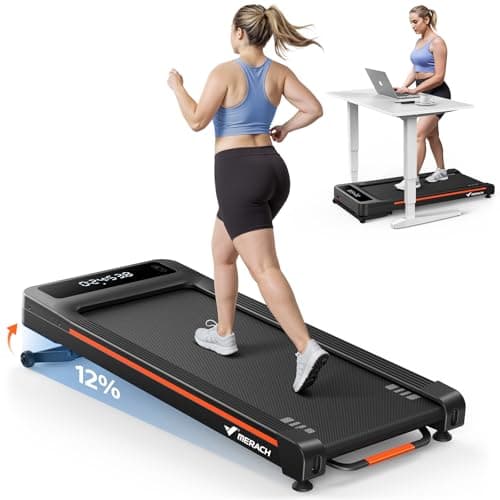
An honest MERACH 12% auto incline walking pad review: 400lb limit, 42cm belt, 6km/h top speed, no fold, no handrail, and why the sprint claims don't hold up.
Most walking pads take 100 to 120kg, mid-range models 120 to 136kg and heavy-duty pads 150 to 180kg. What the limit covers and how much headroom to leave.
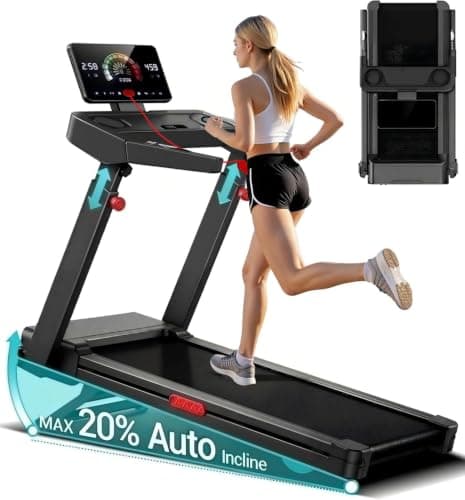
An honest CURSOR FITNESS treadmill review: 2 to 20% auto incline, 14km/h, a 40 x 107cm belt and a 180kg rating for £240, plus the claims we'd treat with care.
Best Exercise is a participant in the Amazon EU Associates Programme, an affiliate advertising programme designed to provide a means for sites to earn advertising fees by advertising and linking to Amazon.co.uk. As an Amazon Associate we earn from qualifying purchases. This comes at no extra cost to you and never influences our independent reviews or rankings.