Home Gym
Are Vibration Plates Worth It? What the Research Actually Shows
Are vibration plates worth it? Yes for balance, bone health support and low-impact warm-ups; no for weight loss or replacing strength training. The evidence.

By Jack Atkins, Home Gym Equipment Specialist · Updated 17 August 2026
We may earn a commission from qualifying purchases made through links on this page, at no extra cost to you. This never affects our ratings.
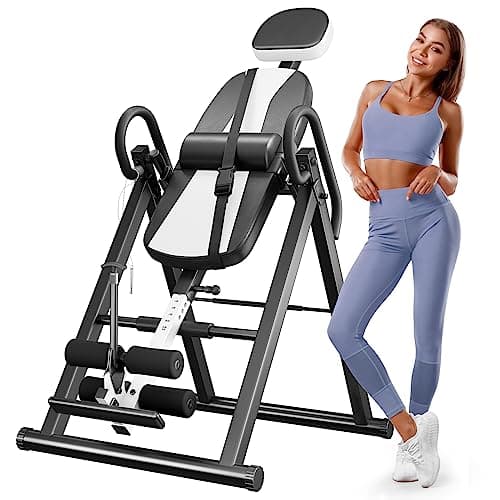
An inversion table hangs you upside down by the ankles so gravity pulls your spine apart instead of squashing it. That is the whole idea, and it is a much older one than the fitness industry admits. Whether it earns a place in your house depends less on the marketing and more on which frame you buy, because the gap between a £90 table and a £330 one is real and it shows up in your ankles first.
We looked at the inversion tables you can actually buy on Amazon UK right now, checked weight ratings and height ranges against the manufacturers' own figures, and read through what owners complain about after six months rather than six days. Five made the list.
How we chose
We researched the most popular inversion tables on Amazon UK rather than running our own long-term hands-on test of each one. Weight capacities, height ranges and dimensions come from the manufacturers' published specifications; the strengths and weaknesses come from patterns across verified owner reviews and expert coverage. Prices and specs were correct at the time of writing and change often, so check the current listing before you buy.
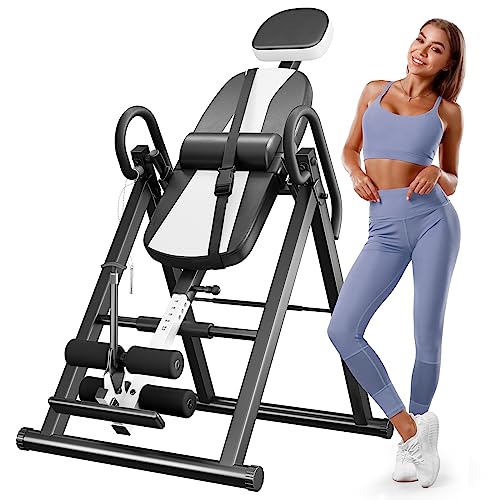
The YOLEO is the one we would point most people to, mainly because of a spec nobody advertises loudly enough: it fits users from 4ft 10in to 6ft 6in. That is the widest height range of any table here, and it matters, because an inversion table that does not match your leg length either pinches your ankles or leaves your hips hanging off the backrest. Six positions on the rear cross bar let you dial the pivot point in properly.
Everything else is solid rather than special. The tubular steel frame is rated to 300 lb (roughly 136kg), the backrest uses memory foam shaped to the lumbar curve, and the ankle lock is a ratchet system you can reach without contorting yourself. There is a safety lock pin as well as the strap, so you can cap your maximum angle while you build up tolerance. At around 22kg assembled it is heavy enough to feel planted and light enough to shift on your own.
The honest limitations: assembly takes a good hour and the instructions are the usual translated diagrams, the ankle cushions are the first thing to compress with regular use, and rotation is a little abrupt compared with the Teeter. For just over £100 those are fair trades.
Check price on Amazon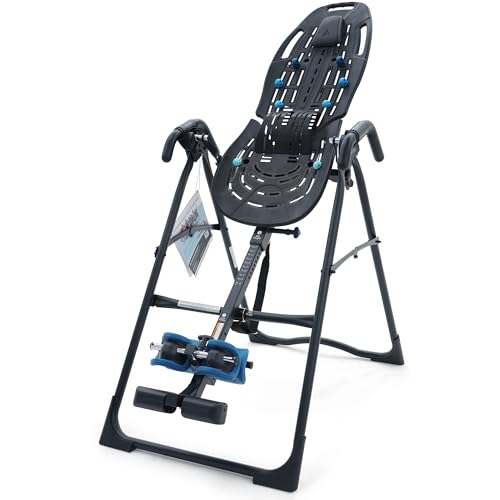
Teeter has been building these for over forty years and the EP-560 is where that shows. It is the only inversion table brand registered with the FDA as a 510(k) medical device, and it uses heat-treated steel rather than the standard tubing everyone else runs. If you are inverting regularly, or you are near the top of the weight range, this is the frame that stops being a compromise.
The features that justify the price are the ones you feel. Wrap-around ankle cups spread the pressure across the whole joint instead of pinching the front of the shin, which is the single most common complaint about cheaper tables. The ComforTrak backrest lets your body slide as you rotate, so you actually get decompression rather than just hanging still. Acupressure nodes and an adjustable lumbar bridge slot into the backrest to focus traction where you want it, and the rotation itself is smooth enough to control with small arm movements rather than a lurch.
It folds without disassembly, which given its 65 lb (about 29.5kg) weight is welcome. What you are paying for, roughly three times a budget frame, is comfort and certification. If you invert twice a week for ten minutes total, that is hard to justify. If your back dictates your week, it is not.
Check price on Amazon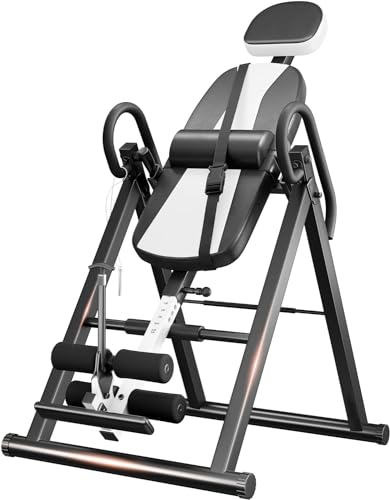
The Dripex sits in the middle on price and behaves like it. Same 300 lb steel frame and ratchet ankle lock as the YOLEO, same memory foam backrest, but with a genuinely better folding action for storage and what Dripex calls a true balance system, meaning the pivot is set so a small shift of the arms rotates you rather than a full commitment of bodyweight.
The catch is the height range: 4ft 3in to 6ft 1in. Shorter than the YOLEO's ceiling by five inches. If you are over six foot, skip this one and buy the YOLEO instead; if you are under 6ft 1in it is arguably the nicer table to use day to day. Dripex also prints the clearest warning list of the budget brands, spelling out that high blood pressure, stroke history, fused vertebrae, detached retinas and pregnancy all warrant a conversation with a doctor first. That is the correct advice and worth repeating.
Check price on Amazon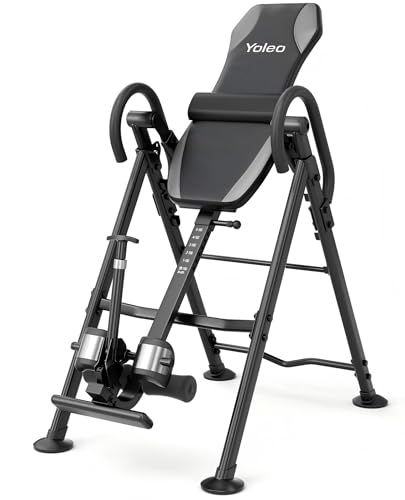
This is YOLEO's other frame, and the difference is the lumbar support built into the backrest rather than clipped on afterwards. If your pain sits low, in the L4 to L5 region where most disc trouble lives, having something pushing into that arch while you hang changes the feel considerably. It is the same 300 lb rating and the same ratchet ankle lock, in grey rather than white, at around 20.5kg.
Height range is 4ft 9in to 6ft 1in, so it is narrower than the standard YOLEO at both ends. Four to six positions on the rear cross bar rather than six flat. Whether the lumbar pad is worth the extra £60 over the base model is genuinely personal: some people find the pressure point makes a session, others find it uncomfortable within a minute. If lower back decompression is specifically why you are buying, it is the more targeted purchase. If you want general spinal traction, save the money.
Check price on Amazon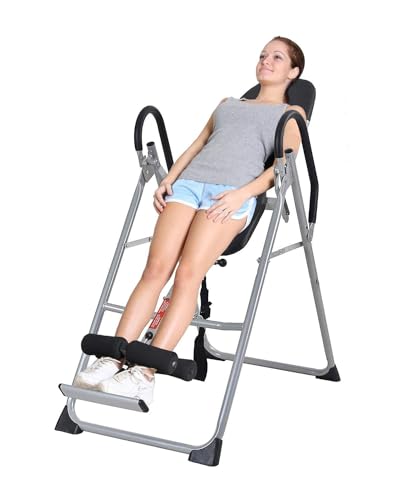
Under £100 and it does the job. Tubular steel with a powder-coated finish, foam-padded backrest, foam rollers and ankle cushions with an easy pull-pin release, and a three-position roller hinge that lets you control how fast you rotate. Full 180 degree inversion is available if you want it, though we would not recommend rushing there.
Cuts show up in the details. Ankle cushions are simple rollers rather than contoured cups, so longer sessions get uncomfortable faster than on the Teeter. The folded footprint is 110 x 58 x 110cm, which is not small. Kemket also does not deliver to Northern Ireland or BT postcodes because of the weight, so check that before you order. As a way of finding out whether inversion suits you at all, without committing £330, it is the sensible entry point.
Check price on AmazonInversion therapy occupies an awkward space: plenty of anecdote, not much high-quality trial data. The most cited UK study is a pilot randomised trial run at the Regional Neurosciences Centre in Newcastle upon Tyne, which put 24 patients waiting for single-level lumbar disc surgery into either physiotherapy alone or physiotherapy plus intermittent inversion traction. Surgery was avoided in 76.9% of the inversion group compared with 22.2% of controls, yet the pain, disability and MRI measures showed no significant difference between groups (Prasad et al., Disability and Rehabilitation, 2012). It is a small pilot, and the authors themselves called for a larger multicentre trial that has not really materialised since.
The NHS position on back pain is more prosaic and, for most people, more useful: keep moving, stay at work if you can, and use exercise rather than rest as the primary treatment (NHS guidance on back pain). Inversion is worth trying as symptomatic relief. It is not worth trying instead of strengthening your hips, glutes and trunk.
Match the height range to your body first, because everything else is negotiable and that is not. Then look at weight capacity with honest headroom, not a number you will be sitting right against. After that, ankle comfort decides whether the table gets used or ends up folded behind a door: cups beat rollers, and padded beats bare foam. Rotation control comes last but matters more than people expect, since a table that lurches through the arc will put you off using it.
Angle is worth a word. You do not need to go fully upside down to decompress the spine; 20 to 60 degrees does most of the work, and every table here lets you cap the maximum with a strap or pin. Start shallow and short.
The evidence is thinner than the marketing suggests, but it is not nothing. A small randomised trial at the Regional Neurosciences Centre in Newcastle put patients waiting for lumbar disc surgery into either physiotherapy alone or physiotherapy plus inversion. Surgery was avoided in 10 of 13 people in the inversion group against 2 of 9 in the control group, though the pain and disability scores did not separate meaningfully. Most owners describe short-term relief that lasts hours rather than a cure. Treat it as one tool alongside strengthening work, not a replacement for it.
Start with one to two minutes at a shallow angle, around 20 to 30 degrees, and stop the moment anything feels wrong. Once your body has adapted over a couple of weeks you can work up to five minutes, two or three times a day. Full 180 degree inversion is rarely necessary; most of the decompression happens well before you are upside down.
Anyone with high blood pressure, glaucoma or other eye conditions, a history of stroke, heart disease, hernia, a detached retina, fused vertebrae, or who is pregnant should speak to a doctor first. Inversion raises blood pressure in the head and eyes, which is why every manufacturer prints the same warning. If you take blood pressure medication, ask your GP before you buy one.
Most home tables in the UK are rated to 300 lb, which is roughly 136kg. That covers the vast majority of users, but the rating assumes static load, not people bouncing or swinging on the frame. If you are near the limit, spend more on a heat-treated steel frame like the Teeter rather than pushing a budget table to its ceiling.
The £90 to £130 frames sold on Amazon UK share a common design: tubular steel, a ratchet ankle lock and a safety strap that caps your maximum angle. They are safe enough when assembled properly and used within their rating. The differences you pay for higher up are ankle comfort, backrest quality, smoother rotation and, on Teeter, independent safety certification. The most common complaint about budget tables is ankle pain, not frame failure.
Most fold, but folded is not flat: expect something close to a wardrobe door leaning against a wall, roughly 110cm tall. You also need clear space behind the table equal to your own height plus a bit, so a corner of a spare room or garage works better than a lounge. Check the folded dimensions before you buy if storage is tight.
Are vibration plates worth it? Yes for balance, bone health support and low-impact warm-ups; no for weight loss or replacing strength training. The evidence.
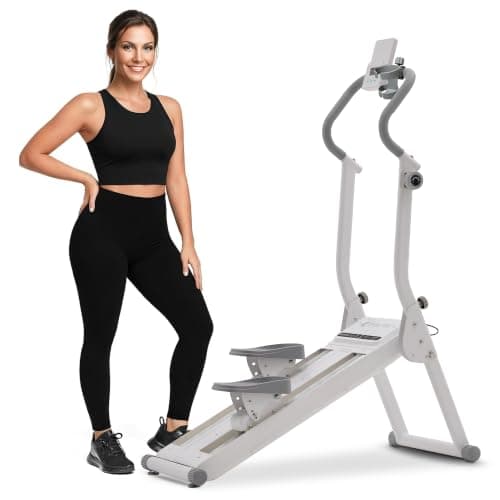
Our ExacMe magnetic stair climber review covers its 16 magnetic resistance levels, 48cm stride, 158kg user limit, app and noise claims, and who should buy it.
What a cambered bar is, the three main types (cambered squat bar, bowed bench bar, cambered Swiss bar), what each one does, how much they weigh and how to buy one.
What a landmine attachment is, the rack-mounted, plate-post and floor platform types, how to check bar and rack fit, safety tips, and the best exercises to do.
Best Exercise is a participant in the Amazon EU Associates Programme, an affiliate advertising programme designed to provide a means for sites to earn advertising fees by advertising and linking to Amazon.co.uk. As an Amazon Associate we earn from qualifying purchases. This comes at no extra cost to you and never influences our independent reviews or rankings.