Home Gym
Are Vibration Plates Worth It? What the Research Actually Shows
Are vibration plates worth it? Yes for balance, bone health support and low-impact warm-ups; no for weight loss or replacing strength training. The evidence.

By Jack Atkins, Home Gym Equipment Specialist · Updated 16 August 2026
We may earn a commission from qualifying purchases made through links on this page, at no extra cost to you. This never affects our ratings.
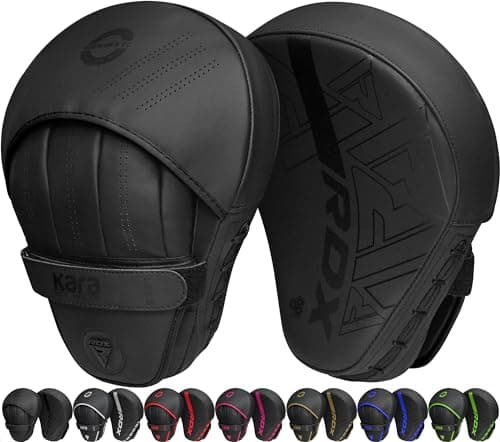
Pads are the one bit of boxing kit that instantly makes home training feel like actual boxing. A bag takes your punches; a pad holder moves, feeds you angles, calls combinations and hits back. Fifteen minutes on the pads is more tiring, more technical and considerably more fun than half an hour thumping a bag. The catch, and it's the reason plenty of people buy pads and never use them, is that you need someone else in the room.
If you have that person, the good news is that pads are cheap. Something genuinely usable starts around £12, and £35 buys a pair that will outlast the enthusiasm of most people who buy them. Below are six picks from what's actually in stock on Amazon UK right now, covering punching, kicking and the cheap end where the quality varies wildly.
How we chose
We researched what's currently available and well reviewed on Amazon UK rather than testing every pair ourselves. Foam depth, the shape of the curve, strap design and what owners say about durability after a few months all fed into the picks. Prices and specs were correct at the time of writing and change often, so check before you buy.
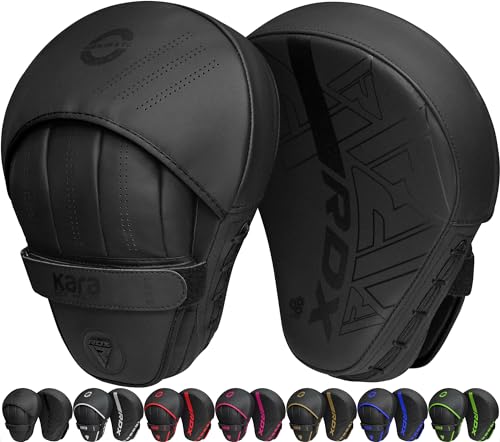
RDX makes more boxing pads than anyone else selling into the UK, and the KARA line is where their quality settles into something you'd genuinely recommend. The shell is Maya Hide, a synthetic leather that shrugs off sweat far better than the vinyl on budget pads, and underneath sits layered EVA foam deep enough that a heavy cross doesn't ring through into the holder's forearm.
The curve is the detail worth paying for. A flat pad forces the holder to angle their wrist awkwardly to present a target, and after three rounds that gets sore; the KARA's pre-curved face sits naturally when your arm is up in a guard position, so you hold them properly without thinking about it. Ventilation holes through the hand compartment stop the inside turning into a swamp, and there's a grip ball for your fingers to close around, which stops the pad twisting on impact.
Downsides? At around £33 these cost roughly triple the cheapest pads on this list, and the wrist strap runs slightly short for anyone with very large hands. The finish is also unapologetically loud, all logos and contrast panels, which some people love and some don't.
Check price on Amazon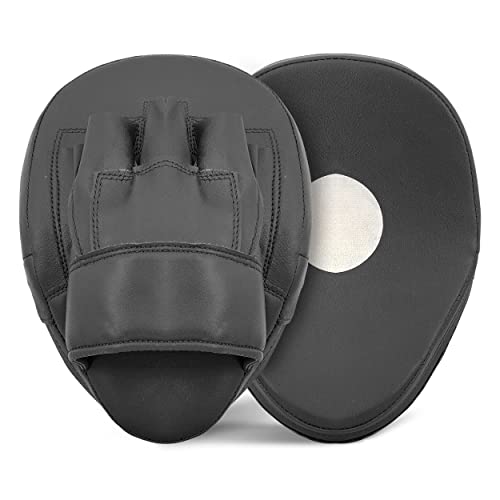
Roughly £12 for a pair of curved pads that hold up to regular use is the kind of value that makes you suspicious, and the Lions pads have been quietly selling on Amazon UK for years on exactly that basis. They're plain black synthetic leather with a curved striking face, a velcro wrist strap and a finger grip bar, and that's about the whole story.
What you give up is foam depth and long-term durability. Light and moderate punching feels fine; a genuinely heavy puncher will find the sweet spot small and the edges hard, and the stitching where the strap meets the pad is the first thing to fail. For a parent holding pads for a kid, a beginner learning combinations, or a spare pair to leave in the boot of the car, they're hard to beat.
Check price on Amazon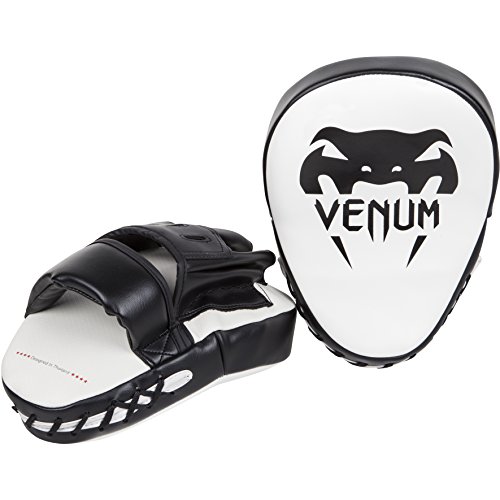
Venum's Light mitts are what you buy when the pad holder matters more than the puncher. They're built deliberately slim and light so a coach can hold them up for round after round without their shoulders burning out, and the shock absorption is better than the thin profile suggests because the foam is denser rather than simply thicker.
At around £50 they're the most expensive pads here, and the value case rests entirely on how often you'll use them. Hold pads twice a week for a year and the reduced arm fatigue is worth every penny. Hold them twice a month and you're paying for engineering you'll never notice. Note too that "light" means exactly that: for a very heavy puncher these transmit more than a chunky pad would, so a big cruiserweight hitting hard is better served by the RDX.
Check price on Amazon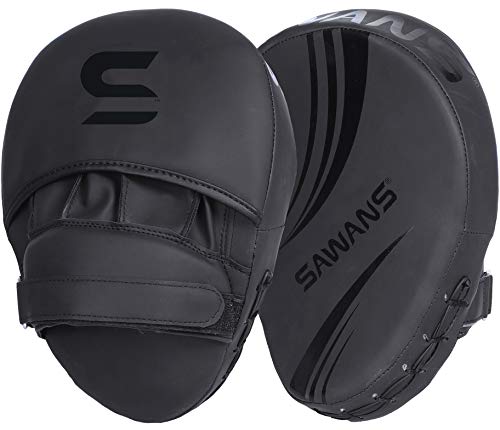
Sitting at about £19, the SAWANS pads land in the gap where most people should probably be shopping. You get faux leather over multi-layer foam, a curved face, a padded wrist wrap and a hand compartment that's roomy enough to hold with wraps on. It's the same feature list as pads costing twice as much, executed to a slightly lower standard.
They're a good first pair precisely because nobody hitting them in the first six months will be generating enough force to expose the limits. If you stick with boxing and start putting real weight behind punches, you'll notice the foam packing down. That's a problem for future you, and by then you'll know whether it's worth £50 to solve it.
Check price on Amazon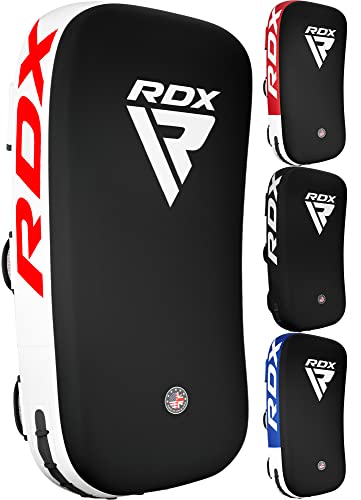
Focus mitts and kicks don't mix. A roundhouse into a small hand pad puts the shock through the holder's wrist at an angle it was never designed to take, and it's a quick route to a sprain. Thai pads solve this by strapping to the forearm, spreading the impact across a much larger area and letting the holder brace with their whole body.
RDX's curved Thai pad, sold individually at around £44, is dense, long and properly stiff through the spine. Buckle straps rather than velcro means it stays put through a hard round, though it also means a slower changeover between partners. Buy two if you're serious about kickboxing, since holding one pad for kicks is awkward and unsafe once the power goes up. One is fine if you mostly want it for knees and body kicks alongside your focus mitts.
Check price on Amazon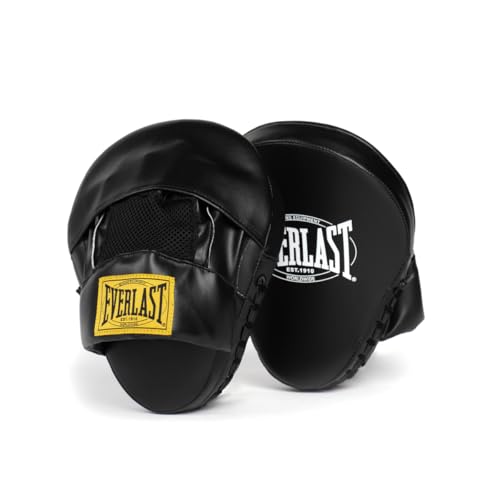
Everlast has been making boxing equipment since 1910, which is where this range gets its name, and the 1910 pads trade on that heritage with a stripped-back look and a price around £22. They're a straightforward curved focus mitt: synthetic leather, layered foam, velcro closure, no gimmicks.
Performance sits roughly where the SAWANS pads do, so you're partly paying for the logo. The reason to pick them anyway is consistency. Everlast's quality control is more predictable than the rotating cast of budget brands on Amazon, and the retro brown and black colourway looks far better in a home gym than the neon that dominates this category.
Check price on AmazonFoam depth beats everything. Squeeze the striking face in the product photos and read the reviews for anyone complaining about sore wrists. That complaint is the tell for a thin pad. Anything under about 4cm through the face will punish the holder once the puncher gets confident.
Curved or flat. Curved pads are easier for the holder to present at the right angle and easier for the puncher to hit cleanly. Flat pads give a bigger target and suit precision work. For general home use, curved wins.
Straps. Velcro is faster to swap between partners, buckles hold more securely under heavy work. Focus mitts are almost always velcro; Thai pads go either way.
Buy gloves at the same time. Pads without gloves is a bad trade for your knuckles. Our best boxing gloves UK guide covers what to pair them with, and 12oz to 16oz suits most people for pad work.
They do, and the physiological evidence for boxing training is stronger than its slightly niche reputation suggests. Six weeks of boxing training has been shown to lower blood pressure in adults with elevated readings (randomised trial), and work measuring muscle oxygenation in professional boxers found that pad rounds place a genuine metabolic load on the upper body, comparable in demand to bag and sparring rounds (NIRS study of pad, bag and spar training).
Three-minute rounds with a minute of rest is the standard structure, and four to six rounds is a serious session for anyone who isn't already fit. That comfortably counts towards the NHS recommendation of 150 minutes of moderate activity a week plus two strength sessions (UK physical activity guidelines). The bonus nobody mentions until they've tried it: holding pads is harder work than hitting them.
If nobody in your house wants to hold pads, buy a punch bag instead and save yourself the disappointment.
The RDX KARA curved focus mitts are the best all-round boxing pads for most UK buyers at around £33. They use Maya Hide leather over layered foam, the curve sits naturally in front of your face when you hold them, and the wrist strap is adjustable enough to fit a teenager or an adult. If you only want something cheap to knock about with, the Lions curved pads do the same job for about £12.
Focus pads (also called focus mitts or hook and jab pads) are small round targets you wear on your hands for punches. Thai pads are long rectangular pads strapped to your forearms, built to absorb kicks, knees and elbows as well as punches. If you box, buy focus mitts. If you kickbox or train Muay Thai, you want at least one pair of Thai pads too.
Look for at least 5cm of foam through the striking face for adult use. Thinner pads transmit shock straight into the holder's wrists and elbows, which is where most pad-holding injuries come from. Cheap pads under £15 tend to feel fine for a light beginner and punishing once someone with real power starts hitting them.
Yes, at minimum a pair of bag gloves or wraps. Hitting pads bare-knuckle grazes your skin and does nothing for the small bones in your hand. Most people pair 12oz to 16oz gloves with pads at home, and glove and pad sets sold together will cover both if you are starting from nothing.
Not really, and that is the honest catch with pads. They need a partner to hold them, so if you train alone you want a punch bag instead. Pads earn their keep when you have someone to work with, because they let you practise real combinations, timing and reaction speed rather than hitting a stationary target.
A decent pair of synthetic leather pads used two or three times a week will last a couple of years before the foam packs down and the stitching around the strap starts to go. Foam compression is what kills pads, not the outer cover, so pads that feel thin and hard when you press them have already done their time.
Are vibration plates worth it? Yes for balance, bone health support and low-impact warm-ups; no for weight loss or replacing strength training. The evidence.
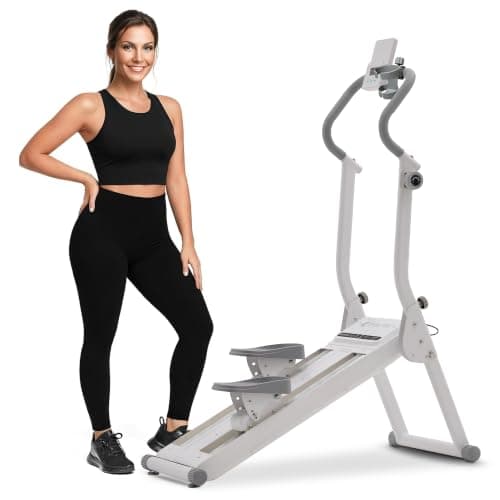
Our ExacMe magnetic stair climber review covers its 16 magnetic resistance levels, 48cm stride, 158kg user limit, app and noise claims, and who should buy it.
What a cambered bar is, the three main types (cambered squat bar, bowed bench bar, cambered Swiss bar), what each one does, how much they weigh and how to buy one.
What a landmine attachment is, the rack-mounted, plate-post and floor platform types, how to check bar and rack fit, safety tips, and the best exercises to do.
Best Exercise is a participant in the Amazon EU Associates Programme, an affiliate advertising programme designed to provide a means for sites to earn advertising fees by advertising and linking to Amazon.co.uk. As an Amazon Associate we earn from qualifying purchases. This comes at no extra cost to you and never influences our independent reviews or rankings.