Home Gym
Adjustable Kettlebell: Is One Worth Buying? Types, Pros and Cons
Is an adjustable kettlebell worth it? The main designs, weight jumps, how they cope with swings and snatches, cost per kg versus fixed bells, and what to buy.

By Jack Atkins, Home Gym Equipment Specialist · Updated 28 August 2026
We may earn a commission from qualifying purchases made through links on this page, at no extra cost to you. This never affects our ratings.
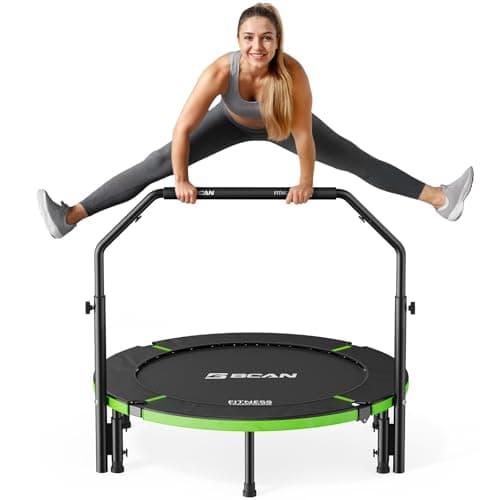
The BCAN 102cm rebounder is the mini trampoline most UK buyers end up looking at, largely because it sits near the top of Amazon's fitness charts with thousands of reviews behind it. At around £89.99 it costs roughly a third of what a bungee-corded rebounder from a specialist brand asks, and it uses 32 steel springs rather than elastic cords to get you off the mat. That single design decision explains most of what people love and most of what they complain about.
Bought as a low-impact cardio machine for a spare bedroom, it does the job well. The 150kg load rating is genuinely useful, the mat is wide enough that you stop thinking about your foot placement after a session or two, and the height-adjustable handle turns it into something a nervous beginner can actually use. Where it falls short is noise, and where its marketing falls apart is calorie burn.
How we review
This review draws on BCAN's published specifications, the patterns that repeat across verified owner feedback, and peer-reviewed research into rebound exercise. We have not put this exact unit through a year of daily use, so we report the consistent findings rather than isolated opinions, and we flag manufacturer claims that the evidence does not support.
Anyone who wants cardio at home without hammering their knees and ankles. Rebounding suits people carrying extra weight, older trainers, and anyone coming back from a lower-limb injury who has been told to keep impact down. A six-week trial of mini-trampoline training in older adults produced measurable gains in balance, mobility and walking capacity (J Aging Phys Act, 2026), which is a more honest reason to buy one than fat loss.
It is a poor fit if you live above someone, if your ceiling is under about 2.4m, or if you already run and lift and just want more of the same intensity. Serious cardio kit does more for that money, and our home gym section covers the alternatives.
Check the BCAN rebounder price on AmazonSprings are cheap, durable and immediate. Push down and the mat throws you back quickly, with a short, firm rebound that feels closer to skipping than to floating. Bungee rebounders slow that curve down: you sink further, you hang longer, and your joints see a gentler deceleration. If you have used a Bellicon or a similar corded model, the BCAN will feel abrupt for the first week.
Whether that matters depends on your body. Most people adapt inside a couple of sessions and stop noticing, but anyone with cranky knees or a sensitive lower back tends to prefer the deeper cord bounce, and that preference is worth £200 to them. For everyone else, 32 springs across a 102cm frame gives a bounce that stays even across the mat rather than dumping you towards the middle, which is the failure mode of the really cheap 91cm units.
Noise is the honest downside. Each landing produces a soft metallic chorus, and while it is not loud in absolute terms, it is rhythmic, which is exactly the sort of sound that travels through joists and irritates a neighbour. A dense exercise mat underneath kills a surprising amount of it.
| Mat diameter | 102 cm (40 inch) |
|---|---|
| Suspension | 32 steel springs, padded cover |
| Maximum user weight | 150 kg / 330 lb |
| Handle height | Adjustable, approx 81 cm to 107 cm |
| Frame height | Approx 19 cm |
| Product weight | Approx 12 kg |
| Legs | Six, fold flat for storage |
| Assembly | Around 80% pre-assembled, 10 to 20 minutes |
| Warranty | Two years, manufacturer |
| Typical UK price | £89.99 (RRP £99.99) |
BCAN's listing promises 250 calories from 10 minutes of bouncing. That would put rebounding somewhere above a hard 5K pace, which nothing about gentle bouncing on a mat supports. Published work on rebound exercise puts it in the moderate-intensity bracket, useful for cardiorespiratory fitness and functional capacity rather than dramatic energy expenditure (scoping review, Cureus 2024). A 12-week rebounding programme in overweight women did improve body composition and functional measures, but over months of consistent training, not over a fortnight (J Sports Med Phys Fitness).
Treat 250 calories as marketing. Treat 20 low-impact minutes, five days a week, as the thing that actually moves your health markers, which lines up with the NHS target of 150 minutes of moderate activity a week.
The frame feels solid for the money. Welds are tidy, the mat is stitched rather than glued at the attachment points, and the spring cover is thick enough that you can kneel on the edge without feeling steel through it. Over months of use the common owner complaint is not the mat or the springs; it is the handlebar, which picks up a small amount of side-to-side play at full extension. Drop it a notch and the wobble mostly disappears.
One safety point deserves more attention than the listing gives it. Clinicians have documented mid-thoracic vertebral compression fractures in people who started mini-trampoline exercise, mostly women with reduced bone density (Medicina, 2023). That is not a reason for a healthy adult to avoid rebounding, but if you have osteoporosis or a history of spinal fracture, talk to your GP before you buy, not after.
See today's BCAN rebounder priceYes, and the 150kg weight limit is the reason. Plenty of cheap rebounders top out at 100kg, which rules out a lot of adults or leaves them bouncing on a mat that has almost no margin left. The 102cm mat also gives you enough room to land without constantly checking your feet, which smaller 91cm models do not.
The six legs fold under the frame, so it slides under a bed or behind a sofa at roughly 10cm thick. The mat and frame themselves do not fold in half, so you still need a gap around a metre wide. The handlebar comes off in seconds if it will not fit.
Noticeably, yes. Springs make a rhythmic metallic sound on every landing and bungee cords do not. If you are bouncing in a flat above a light sleeper, that matters more than any spec on the box. On a rubber mat over a carpeted floor the noise drops enough for most households.
No. That figure appears in BCAN's own listing and it does not survive contact with the research. Steady rebounding sits somewhere near a brisk walk or a light jog for energy cost, so 10 hard minutes is realistically closer to 60 to 100 calories for most adults. The trampoline is still worth owning, just not for that reason.
About 10 to 20 minutes. It arrives largely built, so the job is screwing in six legs and slotting the handlebar together. You do not need tools beyond what is in the box, though a second pair of hands makes flipping the frame easier.
Be careful. There is published evidence of vertebral compression fractures in people with low bone density who took up mini-trampoline training, so anyone with osteoporosis, a previous spinal fracture or ongoing back pain should get medical clearance before starting rather than after something hurts.
Is an adjustable kettlebell worth it? The main designs, weight jumps, how they cope with swings and snatches, cost per kg versus fixed bells, and what to buy.
Bumper plates explained: why each is 450 mm wide, crumb vs virgin vs urethane rubber, IWF colours, thickness, bounce, price per kg and the set to start with.
Calibrated plates are machined to within 10g or 0.25% of their stated weight and are much slimmer than cast iron. What they cost in the UK and who needs them.
How to choose a dumbbell rack for a home gym: A-frame vs 2 and 3-tier racks, saddles vs shelves for hex dumbbells, load ratings, footprint and floor protection.
Best Exercise is a participant in the Amazon EU Associates Programme, an affiliate advertising programme designed to provide a means for sites to earn advertising fees by advertising and linking to Amazon.co.uk. As an Amazon Associate we earn from qualifying purchases. This comes at no extra cost to you and never influences our independent reviews or rankings.