Treadmills
Treadmill Mat: Do You Need One, What Size and How Thick?
Do you need a mat under a treadmill? When it matters on carpet and hard floors, how to measure for the right size, 4mm vs 6mm vs rubber, and walking pad mats.

By Paul Kendrick, Cardio & Endurance Editor · Updated 31 October 2026
A treadmill with a screen is worth paying for when you'll run the classes or filmed routes it was designed around, and when you want the machine to change speed and incline for you while you follow along. Plenty of people don't need either. They want something to look at during a 40-minute walk, and for that a tablet on the console shelf, or a TV on the wall in front of the deck, costs far less and ages better than a touchscreen bolted to the frame.
That's the same conclusion we reached in our exercise bike with screen guide, but treadmills add two twists. Running bounces your head, which makes small screens harder to use, and auto incline on a treadmill changes the workout far more than auto resistance does on a bike.
Every motorised treadmill has a display of some kind. On budget and mid-range machines it's an LCD showing speed, time, distance, incline and an estimated calorie figure, sometimes with heart rate from grip sensors. Some are surprisingly large: the Sportstech F37 has a 7.5in console, but it's still a stats screen rather than anything that plays video.
Don't write these off. Put an LCD treadmill in front of a TV and you've got the setup most home walkers actually use, and nothing on it will stop working because a company changed its app.
This is the route we'd point most buyers towards. The treadmill connects over Bluetooth to an app on your phone or tablet, and the tablet sits on a shelf or cradle above the console. Kinomap plays filmed real-world routes, and on compatible machines it drives the belt speed and incline to match the terrain, which is what the Sportstech F37 is set up to do. Zwift turns your run into a game on virtual roads; it reads your pace and moves your avatar, but it isn't built to control the treadmill for you.
The Reebok i-Run 5.0 is a good example of the budget end: it pairs with Zwift, Kinomap and Reebok's own app over Bluetooth, and picks up a heart rate strap. The Bluefin Kick 5.0 sits a step up, with a 10.1in built-in display for your numbers and Kinomap on your own device for the interactive side.
The downsides are practical. Tablet shelves on cheaper treadmills can rattle at running pace, a 10in screen is small once you're moving quickly, and you've got another device to keep charged.
Here the treadmill has its own internet-connected touchscreen and runs the maker's software directly. NordicTrack and ProForm use iFIT, Peloton runs its own classes, and BowFlex uses its JRNY platform; Technogym and JTX sell connected machines too, at very different price points.
The NordicTrack Commercial 1750 is the benchmark we've covered: a 14in touchscreen, a minus 3% to 15% incline range, and iFIT trainer control that changes speed and incline automatically to follow a coach or a filmed route. At the top of the market, Peloton's UK site lists the Peloton Tread Vision from £2,999, with a 23.8in screen that tilts through 0 to 50 degrees, a 12.5mph top speed and 0 to 12.5% incline. Peloton's page describes speed and incline being set with control knobs, jump buttons and on-screen shortcuts, and doesn't claim the instructor changes them for you, so check that before buying if auto control is the feature you're paying for.
The screen usually comes with a monthly bill, and over three or four years of ownership that bill can rival the price of the treadmill.
NordicTrack's UK store lists iFIT Pro, the tier for machines with built-in touchscreens, at £34 a month or £349 a year at the time of writing. Paid annually, that's £1,047 over three years. iFIT Train, the cheaper tier for using a phone or tablet with iFIT-ready kit that has no built-in screen, renews at £14 a month or £144 a year. Some NordicTrack machines ship with a trial or an included year, so read what's bundled before you add it up.
Peloton's Tread page lists the All-Access Membership at £45 a month, which is £540 a year and £1,620 over three years before you've paid the £2,999 for the Tread itself. Our Is Peloton worth it? breakdown runs those numbers in more detail, and the verdict carries over: count the membership as part of the purchase price.
We couldn't find a published UK price for BowFlex's JRNY membership, and current UK prices for Kinomap and Zwift aren't clearly listed on their sites either, so check inside each app before you commit.
On a treadmill, the strongest argument for a connected screen isn't the video. It's having a coach or a route take over the incline and speed. A hill session where the deck rises to 8% for three minutes and drops back without you touching anything is harder to skip, and it makes hill work actually happen; you can read why that matters in our best incline treadmill UK guide.
You can get this without a built-in screen. Kinomap controls compatible Bluetooth treadmills from a tablet, and iFIT Train does the same on iFIT-ready machines without a touchscreen. Before you buy, check two things on the spec sheet: that the incline is motorised rather than a manual lever, and that the app control works with your specific model, not just the brand.
It can make sessions feel better, though the research is less clear-cut than the adverts. In a 2018 study, 40 people ran for 21 minutes on a treadmill either in a virtual reality world with other runners or while watching neutral images; the neutral-images group actually reported more enjoyment after the run, and the VR benefit depended on how absorbed each person got (Neumann and Moffitt, 2018). A 2023 crossover study of 26 adults walking at 4.5km/h found outdoor coastal walking more enjoyable than both plain treadmill walking and treadmill walking in a VR headset showing the same coast (Greco et al., 2023).
Our reading: having something to look at helps, but it doesn't need to be an expensive purpose-built display. A TV series you only watch on the treadmill can work as well as a filmed run through the Dolomites.
At a walk, a 10in screen at arm's length is fine. Once you're running, your head moves several centimetres with every stride, so a bigger screen or a TV a couple of metres in front of the deck is easier on the eyes than a phone in a cradle.
If you want to follow floor classes off the treadmill, a screen that tilts or turns matters. Most touchscreens sit fixed above the console, so check the quoted angles. Peloton's 0 to 50 degree tilt is vertical only.
This is the risk most buyers ignore. A built-in screen is only as useful as the maker's software support, and you can't swap it for a newer app the way you can on a tablet. If a brand drops a model from its platform, changes what the free tier includes, or stops trading, the screen can be reduced to a stats display. Big platforms have more reason to keep old machines working, but that isn't a guarantee, and it's a much bigger worry with an unknown brand selling a touchscreen treadmill on Amazon. A tablet sidesteps the problem completely.
Prices change constantly, so treat these as rough bands.
If you already own a tablet, this is the setup we'd recommend to most walkers and casual joggers. The Reebok i-Run 5.0 was £499 on Amazon when we checked, with 12 levels of motorised incline, Bluetooth for Zwift and Kinomap, and a compact 120 x 46cm deck. That deck suits walking and jogging rather than proper running, so taller runners should look at a longer belt.
Check the Reebok i-Run 5.0 price on Amazonaround £499If you mainly want to walk at a desk or in front of the TV, compare the options in walking pad vs treadmill first; a walking pad has no screen at all, and for that use you don't need one.
The most expensive one is paying £1,000 or more extra for a touchscreen and then watching Netflix on your phone anyway. Be honest about how you'll use it.
People also judge the screen and forget the treadmill. A short deck, a weak motor or a low user weight limit don't improve because the display is big. Read the specs as if the screen weren't there, and multiply the subscription by the years you'll own the machine.
It's worth it if you'll follow the trainer-led runs and filmed routes the screen was built for, and you want the treadmill to change speed and incline for you. If you mostly watch TV or listen to podcasts while you walk, a cheaper treadmill with a tablet shelf and a good Bluetooth connection gets you most of the benefit, without a membership attached to the screen.
NordicTrack's UK store lists iFIT Pro, the tier for machines with built-in touchscreens, at £34 a month or £349 a year at the time of writing. iFIT Train, the cheaper tier for using a phone or tablet with iFIT-ready equipment that has no built-in screen, renews at £14 a month or £144 a year.
Peloton's UK Tread page says you need the All-Access Membership to access all Peloton content on the machine, and lists it at £45 a month. The current UK model is the Peloton Tread Vision, which starts at £2,999 with a 23.8in screen.
Yes, if the treadmill broadcasts its speed over Bluetooth, which many mid-range machines now do. Both apps run on your own phone, tablet or laptop. Kinomap can also take control of compatible treadmills and change the speed and incline to match a filmed route, while Zwift mainly reads your pace and moves your avatar.
On most treadmills, not on the built-in display, which runs the maker's own software. The easiest route is a tablet on the console shelf or a treadmill facing a wall-mounted TV. Some premium touchscreens add streaming apps, but check the current spec sheet rather than assuming it, because what's allowed changes with software updates.
For a walking pace, a 10in display at arm's length is easy to read. Running makes your head bob, so text and small on-screen numbers get harder to follow, and a 14in to 24in screen or a large TV in front of the treadmill becomes more useful. If you only need your stats, the size of the built-in LCD barely matters.
Do you need a mat under a treadmill? When it matters on carpet and hard floors, how to measure for the right size, 4mm vs 6mm vs rubber, and walking pad mats.
Non-electric treadmills explained: cheap flat manual models vs £2,000+ curved self-powered machines, how each compares with motorised ones, and who should buy.
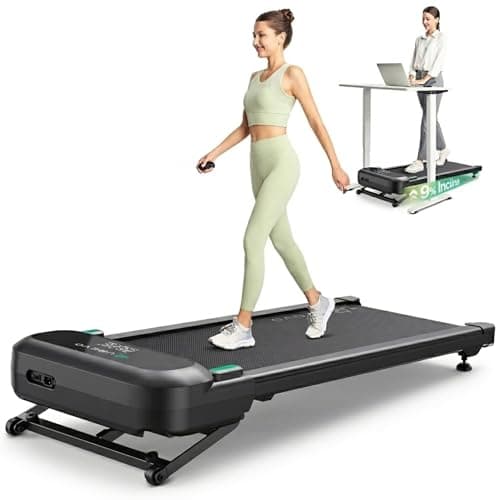
Our honest UREVO SpaceWalk 5L walking pad review: 9% auto incline, dual brushless motor, 136kg limit and a narrow 40x100cm deck, for £349.99 on Amazon UK.
Walking pad vs treadmill compared on deck size, top speed, motor, incline, weight limit, storage and UK price, with a clear verdict on which one to buy.
Best Exercise is a participant in the Amazon EU Associates Programme, an affiliate advertising programme designed to provide a means for sites to earn advertising fees by advertising and linking to Amazon.co.uk. As an Amazon Associate we earn from qualifying purchases. This comes at no extra cost to you and never influences our independent reviews or rankings.