Home Gym
Cambered Bar Explained: Squat, Bench and Swiss Bar Types
What a cambered bar is, the three main types (cambered squat bar, bowed bench bar, cambered Swiss bar), what each one does, how much they weigh and how to buy one.

By Jack Atkins, Home Gym Equipment Specialist · Updated 14 October 2026
A Swiss bar is a barbell with several pairs of parallel handles set inside an open frame, so you hold it with your palms facing each other instead of gripping a straight shaft. You'll also see it sold as a football bar or a multi-grip bar. Full-length Olympic versions usually weigh 15kg to 25kg and take 2 inch plates, while shorter 1 inch "tricep bars" weigh around 5kg to 10kg. Its main job is pressing and rowing with a neutral grip, which many lifters find easier on their shoulders and elbows than a straight bar.
For a home gym that already has a barbell and a rack, it's one of the more useful second bars you can add. It doesn't replace your straight bar, though, and the cheap short versions are a different tool altogether.
Picture a standard barbell where the middle section has been swapped for a ladder. The two long rails run parallel, and short cross handles sit between them at different widths. On most bars you get three or four grip widths, and some angle the handles slightly so your wrists sit somewhere between neutral and pronated.
The GYM MASTER Olympic bar is a fair example of the full-size design. It's 220cm long with 50mm sleeves, lists grip spacings of roughly 30cm, 49cm and 70cm, and has a slight camber so the handles sit a little lower than the sleeves. That camber lets you bring the bar a touch deeper on presses and rows.
Cheaper "multi-grip tricep bars" look similar but are built for arm work. They're short (often around 85cm), take 1 inch plates and are light enough to swing around for hammer curls and extensions.
There isn't one standard weight, which is the most common source of confusion. Unlike an Olympic straight bar, nobody regulates Swiss bars, so the figure depends on how thick the frame is and how long the bar runs.
| Bar type | Typical weight | Plates | Length |
|---|---|---|---|
| Olympic Swiss / football bar | 15kg to 25kg | 2 inch (50mm) | Often around 220cm |
| 1 inch multi-grip tricep bar | 5kg to 10kg | 1 inch (25mm) | Around 80cm to 100cm |
| Men's Olympic straight bar (for reference) | 20kg | 2 inch | 220cm |
| Olympic EZ bar (for reference) | 7kg to 10kg | 2 inch | Around 120cm |
Two real listings bear this out. GYM MASTER quotes approximately 18.5kg for its Olympic Swiss bar, and Mirafit lists its 1 inch tricep bar at about 8kg. If you log your training properly, stick the bar on a set of bathroom scales once and write the number on a strip of tape. Our guides to barbell weights and EZ bar weight cover the other bars in a typical home gym.
On a straight bar your forearms are locked into a palms-down position, and on the bench press most people end up with a fairly wide grip and flared elbows. A Swiss bar turns your palms inward. That makes it almost automatic to use a closer hand position and keep your elbows tucked nearer your sides.
Does that actually matter? A 2024 modelling study of experienced lifters doing 21 bench press variations found that grips narrower than 1.5 times shoulder width reduced compression at the acromioclavicular joint and cut rotator cuff activity and some shear forces at the main shoulder joint (Noteboom et al., Frontiers). That's evidence about grip width on a straight bar, not a trial of the Swiss bar itself, and we haven't found one. But a neutral grip is the easiest way to press narrow without your wrists feeling twisted, which is why coaches reach for this bar when someone's shoulder grumbles on flat bench.
There's a cost. A separate study comparing narrow, medium and wide bench grips found both novices and trained men lifted less with the narrow grip, and triceps activity was lower with the wide grip than the narrow or medium (Saeterbakken et al.). Expect your Swiss bar press to come in below your normal bench, and expect your triceps to feel it.
Elbows tend to like the neutral position too, especially on curls and extensions, although that's based mostly on lifter feedback rather than controlled data. If you have an actual injury, see a physio first; a different bar won't fix a torn tendon.
You can use a Swiss bar for most upper-body barbell lifts. These are the ones where it genuinely beats a straight bar.
The headline exercise. Use the middle handles, tuck your elbows to roughly 45 degrees, lower to your lower chest and press. If unracking is awkward or you train alone, the floor press works brilliantly with this bar: the floor limits the range, so your shoulders never drop into the stretched bottom position at all. It also overlaps heavily with the close-grip bench press as a triceps builder.
A neutral grip lets your elbows sit in front of the bar rather than flared out to the side, and lots of people find this the only way they can press overhead without a pinch at the front of the shoulder. Start lighter than your usual overhead press; balancing the frame takes a few sessions to get used to.
Bent-over and chest-supported rows with a neutral grip shift a little more work to the lats and let you pull the bar into your stomach without your wrists rolling. The narrow handles feel close to a cable row handle with far more load available.
Neutral-grip curls are basically barbell hammer curls, hitting the brachialis and brachioradialis hard. For skull crushers, the closest handles keep your wrists stacked and spare the elbows compared with a straight bar. A light 1 inch tricep bar does this job well; you don't need the big Olympic frame for arm work.
Treat Swiss bar pressing like any main lift: 3 to 5 sets of 5 to 8 reps, twice a week, adding a small amount of weight when every rep looks clean. Rows and arm work suit 3 sets of 8 to 15. The NHS recommends strength work on at least two days a week, and swapping a couple of your pressing sessions onto this bar fits neatly into that.
Short version: a straight bar is still your main barbell, an EZ bar is for arms, and the Swiss bar is for neutral-grip pressing and rowing.
| Straight Olympic bar | EZ bar | Swiss bar | |
|---|---|---|---|
| Grip | Pronated, any width | Semi-supinated, angled | Neutral, fixed widths |
| Best for | Squat, deadlift, bench, press | Curls, skull crushers | Pressing and rowing around sore shoulders |
| Rackable | Yes | Usually too short | Full-length versions, yes |
| Typical weight | 20kg | 7kg to 10kg | 15kg to 25kg |
| Load capacity | High | Low to moderate | Moderate to high |
Choose a straight bar first if you only own one. It does everything, including squats and deadlifts, which a Swiss bar simply can't. If you'd mainly like better arm training, an EZ bar costs less and fits in a cupboard. Add a Swiss bar once your shoulders, elbows or boredom start limiting your pressing.
These get lumped together on Amazon and they shouldn't be. An Olympic Swiss bar is a full-length piece of equipment you rack in a cage and load with heavy plates; a 1 inch tricep bar is a hand-held arm-training tool.
The 1 inch type is short, light and cheap, and it only takes standard 1 inch plates. Mirafit lists its version at 85cm long with 20cm sleeves and a 150kg rating. That's plenty for curls and extensions, but you can't rack it, so bench pressing anything heavy is out unless you're happy to floor press from a dead start.
If your home gym runs on 2 inch Olympic plates and a power rack, go Olympic. If you have a set of 1 inch spinlock plates and want something for arm day, the tricep bar does that job for a fraction of the price.
These are current Amazon UK listings we've checked against our product data. We haven't tested them ourselves; the notes below come from the manufacturers' published specs.
The GYM MASTER Olympic Cambered Multi Grip Swiss Bar is the sensible all-rounder for a home rack. It's 220cm long, around 18.5kg, rated to 350kg, and offers three angled grip widths with 44.5cm of loadable sleeve. Collars aren't included, so budget for a pair. It was listed at £79.99 when we checked.
Check price on AmazonThe Bells of Steel Arch Nemesis Swiss Bar is the premium pick, with a 600lb (about 272kg) rating, more aggressive knurling and a cambered arch. Its sleeves are steel tubing that doesn't rotate, sized at 49.7mm so standard Olympic collars fit. At £129.99 it costs a fair bit more, and stock was down to a single unit when we looked, so it may come and go.
Check price on AmazonThe Mirafit 1 inch Multi Grip Tricep Bar is the budget arm-training option rather than a true rackable Swiss bar. At around 8kg, 85cm long and rated to 150kg, with spinlock collars included, it's ideal for hammer curls and extensions with 1 inch plates. It was £29.99 at the time of writing.
Check price on AmazonOur take
If you own a power rack and Olympic plates, the GYM MASTER bar is the one to buy for most people. Only pay up for the Bells of Steel if your rack is a 3x3 inch model and you want the extra capacity. If you just want better arm days, the Mirafit tricep bar is all you need.
Most full-length Olympic Swiss bars weigh somewhere between 15kg and 25kg, depending on the frame thickness and length. The GYM MASTER Olympic version lists roughly 18.5kg. Shorter 1 inch multi-grip tricep bars are much lighter, usually 5kg to 10kg, and the Mirafit one is listed at about 8kg. Weigh your own bar on bathroom scales if you want to log exact loads.
Yes. Swiss bar, football bar and multi-grip bar are three names for the same thing: a bar with several pairs of neutral handles welded inside an open frame so your palms face each other. The football name comes from American football strength programmes, where coaches used it to keep pressing around shoulder problems.
For many lifters it's more comfortable, because the neutral grip makes it natural to use a narrower hand position and keep the elbows tucked. Biomechanics research on the barbell bench press found that narrower grips reduced some shoulder joint loads. No large trial has tested the Swiss bar itself, so treat it as a sensible option for cranky shoulders rather than a cure.
Yes, and it's one of the best uses for it. Most people press less than they would with a straight bar because the grip is narrower and the triceps do more of the work. Floor press is a good alternative if your bench and rack setup makes unracking awkward.
A full-length Olympic Swiss bar around 220cm long will usually sit in the same J-hooks as a standard 7ft barbell, but the frame is wider than a plain shaft and can foul narrow uprights. Measure the gap between your J-hooks and compare it with the bar's inner collar-to-collar distance before you buy. Short 1 inch tricep bars are too short to rack at all.
Not strictly. An EZ bar covers curls and skull crushers well. A Swiss bar earns its place if you want neutral-grip pressing and rowing with heavy loads, which an EZ bar can't really do. If you only train arms, the EZ bar is enough.
What a cambered bar is, the three main types (cambered squat bar, bowed bench bar, cambered Swiss bar), what each one does, how much they weigh and how to buy one.
What a landmine attachment is, the rack-mounted, plate-post and floor platform types, how to check bar and rack fit, safety tips, and the best exercises to do.
What a safety squat bar is, how much it weighs, how it changes your squat compared with a straight bar, who it suits and what to check before buying one in the UK.
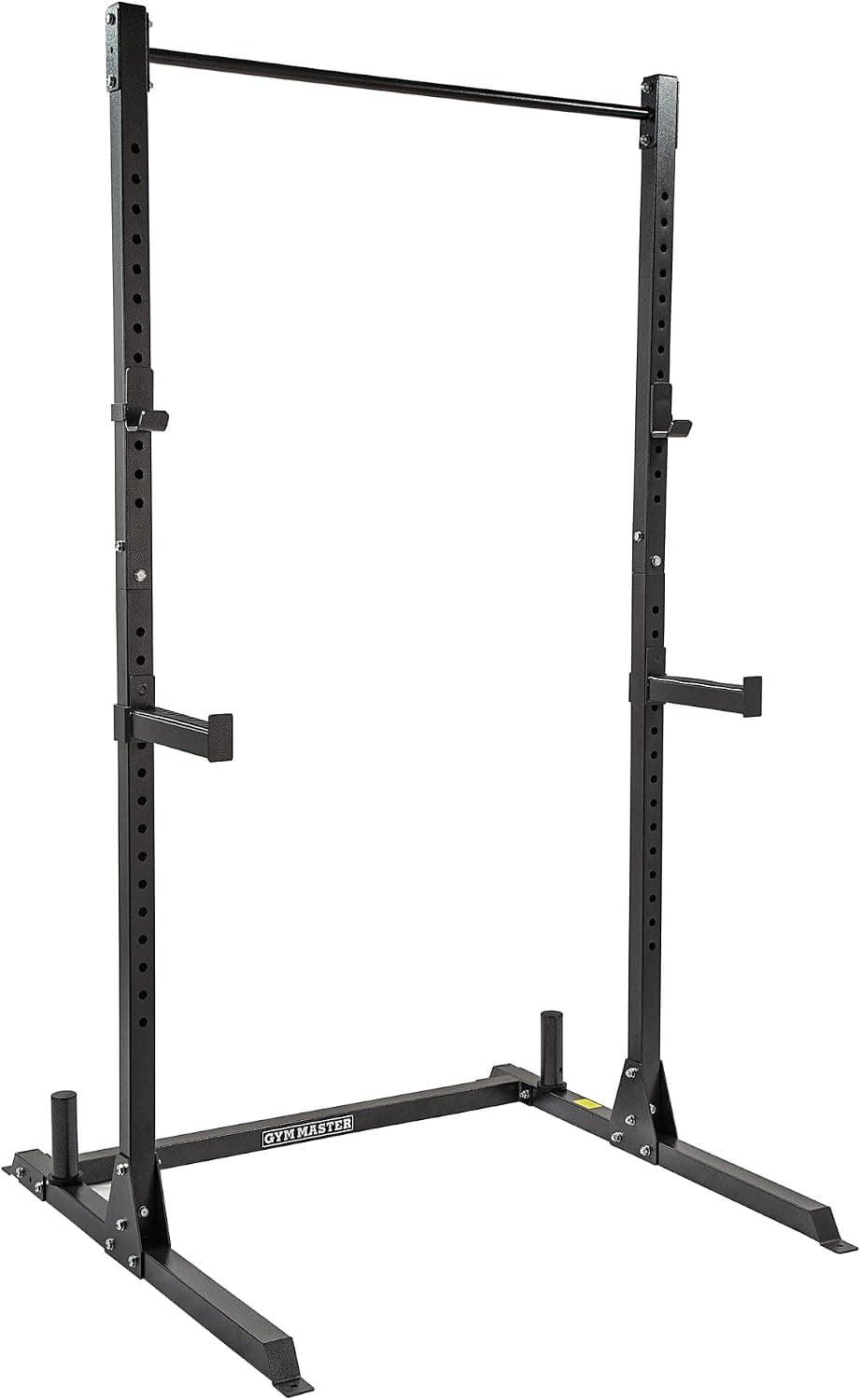
The best squat racks in the UK for 2026, compared on weight rating, height range and spotters. Cheap squat stands, half racks and a full cage for home gyms at every budget.
Best Exercise is a participant in the Amazon EU Associates Programme, an affiliate advertising programme designed to provide a means for sites to earn advertising fees by advertising and linking to Amazon.co.uk. As an Amazon Associate we earn from qualifying purchases. This comes at no extra cost to you and never influences our independent reviews or rankings.