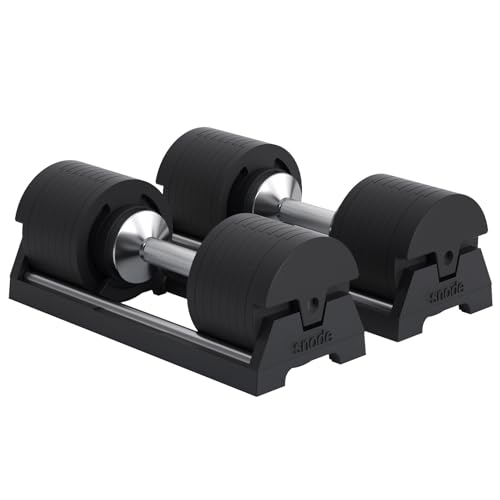
The SNODE AD85 is one of the few adjustable dumbbell pairs on Amazon UK that genuinely goes to 40kg per hand, and it does it in cast iron rather than plastic-shrouded plates. At £584 it's a fair price for 80kg of iron with a quick selector and a claimed 80cm drop rating. What stops it scoring higher is the gap between settings: 4.5kg steps, then a 7kg leap at the top, on a dumbbell that's 49cm long. Buy it if you press and row heavy; look elsewhere if most of your training is raises and curls.
How we review
This review is based on research into SNODE's Amazon UK listing, retailer spec sheets for the AD85 and how the AD85 compares with the adjustable dumbbells we've already reviewed. We haven't run our own long-term test of this exact pair, so we report the specs as SNODE states them and flag where a claim (such as the drop rating) isn't independently verified.
The AD85 suits someone who already lifts and has outgrown the 20 to 25kg ceiling of most dial dumbbells. If you can row 30kg-plus per hand, do heavy goblet squats or press a 28kg dumbbell for reps, this pair has headroom that the NordicTrack Select-A-Weight (25kg) and most twist-handle sets simply don't. It's also aimed at people who are a little rough with their kit, since the all-iron build and dovetail locking are its main selling points.
It's a poor fit for beginners. The lightest setting is 6kg, which is already heavy for lateral raises if you're new, and the 4.5kg steps mean you'll stall on small-muscle exercises long before you stall on big ones. Our guide to what weight dumbbells you should use gives sensible starting loads by exercise if you're unsure where you sit.
Pros
Genuine 40kg per dumbbell, 80kg of iron across the pair
Cast iron plates rather than plastic shells over the weights
Rotating ring selector, so you don't have to twist the whole handle or move pins
Dovetail slots and a claimed 80cm drop rating give some margin for accidents
Works out at roughly £7.30 per kilo of iron, competitive for a selector system
Cons
4.5kg steps for most of the range, then a 7kg jump from 33kg to 40kg
49.1cm long at every weight, which gets in the way on curls and presses
6kg minimum is heavy for raises if you're starting out
Usually dispatched within 2 to 3 weeks on Amazon UK
No stand mentioned in the listing, and SNODE's UK support details are thin
Design and how it adjusts
Most adjustable dumbbells use one of two systems. A dial at each end (Bowflex, NordicTrack) or a twist of the whole handle (BRAINGAIN, Newpower) selects how many plates the handle picks up from its cradle. The AD85 does something slightly different: a rotating ring on the dumbbell selects the weight, and you then lift the handle out with the chosen plates attached. In practice it works like other cradle-based systems (set it down, select, lift), so the speed is similar to a dial, but it avoids the slightly awkward wrist rotation of twist-handle designs.
The plates are cast iron with dovetail slots that interlock, which is how SNODE justifies the drop-proof claim. That matters more than it sounds, because the classic failure on cheap selector dumbbells is a plate that shakes loose after a few hard knocks. Our how adjustable dumbbells work explainer covers why the locking mechanism is usually the weak point.
The handle is 11.5cm long with a 3.6cm diameter. That's a thick-ish grip, which some lifters like on rows and presses because it spreads the load across the palm, though people with smaller hands may find their grip goes before their back does on heavy rows. The set ships in four parts.
SNODE AD85 key specs (per dumbbell unless stated)
Sold as
Pair (two dumbbells)
Weight range
6kg to 40kg
Settings
8: 6, 10.5, 15, 19.5, 24, 28.5, 33, 40kg
Selector
Rotating ring
Plates
Cast iron with dovetail slots
Claimed drop rating
80cm (manufacturer claim)
Dimensions
49.1 x 19.8 x 18cm
Handle
11.5cm long, 3.6cm diameter
Delivery
Ships in four parts
Warranty
Not stated on the UK listing
Amazon UK price
£584.00 at time of writing
The weight jumps are the real problem
Eight settings across a 34kg range means big gaps, and there's no way around that. Going from 19.5kg to 24kg on a dumbbell bench press is a 23% increase in load, which is a large step even for an experienced lifter; on a shoulder press or a single-arm row it can be the difference between eight good reps and three ugly ones. The final jump from 33kg to 40kg is bigger again, at just over 21%, and there's nothing in between.
You can work around it. Add reps at one weight until you're well past your target range before moving up, slow the lowering phase, or pause at the bottom. Those methods do work, and the NHS guidance on strength training only asks that you work all the major muscle groups on at least 2 days a week, to the point where you need a short rest. The WHO 2020 guidelines likewise recommend moderate or greater intensity strength work on 2 or more days a week. But it's fiddlier than simply picking up a dumbbell 2kg heavier, and for lateral raises, curls and triceps work the AD85 will feel blunt. Compare the Newpower Fitness 36kg set, which moves in 2kg steps.
Length and how it feels in use
Every adjustable dumbbell is longer than a fixed one of the same weight, because the frame has to hold the full plate stack even when you're only using two plates. The AD85 is at the long end at 49.1cm. On a dumbbell bench press that means the outer ends can touch at the top if you bring them together, and on hammer curls the inner plates can brush your thighs. Neither is a deal-breaker, but if you're used to hex dumbbells it takes a week or two to adjust your groove.
The upside of all that iron is density: the plates are cast iron throughout, so the weight sits compactly in the cradle instead of being bulked out by plastic shells, which is part of why the frame is long rather than tall.
Price and value against our other reviews
£584 isn't cheap, but you need to divide it by what you get. Across the pair there's 80kg of cast iron, so roughly £7.30 per kilo. The BRAINGAIN 40kg set costs around £369 but the numbers point to about 20kg per hand, so per kilo of usable weight the SNODE is the better deal. The NordicTrack Select-A-Weight has a smoother dial and finer steps but stops at 25kg. The PowerBlock Elite EXP remains our favourite for durability and expandability, starting at 5 to 50lb (about 2.3 to 22.7kg) and growing to 90lb with add-on kits, though the extra kits push its total cost well past the SNODE's.
If you're still weighing up whether any selector set beats a rack of fixed weights, our piece on whether adjustable dumbbells are worth it runs the cost and space maths. For a strong lifter with limited floor space, the AD85 replaces eight pairs of fixed dumbbells weighing 352kg in total, which no spare room will thank you for.
The 2 to 3 week dispatch time is the other thing to factor in. It doesn't change the product, but you're paying £584 and waiting most of a month to train with it.
Is the SNODE AD85 40kg per dumbbell or 40kg in total?
40kg per dumbbell. You get a pair, and each one adjusts from 6kg to 40kg, so the set holds 80kg of iron in total. That's a lot more than the many '40kg' adjustable sets on Amazon that turn out to be 20kg per hand.
What weights does the SNODE AD85 go up in?
There are eight settings per dumbbell: 6, 10.5, 15, 19.5, 24, 28.5, 33 and 40kg. That's a 4.5kg jump between most settings and a 7kg jump from 33kg to 40kg at the top, which is coarse for shoulder and arm work.
Can you drop the SNODE AD85?
SNODE claims the AD85 is drop-proof from 80cm, helped by dovetail slots that lock the cast iron plates together. We haven't drop-tested it ourselves, and no independent standard backs the figure, so treat it as a margin for accidents rather than an invitation to throw it down after every set.
How long is the SNODE AD85?
Each dumbbell measures 49.1 x 19.8 x 18cm, so it's close to half a metre long at every setting, because the unused plates stay in the cradle but the frame doesn't shrink. That length can clip your thighs on curls and gets in the way at the bottom of a dumbbell press.
Why does the SNODE AD85 take weeks to arrive?
At the time of writing, Amazon UK lists it as usually dispatched within 2 to 3 weeks. That's a stock and shipping issue rather than a fault with the dumbbells, but if you want to start training this weekend it rules the AD85 out.
How Apple Watch estimates VO2 max (Cardio Fitness), where to find it in the Health app, how accurate it is against lab tests, how to raise it and how it compares to Garmin.
Fitbit Charge 6 vs Inspire 3 compared: built-in GPS, ECG, Google Wallet, battery, size and price. Our clear verdict on which tracker suits you in the UK.
Fitbit Charge 6 vs Versa 4 compared on screen, ECG, heart rate broadcast, calls, battery, GPS and price, with a clear verdict on which one UK buyers should pick.
Fitbit Versa 4 vs Sense 2 compared: same design, GPS and 6+ day battery, but the Sense 2 adds ECG and a cEDA stress sensor. Which is worth the extra £45?
Best Exercise is a participant in the Amazon EU Associates Programme, an affiliate advertising programme designed to provide a means for sites to earn advertising fees by advertising and linking to Amazon.co.uk. As an Amazon Associate we earn from qualifying purchases. This comes at no extra cost to you and never influences our independent reviews or rankings.