Treadmills
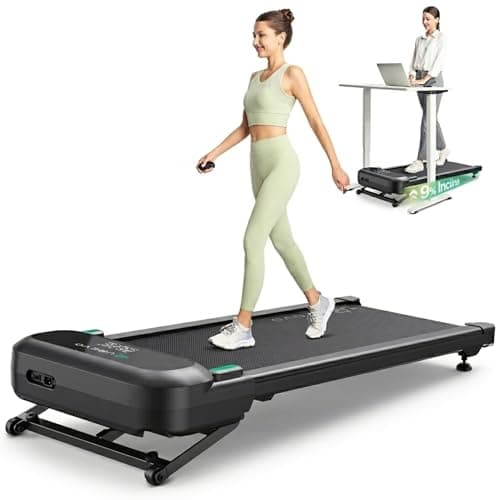
UREVO SpaceWalk 5L Review: A Quiet Incline Walking Pad
Our honest UREVO SpaceWalk 5L walking pad review: 9% auto incline, dual brushless motor, 136kg limit and a narrow 40x100cm deck, for £349.99 on Amazon UK.

By Paul Kendrick, Cardio & Endurance Editor · Updated 27 October 2026
A non-electric treadmill is one with no motor: you move the belt yourself, so there's nothing to plug in. They come in two very different forms. Cheap flat manual treadmills cost about £100 to £250 and suit short, brisk walks, while curved self-powered treadmills like the Assault AirRunner and Woodway Curve cost £2,000 or more and are built for hard running and sprints. For most people wanting a home treadmill, a motorised machine is still the better buy, and this guide explains exactly where each non-electric type earns its place.
Search Amazon for a manual treadmill and you'll see a £140 folding machine next to a £5,000 slatted one, both labelled non-motorised. They share the "no motor" part and almost nothing else.
These are the budget machines. The deck is a normal fabric belt running over rollers, but because there's no motor to turn it, the whole deck sits at a fixed incline, typically somewhere around 10% to 14%. Gravity plus your footstrike pushes the belt backwards. Lean into the handrails and walk, and the belt goes round.
Some add a magnetic resistance knob (sold as a "magnetic treadmill") that brakes a small flywheel so the belt feels heavier or lighter. A battery-powered LCD usually shows time, distance and an estimated calorie count. The Sunny Health & Fitness SF-T1407M, one of the better-known examples, has a fixed incline of roughly 13.5%, folds up and is light enough to carry between rooms.
What they're like to use is the part listings skip. The belt can feel sticky and jerky at the start of each stride, the decks are short, and the incline never changes. Most people end up holding the handrails, which is fine for walking but cuts the work your legs and core do.
This is the other end of the market: Woodway Curve, Assault AirRunner, TrueForm Runner and similar. The running surface is a concave U shape made of rubber-topped slats on bearings rather than a fabric belt. Step forward onto the rising front of the curve and the belt speeds up; drift back towards the bottom and it slows. Your position is the speed control.
They're heavy (often 130kg or more), long, noisy at speed and expensive, but they're superb for sprints and intervals. We cover how they work in detail in our curved treadmill guide.
| Flat manual treadmill | Curved self-powered treadmill | Motorised treadmill | |
|---|---|---|---|
| Typical UK price | £100 to £250 | £2,000 to £6,000+ | £200 to £3,000+ |
| Power | Your legs plus fixed incline | Your legs on a curved deck | Mains electricity |
| Incline | Fixed, steep (around 10% to 14%) | Built into the curve | Adjustable on most models |
| Best for | Short brisk walks | Sprints, HIIT, HYROX | Walking and steady running |
| Running | Poor beyond a slow jog | Excellent | Good to excellent |
| Slow, steady walking | Okay, but tiring | Awkward | Easiest |
| Noise | Quiet to moderate | Loud slat clatter | Motor hum plus footfall |
| Folds | Usually | No | Often |
| Running costs | None (display battery) | None | Electricity, belt lubrication |
On a motorised treadmill the belt does part of the job of pulling your foot backwards. Take the motor away and you supply all of that force yourself, so the same speed costs more energy.
The best data comes from curved machines. A crossover study at High Point University found walking at about 4.8kph cost 5.9 METs on a non-motorised curved treadmill against 3.4 METs on a motorised one, and running at about 8kph came out at 10.7 versus 7.3 METs (Smoliga et al., 2015). A University of Essex study of 13 trained runners went further: on the curve, oxygen uptake ran about 32% higher and heart rate about 17% higher across every speed tested, and not one runner could finish four minutes at 80% of their top treadmill speed (Schoenmakers and Reed, 2018).
We couldn't find comparable lab studies on the cheap flat manual machines, so we won't put numbers on them. What we can say is that walking up a 13% slope while dragging a belt is plainly harder than strolling on a flat motorised deck, and that's the main reason they feel like a workout so fast.
There's a catch. Both studies above found people pick slower speeds, or tire sooner, without a motor. Run by feel and some of that extra calorie burn disappears.
A 2021 study of 27 recreational runners measured lower impact accelerations at the shin and head on a curved non-motorised treadmill than on a motorised one at matched speeds, while heart rate and perceived effort were higher (Encarnación-Martínez et al., 2021). That's one study on healthy runners. Don't assume a £150 flat manual treadmill shares the benefit; its thin deck and short rollers offer far less cushioning than a decent motorised machine.
Both types are free to run and have no motor controller to fail, which is genuinely useful in a garage, a shed or a room with no spare socket. Maintenance on a flat manual model is mostly keeping the belt centred and checking bolts. Curved machines need the occasional slat and bearing check.
Walking. A flat manual treadmill handles brisk walking in sessions of 15 to 30 minutes, and the steep incline makes even a slow pace work your calves and glutes. Long walks are another story; the fixed slope tires your calves and shins, and you can't drop it to rest. Curved treadmills are oddly bad at slow walking, because holding 4kph takes constant tiny corrections to stay in the same spot on the curve.
Running. Here the two types split completely. On a short, inclined flat manual deck, anything beyond a light jog feels cramped and unstable, and the belt can stutter under a heavier footstrike. Most manufacturers pitch them as walking machines for that reason. A curved treadmill is the opposite: it's built for running, and you can go from a jog to a flat-out sprint in a couple of strides. If you're unsure which suits your plan, our walking pad vs treadmill comparison covers the walking side in more depth.
Buy a flat manual treadmill if you want the cheapest possible way to walk indoors, you only plan short brisk sessions, you have no convenient socket, or you need something light that folds and moves between rooms. Accept that it's a walking machine with a fixed hill built in, not a running treadmill.
Buy a curved self-powered treadmill if you're a sprinter, team-sport athlete or HYROX competitor, you train mostly with intervals, and you have the budget, a ground-floor room and tolerant neighbours. Gyms and PT studios get the most from them.
Buy a motorised treadmill if you want to run steadily, walk for long periods, use programmes or adjustable incline, or simply want one machine that does a bit of everything. That's most people. Our pick of the best treadmills under £200 shows how little you now need to spend for a motor, and the best treadmills for home use covers the mid-range and premium end. Spend around £400 and something like the Toputure folding treadmill adds a 12% incline and a 16km/h top speed, which no manual model can touch.
Check the listing before you buy
Plenty of Amazon walking pads with "manual incline" in the title still have a motor; the "manual" refers to propping the incline by hand. If the listing mentions horsepower (HP) or a motor, it's electric. A true non-electric treadmill will say non-motorised, non-electric or self-powered.
If you've weighed it up and a cheap manual walker suits you, the Sunny Health & Fitness SF-T1407M is the one we'd point you to. It's a non-electric model with a fixed incline of around 13.5% to 14%, folds for storage, has a battery LCD for time, distance and calories, and was in stock at about £143 on Amazon UK on 27 October 2026. Prices move, so check the current figure. Treat it as a walking machine: it's not built for running, and the steep fixed slope is the workout.
Check price on AmazonIt's a treadmill with no motor, so your own legs move the belt. There are two kinds: cheap flat-belt manual treadmills (about £100 to £250) that sit at a fixed incline so gravity helps the belt turn, and curved self-powered treadmills like the Assault AirRunner and Woodway Curve that cost £2,000 or more. Neither needs a plug socket, though some have a battery-powered display.
On a cheap flat manual treadmill, not really. The short deck, steep fixed incline and heavy belt make anything faster than a brisk walk or slow jog awkward and tiring. Curved self-powered treadmills are the opposite: they're built for running and sprinting, and many athletes and HYROX gyms use them for intervals.
At the same speed, yes. In a 2015 study, running at a matched pace on a curved non-motorised treadmill cost about 10.7 METs against 7.3 METs on a motorised treadmill. Cheap manual treadmills also feel harder because you're dragging the belt up a fixed slope. The catch is that people naturally go slower on them, which eats into the difference.
A budget manual treadmill is fine for short, brisk walks of 15 to 30 minutes if you want something cheap, quiet and plug-free. For long daily walks or walking while you work, a walking pad or motorised incline treadmill is easier on your legs and holds a steady pace for you.
For most home users, no. An electric treadmill holds a pace, adjusts incline, cushions better and suits both walking and running. A manual treadmill wins only on upfront price, zero running costs and not needing a socket. A curved self-powered treadmill beats electric for sprints and HIIT but costs far more.
Our honest UREVO SpaceWalk 5L walking pad review: 9% auto incline, dual brushless motor, 136kg limit and a narrow 40x100cm deck, for £349.99 on Amazon UK.
Walking pad vs treadmill compared on deck size, top speed, motor, incline, weight limit, storage and UK price, with a clear verdict on which one to buy.
What a curved treadmill is, how the self-powered slat belt works, what research says about calorie burn vs motorised treadmills, and whether one suits you.
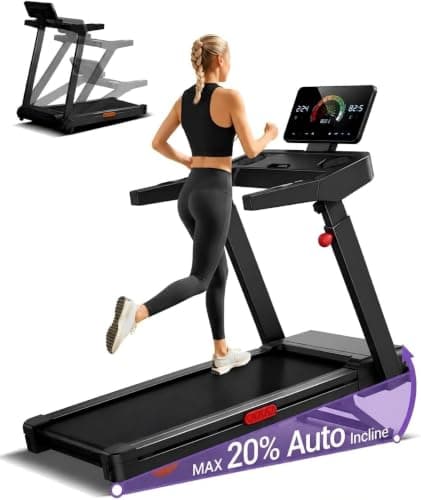
An honest UMAY 20% incline treadmill review: 3.5HP, 14km/h, a 108 x 40cm belt and a 180kg rating for around £240, plus the listing claims we'd question.
Best Exercise is a participant in the Amazon EU Associates Programme, an affiliate advertising programme designed to provide a means for sites to earn advertising fees by advertising and linking to Amazon.co.uk. As an Amazon Associate we earn from qualifying purchases. This comes at no extra cost to you and never influences our independent reviews or rankings.