Rowing Machines
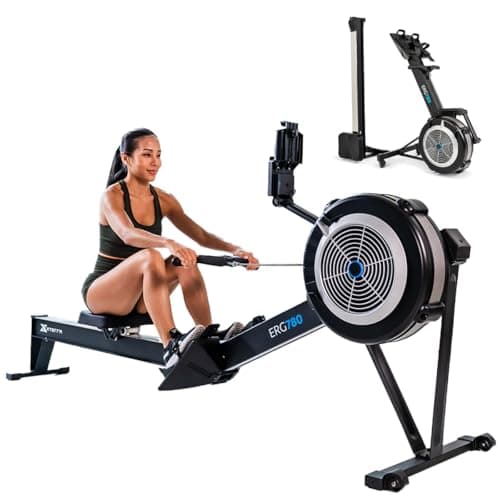
Xterra ERG780 Review: A Folding Air Rower at Half Concept2 Money
Our Xterra ERG780 air rower review covers the 10-level damper, Bluetooth FTMS app support, noise, monitor accuracy, folding storage and how it compares with a Concept2.

By Jacob Chambers, Founder & Lead Reviewer · Updated 28 July 2026
We may earn a commission from qualifying purchases made through links on this page, at no extra cost to you. This never affects our ratings.
Concept2 has owned the home rowing market for so long that the standard advice has calcified into a single sentence: buy a Concept2, buy a used Concept2, or don't buy a rower. At £990 for the current RowErg that's a lot of money to accept on faith, and the alternatives have historically deserved their reputation, with light fans, vague monitors and rails too short for anyone over six foot.
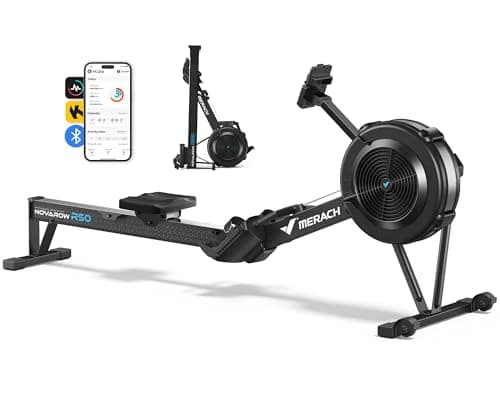
The MERACH R50 Pro is the first budget air rower I've looked at that seems to have been designed by someone who actually rows. At around £484 it's half the money, and the specification sheet suggests MERACH has spent it in the right places.
How we review
This review draws on MERACH's published specifications, independent expert testing of the R50 platform, and repeated themes across verified owner reviews on Amazon UK. We have not put months of metres on this machine ourselves, so we report consistent findings rather than a single impression, and we flag where the long-term picture is genuinely unknown.
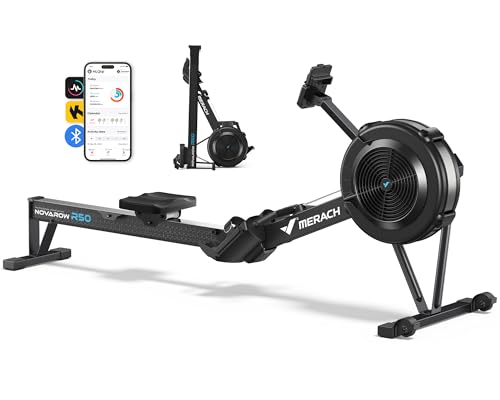
Air rowers live or die on the flywheel, and MERACH has gone with a 32-blade fan and a ten-position lever that changes how much air reaches it. That's a proper mechanism rather than a magnet pretending to be one, and it produces the behaviour you actually want from a rower: the resistance rises with the speed of your stroke, so pulling harder makes it harder, in the same way a boat does. Peak resistance is quoted at up to 110lb.
The flywheel itself is 3.5kg, which is on the light side, and it's the clearest place the machine differs from a Concept2. A heavier wheel carries more momentum between strokes and smooths out the dead spot at the catch. On the R50 Pro the recovery feels a fraction quicker and the catch a fraction sharper. Whether you notice depends on whether you've rowed on a Concept2 recently.
Check price on Amazon| Resistance | Air, 32-blade fan, 10 manual levels |
|---|---|
| Flywheel weight | 3.5kg |
| Peak resistance | Up to 110lb |
| Monitor | 5.3 inch backlit LCD, 20+ training modes |
| Metrics | Time, distance, calories, strokes, SPM, watts, drag factor, pulse |
| Connectivity | Bluetooth 5.0, MERACH app and Kinomap |
| Rail | Stainless steel, 1,365mm track, 1,200mm inseam |
| Footprint in use | 2,380 x 610 x 1,022mm |
| Folded | 635 x 835 x 1,370mm, separates into two parts |
| Weight | 33.3kg net, 40.8kg boxed |
| Seat height | 380mm from the floor |
| Warranty | 2 years |
Specifications above come from MERACH's official R50 product page.
Most sub-£500 rowers give you a monitor that counts strokes and invents a calorie figure. This one reports watts and drag factor, and those two numbers are what separate a rowing machine from an exercise machine with handles.
Watts is your actual power output, unaffected by how the manufacturer has calibrated anything, so it's the only honest way to compare one session with another or one machine with another. Drag factor tells you how the fan is set, which lets you reproduce a session exactly rather than guessing where the lever was last Tuesday. Anyone following a structured programme needs both.
The screen is a 5.3 inch backlit LCD, with a tablet stand above it at an adjustable angle. Twenty workouts store offline and sync when you're back in range. It's not a touchscreen and it doesn't stream classes, which is the correct decision at this price.
The 1,200mm inseam is the specification tall buyers should look at first, because it's where cheap rowers usually fail. Plenty of budget machines run out of rail at around six foot, leaving taller users unable to reach full compression at the catch. This one has room, and the 380mm seat height makes getting on and off easy for anyone with dodgy knees.
Noise is the honest drawback, and it applies to every air rower ever made. Rowing hard sounds like a large desk fan running at full speed, roughly comparable to a hoover in the next room. In a garage or a spare room that's fine. In a first-floor flat with neighbours below, buy a magnetic rower instead and accept the less realistic feel; our best rowing machine UK guide covers both types.
For a home gym, I think so, and the £500 you save is real money that could go towards a weight bench or adjustable dumbbells.
The case for spending the extra on a Concept2 Model D rests on three things, and none of them is stroke feel by much. It holds its value, so a used one after five years costs you relatively little in depreciation. Its spares are available for machines built in the 1990s. And its PM5 monitor is the standard that every rowing programme, ranking and online race is written around. If you plan to race or you want the machine to be a lifetime purchase, that ecosystem matters.
If you want to row three times a week in a garage and you'd rather not spend a grand doing it, the R50 Pro gives you most of the experience for around half the price.
Rowing is the most complete cardio machine in a home gym, and the reason is simply that it moves more muscle than the alternatives. Competitive rowing draws roughly 75 to 80 percent of its energy from aerobic metabolism while demanding real muscular strength across the legs, back and arms (Physiological and Mechanical Responses to a Graded Exercise Test in Traditional Rowing, IJERPH, 2023), which is why a hard 2,000 metre piece leaves you in a worse state than almost anything else you can do indoors.
It's also low impact, which is the practical argument. Thirty minutes on a rower five times a week gets you comfortably past the NHS target of 150 minutes of moderate activity per week without the joint loading of running. The catch is technique: rowing badly for months teaches you to row badly and grumbles your lower back. Spend the first fortnight on the legs-body-arms sequence before you chase split times.
Not quite, and it costs roughly half as much. The stroke feel is genuinely close, the monitor reports the metrics that matter including watts and drag factor, and the rail length suits tall users. Where the Concept2 still wins is the flywheel damping, the resale value, and a spares supply that stretches back two decades. For a home gym, the R50 Pro is the better value; for a rowing club, it is not.
It is 2,380mm long and 610mm wide in use, so allow roughly 2.4 metres by 1.2 metres including room to get on and off. The frame separates into two parts for vertical storage, which brings the footprint down to about 635mm by 835mm against a wall. It weighs 33.3kg, so moving it is a two-handed job rather than a two-person one.
For technique and interval training, yes. Air resistance scales with how hard you pull, so a lazy stroke feels light and a hard one feels heavy, which is exactly how a boat behaves. The trade-off is noise: an air rower under load sounds like a desk fan on full, and that rules it out for flats with thin floors. Magnetic rowers are quieter and less honest.
The monitor reports drag factor, which is the useful part, and the ten-position lever changes how much air the fan takes in. Most rowers should sit around the lower to middle settings rather than winding it to ten, since a high drag factor mainly teaches you to row slowly and heavily. Treat the lever as a gearing choice, not a difficulty setting.
It connects over Bluetooth 5.0 to the MERACH app and to Kinomap, which covers scenic routes and structured sessions. Zwift support for rowing machines is limited generally, so do not buy it on that basis. Twenty offline workouts are stored on the monitor and sync afterwards, which is handy if the garage has poor signal.
It arrives about 90 percent assembled and most owners are rowing within 30 to 45 minutes. The heavier part is lifting the 40.8kg boxed unit into position, so unpack it where you intend to use it rather than carrying the assembled machine through a doorway.
Our Xterra ERG780 air rower review covers the 10-level damper, Bluetooth FTMS app support, noise, monitor accuracy, folding storage and how it compares with a Concept2.
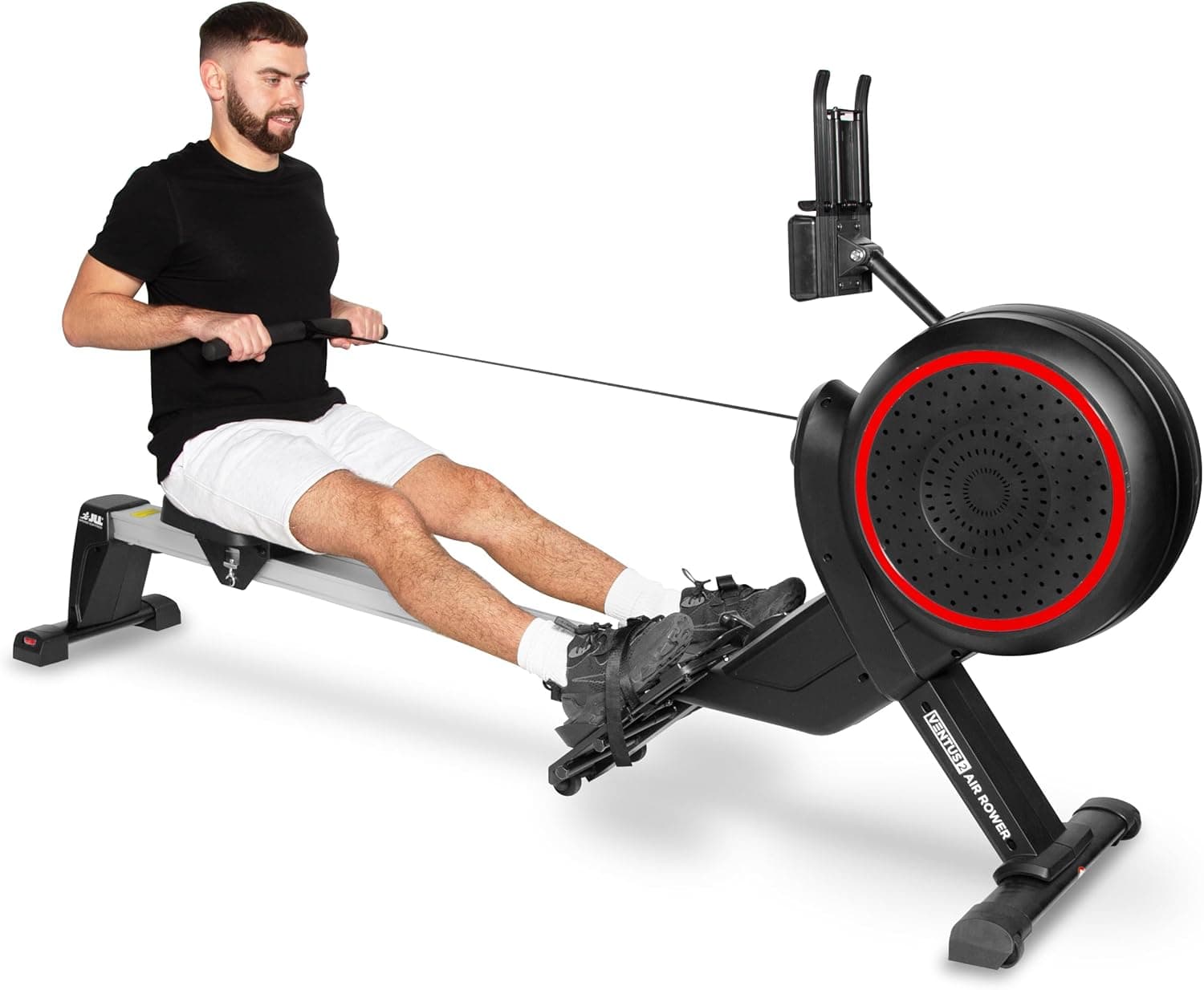
The best foldable rowing machines in the UK for 2026, compared on folded footprint, rail length and weight limit. Picks from JLL, DMASUN, YPOO, Viavito and MERACH for every budget.
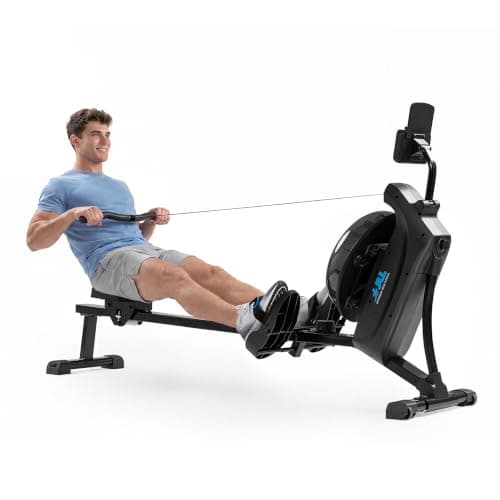
An honest JLL water rowing machine review of the dual resistance rower: the 60 degree tank, 16 magnetic levels, 130cm rail, 150kg capacity, SunnyFit app and who it suits.
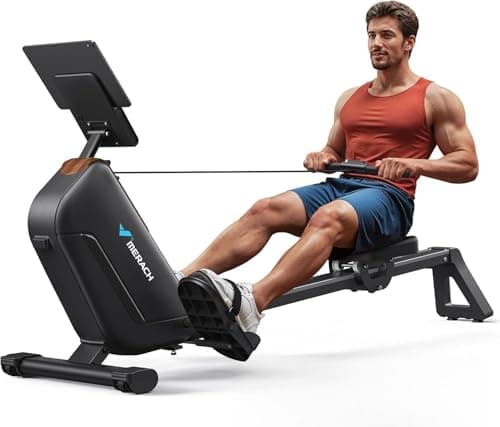
An honest MERACH R15 Pro review: 40kg peak electromagnetic resistance, 16 levels adjusted from the handlebar, a 130cm rail, 158kg capacity and who this £300 rower suits.
Best Exercise is a participant in the Amazon EU Associates Programme, an affiliate advertising programme designed to provide a means for sites to earn advertising fees by advertising and linking to Amazon.co.uk. As an Amazon Associate we earn from qualifying purchases. This comes at no extra cost to you and never influences our independent reviews or rankings.