Cross Trainers
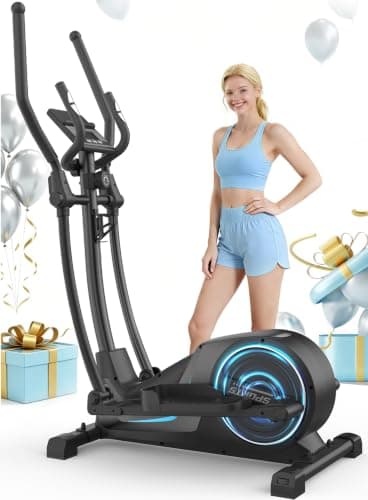
Cowmew Cross Trainer Review: 8kg Flywheel and 150kg Limit for £250
An honest Cowmew cross trainer review: 8kg flywheel, 16 manual magnetic levels, 150kg limit and Bluetooth for £249.99, plus the stride length Cowmew won't publish.

By Paul Kendrick, Cardio & Endurance Editor · Updated 4 November 2026
Yes, a cross trainer is good for weight loss, with two conditions attached. You have to work at a real effort, and you have to keep eating less than you burn. At a vigorous pace it burns about the same as running at 5 to 6 mph, roughly 315 kcal in 30 minutes for a 70kg person, and your feet never leave the pedals, so there's no impact to wreck your knees. But the machine doesn't cause weight loss by itself; a calorie deficit does, and the cross trainer is one of the easiest ways to widen it week after week.
The most useful numbers come from the Compendium of Physical Activities, the research database exercise scientists use to estimate energy cost. It lists the elliptical trainer at 5.0 METs for moderate effort (code 02048) and 9.0 METs for vigorous effort (code 02049). One MET is roughly what you burn sitting still, so vigorous elliptical work costs about nine times your resting rate.
To turn METs into calories, use this:
kcal = MET x body weight (kg) x hours
So a 70kg person doing 30 minutes (0.5 hours) at vigorous effort burns 9.0 x 70 x 0.5 = 315 kcal. Here's how that compares with other cardio, using values from the same Compendium:
| Activity (Compendium code) | MET | 70kg, 30 min | 90kg, 30 min |
|---|---|---|---|
| Elliptical, moderate (02048) | 5.0 | 175 kcal | 225 kcal |
| Elliptical, vigorous (02049) | 9.0 | 315 kcal | 405 kcal |
| Running, 5 mph / 12 min mile (12030) | 8.5 | 298 kcal | 383 kcal |
| Running, 6 mph / 10 min mile (12050) | 9.3 | 326 kcal | 419 kcal |
| Stationary bike, 101 to 125 watts (01224) | 6.8 | 238 kcal | 306 kcal |
| Rowing machine, general vigorous (02070) | 7.3 | 256 kcal | 329 kcal |
Two things jump out. Hard elliptical work lands between a 12 minute mile and a 10 minute mile jog, which is a lot better than its reputation as the "easy" machine suggests. And body weight matters a great deal: the 90kg person burns about 29% more for an identical session, which is why heavier beginners often see faster early results.
The catch is the gap between the moderate and vigorous rows. Pedalling along at 5.0 METs while scrolling your phone burns barely more than half of a properly hard session. Rowing and cycling both climb higher than the elliptical if you push big wattage (the Compendium has stationary rowing at 11.0 METs for 150 to 199 watts), so the cross trainer isn't the top calorie burner on paper. Its strength is that you can sustain a high effort for longer without your joints complaining. For a fuller head to head, see our rowing machine vs cross trainer comparison.
The NHS asks adults to do at least 150 minutes of moderate activity or 75 minutes of vigorous activity a week, plus strength work on two days. That's the health baseline. For weight loss you'll probably need more.
The American College of Sports Medicine's position stand on physical activity for weight loss found that 150 to 250 minutes of moderate activity a week produces only modest weight loss on its own; clinically meaningful loss showed up above 250 minutes a week, or when exercise sat alongside a moderate diet. In practice that means four or five sessions of 40 to 50 minutes, or a mix of shorter hard sessions and longer easy ones.
Do the maths on a realistic week. Suppose an 80kg person does three 30 minute vigorous sessions and two 45 minute moderate ones: that's 1,080 kcal from the hard sessions plus 600 kcal from the easy ones, about 1,680 kcal a week. Useful, but it's roughly a single takeaway and a few drinks. Exercise widens the deficit; it can't outrun a diet that's drifting the other way.
This plan assumes you can already manage 20 minutes of easy pedalling. Use a 1 to 10 effort scale: 5 is a pace where you can talk in sentences, 8 is a few words at a time, 9 is close to flat out. Every session starts with 5 minutes easy and ends with 5 minutes easy, which aren't counted below.
| Week | Session A (intervals) | Session B (steady) | Session C (mixed) | Weekly total |
|---|---|---|---|---|
| 1 | 8 x 30s at effort 8, 90s at effort 4 | 25 min at effort 5 to 6 | 20 min steady, last 5 min reverse stride | About 105 min |
| 2 | 10 x 30s at effort 8, 90s at effort 4 | 30 min at effort 6 | 25 min steady with 4 x 1 min hill climbs | About 125 min |
| 3 | 6 x 1 min at effort 8 to 9, 1 min at effort 4 | 35 min at effort 6 | 30 min, alternate 5 min forward and 5 min reverse | About 145 min |
| 4 | 8 x 1 min at effort 8 to 9, 1 min at effort 4, plus a 4th steady 30 min session | 40 min at effort 6 | 30 min with 5 x 2 min at effort 7 | About 185 min |
For intervals, raise the resistance rather than just spinning your legs faster; a high cadence on a low setting feels busy but burns less than you'd think. If a session leaves you wrecked for two days, drop back a week. Our cross trainer workout guide has five more sessions with exact timings once this block is done.
The moving handles are there to do work, not to hold you up. Push and pull them actively, and you'll bring your chest, back, shoulders and arms into the session; more working muscle at the same leg effort tends to mean a higher heart rate. Our breakdown of cross trainer muscles worked explains which handle action loads which muscles.
Resistance is the main dial. As a rule of thumb, if you can hold a cadence above about 70 rpm with no effort at all, the setting is too low for anything but a warm up. Most home machines give you 8 to 32 levels, and the useful range for weight-loss intervals is usually the top half.
Some cross trainers have a motorised ramp, and raising it shifts the work towards your glutes and hamstrings and makes the same resistance feel harder. On machines without one, reverse pedalling gives a similar change of emphasis. Stride matters too: a short 30 to 35cm stride on a cheap compact model feels choppy for anyone over about 5ft 8in, and choppy strides are hard to sustain at effort 8. The 42cm stride on the Aeriflo M100 suits most people under about 5ft 10in, while the JLL CT300 is a stripped-back option with a small footprint if floor space is the bigger problem.
Leaning on the handles. Gripping the fixed handlebars and letting your arms take your body weight unloads your legs. Stand tall with your weight over your feet; if you need the fixed bars to stay upright, the resistance is too high for that cadence.
Living on a low resistance setting. Plenty of people pedal at level 3 for 45 minutes and wonder why nothing changes. That's closer to the 5.0 MET row in the table than the 9.0 one.
Trusting the console calories. Many consoles assume a default body weight unless you enter yours, and none of them know you were leaning on the frame. Use the figure to compare your own sessions over time, never as a licence to eat. Our explainer on active calories vs total calories covers why fitness tech numbers often run high.
Doing the same session every day. Your body gets more efficient at a repeated effort. Rotate intervals, steady work and hills as in the plan above.
Skipping strength training. The ACSM paper found resistance training doesn't add much to weight loss directly, but it may help preserve lean mass and increase fat loss. Two short strength sessions a week alongside your cardio covers the NHS guideline too.
Weight loss happens when, across weeks, you eat fewer calories than you use. A cross trainer adds a few hundred calories a session to the "use" side; the "eat" side is where most of the deficit usually comes from. A modest daily cut of around 300 to 500 kcal, plus four or five cross trainer sessions a week, is a pace most people can keep up without feeling miserable.
Expect hunger to rise a little when you start training more, and plan for it with higher-protein meals rather than post-workout treats. Weigh yourself under the same conditions once or twice a week and look at the monthly trend, along with a tape measure round your waist, because daily scale readings swing with water and food.
The short version
A cross trainer works for weight loss when you push the resistance, drive with your arms, rack up 150 to 300 minutes a week and keep a steady calorie deficit. It burns close to running at the same effort with none of the impact, which is why it suits heavier beginners and anyone with sore knees.
If you're still choosing a machine, our best cross trainer UK roundup compares stride length, flywheel weight and resistance range across the models worth buying, and the cross trainers hub lists every review we've published.
Yes, provided you work at a genuine effort. At a vigorous pace a cross trainer burns roughly the same calories as running at 5 to 6 mph, with no landing impact. It only produces weight loss if your weekly calorie intake stays below what you burn, so pair it with sensible eating.
Using the Compendium of Physical Activities values, a 70kg person burns about 175 kcal in 30 minutes at moderate effort and about 315 kcal at vigorous effort. A 90kg person burns about 225 kcal and 405 kcal respectively. Heavier people burn more for the same session.
Aim for at least 150 minutes a week, the NHS minimum, and build towards 200 to 300 minutes if weight loss is the goal. The American College of Sports Medicine found that 150 to 250 minutes a week gives only modest weight loss on its own, with bigger results above 250 minutes or alongside a moderate diet.
Not better, but close at matched effort and far easier on the joints. Vigorous elliptical work sits at 9.0 METs against 9.3 for running at 6 mph. The real advantage is that most people can do more weekly minutes on a cross trainer without sore knees or shins, and total weekly volume is what matters.
It can help you lose fat overall, which includes belly fat, but no machine targets one area. Where you lose fat first is largely down to genetics. A steady calorie deficit plus regular cardio and some strength training is the reliable route to a smaller waist.
Treat them as a rough guide. Many consoles assume a default body weight unless you enter yours, and none of them can tell if you're leaning on the handles. Use the number to compare your own sessions, not to decide how much to eat.
An honest Cowmew cross trainer review: 8kg flywheel, 16 manual magnetic levels, 150kg limit and Bluetooth for £249.99, plus the stride length Cowmew won't publish.
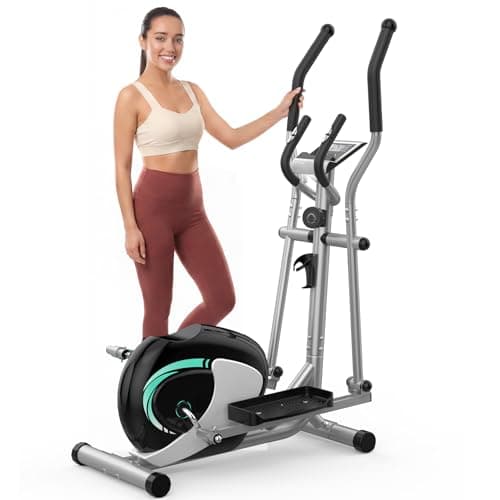
Dripex compact elliptical cross trainer review: the 6kg flywheel, 16 magnetic levels, 120kg limit, missing stride spec and who this £200 machine really suits.
Do under desk ellipticals work? What the research says on calorie burn and sitting less, motorised vs manual models, desk clearance, noise and who should buy one.
An honest review of the Reebok ZR8 elliptical cross trainer: build, magnetic resistance, stride length, who it suits and whether it's still worth the money in 2026.
Best Exercise is a participant in the Amazon EU Associates Programme, an affiliate advertising programme designed to provide a means for sites to earn advertising fees by advertising and linking to Amazon.co.uk. As an Amazon Associate we earn from qualifying purchases. This comes at no extra cost to you and never influences our independent reviews or rankings.