Home Gym
Best Reformer Pilates Machine UK 2026: 6 Foldable Home Picks
The best reformer pilates machines for home use in the UK in 2026, from a £259 foldable to a £788 wooden frame. Honest picks, real specs and how to choose a pilates machine.

By Mike Shilling, Recovery & Training Editor · Updated 3 August 2026
We may earn a commission from qualifying purchases made through links on this page, at no extra cost to you. This never affects our ratings.
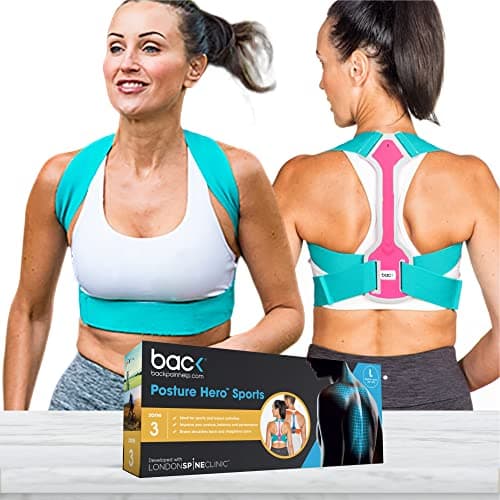
Most people buy a posture corrector hoping it will fix the way they sit, and it won't. That needs saying up front, because almost every product page in this category implies otherwise. A posture strap is a reminder. It pulls your shoulders back, tugs when you round forward and nags you into sitting up again, which is genuinely useful in the first few weeks while you're learning what your own slump feels like. What it cannot do is build the muscle that holds you upright once you take it off. Worn all day it can make things slightly worse, because a brace that does the holding lets the muscles that should be holding you stop bothering. The fix that lasts is strengthening the upper back and rear shoulders while loosening a tight chest and tight hip flexors, and no amount of elastic gets you there.
So buy the strap as a training wheel. Twenty minutes, a few times a day, alongside actual work on the muscles. With that framing, some of these are considerably better made than others, and the picks below are the ones worth your money on Amazon UK right now.
How we chose
This is a research-based round-up, not a long-term hands-on test. We went through owner reviews on Amazon UK, manufacturer specifications and published research on bracing and posture training to weigh up comfort, fit, adjustability, build quality and value. Nobody here wore each of these for six months. Prices and specs were correct at the time of writing and change often, so check the current listing before you buy.
| back Posture Hero Sports | Clavicle brace, around £38, Best Overall |
|---|---|
| SHAPERKY Posture Corrector | Full back brace with rigid panel, around £27, Best Full Back Support |
| Rakiie Posture Corrector | Adjustable shoulder strap, around £20, Best Budget |
| Tommie Copper Support Shirt | Compression top, around £51 (men), Best Under Clothes |
| Neo-G Back Support RX | Lumbar brace, around £48, Best for Lower Back |
| Schiara Posture Corrector | Figure-of-eight strap, around £18, Cheapest Worth Buying |
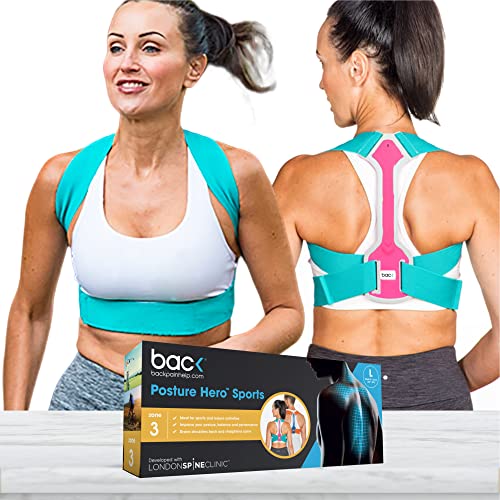
The Posture Hero Sports is made by the British brand "back", and it's the one we'd point most people towards. It's a clavicle-style brace: two loops over the shoulders, an adjustable strap across the upper back, and a design that draws the shoulder blades together rather than clamping your whole torso. The brand describes it as an award-winning posture support developed with physiotherapy input, and while awards mean less than fit, the fit is where this one earns its price.
What makes it work day to day is the padding and the profile. It sits flat enough to disappear under a jumper or a sweatshirt, the shoulder loops are broad rather than cord-thin, and the adjustment is fine enough that you can dial in a gentle cue instead of a yank. That last point matters more than people expect. A brace tightened to the point of discomfort gets taken off after ten minutes and never worn again, whereas one you barely notice actually gets used.
At around £38 it costs roughly double the budget straps here, and you're paying for materials and design rather than any extra function. It also gives you nothing at all for the lower back, so anyone whose problem is a sore lumbar spine rather than rounded shoulders should look at the Neo-G further down.
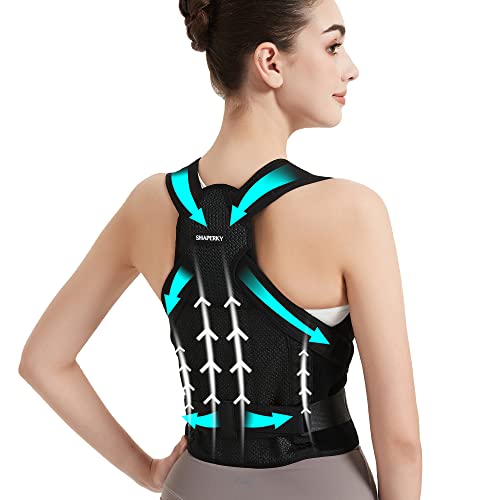
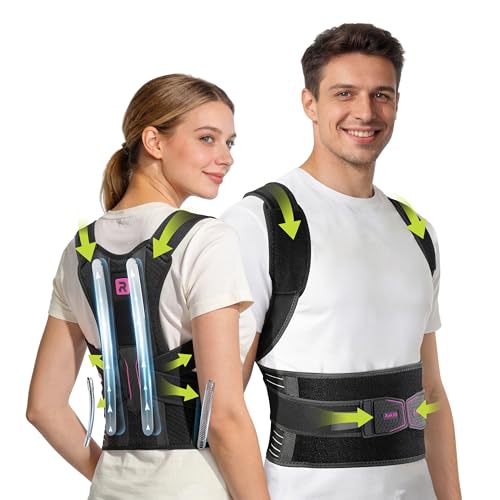
Where the Posture Hero works on the shoulders alone, the SHAPERKY wraps the whole back. It uses a rigid panel down the spine with a waist band and adjustable shoulder straps, so the correction comes from a broader base rather than from the shoulders being pulled backwards in isolation. For people who slump from the mid-back rather than just rolling the shoulders forward, that's the more sensible shape.
It's also the one to pick if you want support you can genuinely feel. The rigid panel gives a firm reference point along the spine, and the waist strap stops the whole thing riding up as you move, which is the usual failure of cheap shoulder-only straps. Owner feedback consistently points at the adjustability, since the shoulder straps and the waist band tighten independently and you can loosen one without slackening the other.
The trade-off is bulk. There's no wearing this discreetly under a fitted shirt, and in a warm room it gets sweaty faster than a two-strap design. Some owners find the rigid panel presses uncomfortably if they sit right back in a hard chair. It's also the pick where the "don't wear it all day" rule bites hardest, because the more support a brace gives, the less your own muscles are doing.
At around £20 the Rakiie does the same fundamental job as the Posture Hero for roughly half the money. It's an adjustable shoulder strap with padded loops and a back buckle, unisex sizing, and the sort of simple construction that leaves little to go wrong. If you're not sure whether you'll stick with wearing a brace at all, this is the sensible amount to risk finding out.
The padding is thinner than on the pricier picks and the webbing is stiffer, so it's more noticeable through clothing and slightly more prone to rubbing under the arms during a long stint. Adjustment is coarser too, which means you'll sometimes be choosing between a bit too loose and a bit too tight. For twenty minutes at a desk, none of that is a dealbreaker.
Check price on Amazon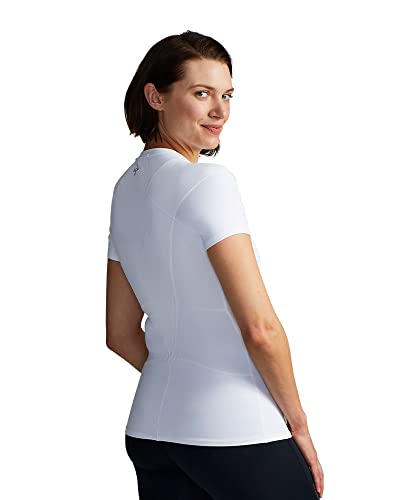
This one is a different animal. Rather than a strap, the Tommie Copper Shoulder Support Shirt is a compression top with graduated tension built into the fabric across the shoulders and upper back. You put it on like a base layer and wear it under a shirt, which solves the single biggest reason posture braces end up in a drawer: nobody wants a visible harness at work.
Because the cue comes from fabric tension rather than a strap pulling the shoulder blades together, the correction is much gentler. That's a genuine advantage for all-day wear and a genuine limitation if you want a strong reminder. Compression tops also have a knock-on benefit for people who find straps chafe under the arms, since there's nothing to dig in. The copper-infused fabric is marketing rather than mechanism; the compression is what does the work.
Two honest problems. It costs around £51 for the men's version, which is a lot for one shirt, and you'll want at least two if you plan to wear it daily. Sizing is also unforgiving, since the fit has to be snug enough to compress without restricting your breathing. The women's version is a separate listing at around £80 at the time of writing, which is a steep ask.
Check price on Amazon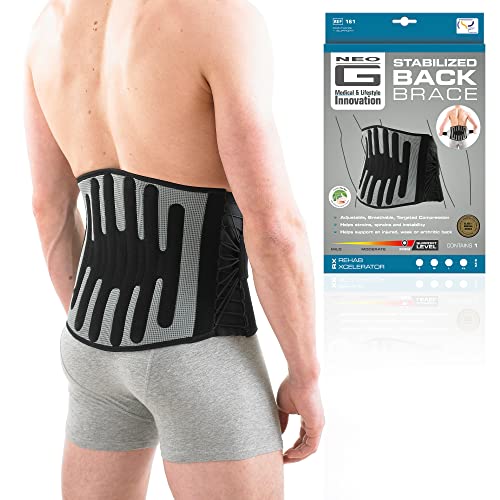
Being straight about this one: the Neo-G Back Support RX is a lumbar brace, not an upper-back posture strap. It wraps the lower back and abdomen with adjustable compression pulls, and it does nothing whatsoever for rounded shoulders. It's here because a large chunk of people searching for a posture corrector actually have a lower back complaint, and buying a shoulder strap for that is money wasted.
What a lumbar support does well is provide compression and warmth around the lower back during activity, plus a proprioceptive reminder not to bend badly when you lift. Neo-G is a British support brand with a long-standing range, and the RX build quality is a step above the generic braces at half the price. The adjustable side pulls let you tighten it over the specific area that's grumbling.
The caution is the same one the NHS gives for back pain generally, which is that staying active beats resting and long periods of immobility make things worse rather than better. A brace that lets you keep moving is doing its job. A brace you wear on the sofa because it feels reassuring is not. At around £48 it's also the most expensive strap-style pick here, and for straightforward desk-slump posture it's simply the wrong product.
Check price on Amazon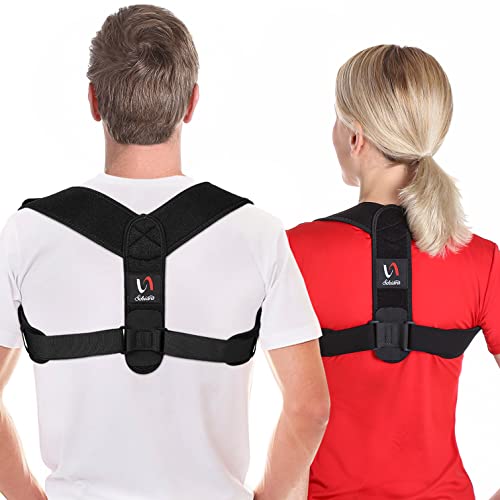
There's a floor below which posture correctors stop being usable, and the Schiara sits just above it at around £18. It's a figure-of-eight strap, adjustable, unpadded in places where the pricier options have foam, and perfectly serviceable for short sessions. Everything cheaper than this on Amazon UK tends to be thin webbing that twists, frays or slips out of adjustment within a fortnight.
You're accepting real compromises. The straps are narrower, so they concentrate pressure over a smaller area and will make themselves known after half an hour. The buckle can slip under load. It's visible under anything lighter than a jumper. But if you want to find out whether a physical cue helps you at all before spending properly, this is a rational £18.
Check price on AmazonShort answer: 15 to 20 minutes at a time, building to an hour a day at most, split across the day rather than worn in one block. Most people do the exact opposite and strap it on at nine in the morning.
The reason to keep it brief isn't comfort. A randomised crossover trial of 30 healthy university students found that wearing a scapular brace during a 30-minute typing task significantly reduced bilateral trapezius muscle activity compared with no brace, with no meaningful difference in pain or fatigue scores between the two conditions. Read that carefully: the brace made the muscles that hold your shoulder blades in place work less, and the wearers felt no better for it. That's the whole argument against all-day wear in one result.
Treat the strap as a timer for awareness. Put it on, notice what upright feels like, take it off and try to hold that feeling unaided. When you catch yourself slumping an hour later, that's the brace having done its actual job. Take it off immediately if it rubs, digs into your armpits or makes your fingers tingle, which usually means it's too tight rather than the wrong product.
Here's where the real work happens, and it's less exciting than a strap. Rounded shoulders come from a strong, tight chest pulling against a weak mid-back, so you need to strengthen one side and lengthen the other. Consistency over months matters far more than intensity in any single session.
The evidence for this is decent. In a randomised trial of older adults with measurable kyphosis, a three-month programme of twice-weekly spine strengthening and posture training produced a 4.8 degree improvement in kyphometer-measured curvature against the control group, at p equal to 0.001. Three months, twice a week, in people whose posture had decades of habit behind it.
Start with face pulls, which are the single most useful movement for this problem because they train external rotation and scapular retraction together. Add rear delt exercises two or three times a week to build the muscle across the back of the shoulder that holds the joint where it should sit. Band pull-aparts belong in the same session, and a set of resistance bands is genuinely all the equipment you need for the whole programme. For the tight side of the equation, chest and lat stretching plus a few minutes with a foam roller across the thoracic spine will restore extension you've probably lost. If you want one movement that decompresses everything at once, the dead hang is hard to beat and costs nothing beyond a bar.
Don't neglect the hips. Sitting shortens the hip flexors, which tilts the pelvis forward and makes the whole chain above it compensate, so posture work that stops at the shoulders only solves half the problem.
Whichever you pick, remember what you've bought. The strap is a reminder that you're slumping, and it stops working the moment it comes off. Build the upper back, open the chest and hips, and after a few months you won't need the reminder. That's the version that lasts, and no brace shortcuts it. If you're putting a training space together, our home gym guides cover the kit worth having. And since most desk-related posture trouble is really a sitting problem, a walking pad under a standing desk does more for your thoracic spine over six months than any strap will.
For most people the back Posture Hero Sports is the best posture corrector in the UK. It is a British-designed clavicle brace at around £38, it sits comfortably enough to wear under a jumper, and it cues your shoulders back without pinning you rigid. If you want firmer support across the whole back, the SHAPERKY at around £27 is the better shape. Neither will fix your posture on its own, and both work best in short stints alongside upper back strengthening.
They work as a reminder, not as a cure. Wearing one gives you a physical cue every time you slump, which is genuinely useful while you are learning what good positioning feels like. What the research does not support is the idea that a brace rebuilds posture by itself. A crossover trial of 30 university students found that wearing a scapular brace during a 30-minute typing task significantly reduced trapezius muscle activity, and made no meaningful difference to pain or fatigue scores. Lasting change comes from strengthening the upper back and rear shoulders.
Start at 15 to 20 minutes a day and build up to no more than an hour, split into short blocks rather than one long stretch. Wearing one all day is the mistake most people make. If the brace is doing the holding, the muscles that should be holding you up get to switch off, and you can end up more dependent on it than when you started. Take it off the moment it rubs, digs in or makes your arms tingle.
No. Rounded shoulders usually come from a tight chest and a weak mid-back, and a strap does not change either. It holds the shoulders back while you wear it and everything returns once it comes off. The permanent fix is face pulls, rear delt work, band pull-aparts and chest stretching, done a few times a week for a few months. A brace is a helpful reminder while you build that habit, nothing more.
Used sensibly they are fine, and most people get on with them without any problem. The risks come from overuse and over-tightening. Worn too tight, clavicle-style straps can dig into the armpits and irritate the nerves that run through there, which shows up as tingling or numb fingers. Worn constantly, they let the postural muscles do less work. If you have an existing back or shoulder condition, or you feel pins and needles, speak to a GP or physiotherapist before continuing.
The best reformer pilates machines for home use in the UK in 2026, from a £259 foldable to a £788 wooden frame. Honest picks, real specs and how to choose a pilates machine.
The best adult weighted blankets in the UK for 2026, with honest picks for hot sleepers, heavier users and daytime use, plus how to choose the right weight and what the research shows.
Are vibration plates worth it? Yes for balance, bone health support and low-impact warm-ups; no for weight loss or replacing strength training. The evidence.
Our ExacMe magnetic stair climber review covers its 16 magnetic resistance levels, 48cm stride, 158kg user limit, app and noise claims, and who should buy it.
Best Exercise is a participant in the Amazon EU Associates Programme, an affiliate advertising programme designed to provide a means for sites to earn advertising fees by advertising and linking to Amazon.co.uk. As an Amazon Associate we earn from qualifying purchases. This comes at no extra cost to you and never influences our independent reviews or rankings.