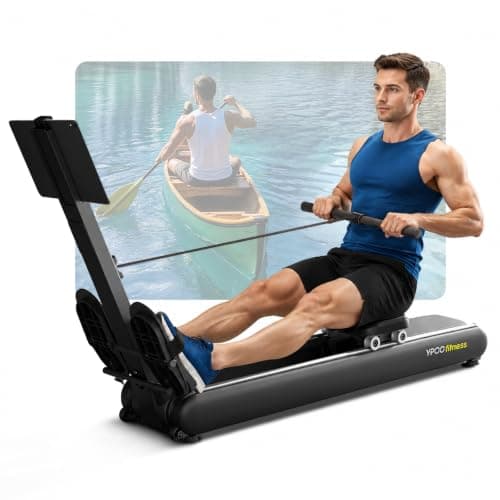
Storage kills more home rowing machines than boredom does. A rower is roughly as long as a single bed, and once it has spent a month in the middle of a spare room it tends to end up in the garage, unused. YPOO's answer on the V2 PRO is to give you two ways to put it away: stand it on its end, or fold it flat against a wall or under a bed.
At around £190 that makes it one of the cheaper folding magnetic rowers with Bluetooth app support, and the spec sheet reads well: 16 resistance levels, a 160kg user rating and a monitor that tracks seven metrics. The listing also carries more marketing than most, including a muscle claim it doesn't back up and a rail length figure that looks suspiciously like the overall length. We'll pick through both.
How we review
This review draws on YPOO's Amazon UK listing specifications, the manufacturer's own claims (labelled as claims where we use them) and recurring themes across owner reviews on a listing with around 450 ratings. We haven't rowed this machine ourselves. Where YPOO leaves a figure out or a claim unsupported, we say so rather than guess.
Buy this if floor space decides everything, you're under about 6ft, and you want quiet, steady cardio three or four times a week without spending £400. It suits a flat, a bedroom corner or a living room where the rower has to disappear before guests arrive.
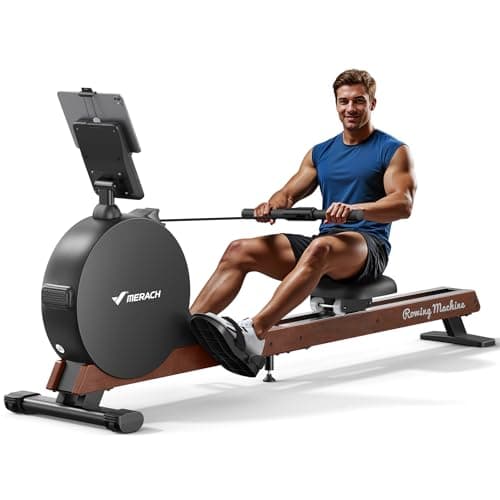
Look elsewhere if you're 6ft 2in or taller, since YPOO's own height range stops there. And if you sprint hard intervals, a heavier frame will stay put better; the Sunny Health and Fitness magnetic rower and the DMASUN rower are both worth comparing before you commit.
Pros
Two storage modes: upright on a small footprint, or folded flat against a wall or under a bed
Arrives about 80 percent assembled, with YPOO quoting around 10 minutes to finish
16 magnetic resistance levels for around £190
160kg user weight capacity is generous at the price
Bluetooth with Kinomap and the YPOO FIT app, plus a device holder
Cons
Magnetic load stays flat however hard you pull
Height range tops out at 6ft 2in, lower than many rivals
The listing shows heart rate but never explains how it's measured
At 19.7kg the frame may shift during all-out sprints
Young Amazon brand with unknown long-term spare parts support
Heavy marketing copy, including an unsourced 90 percent muscle claim
YPOO V2 PRO rowing machine key specs
Resistance
Magnetic, 16 levels
Noise
Under 30dB, manufacturer claim, unverified
Monitor
LCD: distance, time, calories, stroke rate, speed, heart rate, cadence
Heart rate method
Not specified in the listing
Connectivity
Bluetooth
Apps
Kinomap, YPOO FIT
Rail
Dual slide rails, stated as 63.6in (see below)
User height
4ft 5in to 6ft 2in (about 134cm to 188cm)
User weight capacity
160kg (350lb)
Unit weight
About 19.7kg
Dimensions
161.5 x 41.5 x 81cm
Storage
Folds upright (1.29 sq ft footprint claimed) or flat
Assembly
About 80 percent pre-assembled, around 10 minutes claimed
Folding and storage: the reason to buy it
Most budget rowers that "store upright" simply tip onto their front stabiliser and lean against a wall. YPOO claims a folded footprint of 1.29 square feet, which works out at about 0.12 square metres, roughly a 35cm square. The listing converts that into "95 percent less floor space", a marketing sum that compares the folded footprint with the machine laid out, so treat the percentage loosely. The 1.29 square feet figure is the useful one.
The V2 PRO's second trick matters more to some buyers. It also folds fully flat, so it can lean against a wall like an ironing board or slide under a bed. That's rare at £190. What YPOO doesn't publish is the folded height, and a standard divan with drawers won't have much clearance, so measure under your bed and message the seller for the figure before counting on it.
Wheels at the front and a fold YPOO describes as one-handed make the daily routine realistic. At 19.7kg it's light enough for most adults to tilt and roll, and that matters because a rower you can't be bothered to set up is a rower you won't use. If you're still weighing up how different machines fold, our foldable rowing machines guide compares the approaches.
Sixteen levels of magnetic resistance
YPOO splits the 16 settings into two halves: levels 1 to 8 for everyday fitness and rehab, 9 to 16 for harder work. That's a fair description of how people will use them, and 16 steps give you more control than the eight-position knob on many cheap magnetic rowers.
Understand what magnetic resistance does before buying, though. A magnet sits near the flywheel and sets a fixed level of drag; it doesn't care how hard you pull. On an air or water rower, a harder stroke meets more resistance, so the machine responds to effort in a way this one can't. For steady-state cardio that doesn't matter much. For learning a good stroke it does, because a rushed, arms-first pull feels the same as a proper leg drive, and nothing tells you you've got it wrong. Spend some time on rowing technique early rather than relying on the machine to correct you.
The under 30dB claim is YPOO's number. Magnetic rowers are the quietest type, but we haven't seen that figure measured independently.
The monitor and apps
The LCD covers distance, time, calories, stroke rate, speed, cadence and heart rate. Distance, time and stroke rate are the ones worth watching. Calorie counts on any home machine are estimates, and this listing gives no hint of how YPOO calculates them. No 500m split appears in the metric list either, which is a shame, because structured rowing plans are written around it.
Heart rate is the odd one. The listing names it as a metric without saying whether it comes from grip sensors, a chest strap or a paired device. We couldn't find the answer in the product information, so if you plan to train by heart rate, ask the seller first.
Bluetooth links the rower to the YPOO FIT app and to the third-party Kinomap training app. Check Kinomap's current plans before you buy with it in mind, since the listing doesn't say what's free. A device holder keeps your phone or tablet in view.
Fit, weight and the rail length question
YPOO rates the frame for 160kg, which is generous at £190. The height range of 4ft 5in to 6ft 2in is more limiting. Plenty of rival rowers claim to fit taller users, and running short of rail at the catch forces a cramped stroke that shifts work from your legs into your lower back. Low back pain is already the most commonly reported injury among rowers (International Journal of Sports Physical Therapy scoping review, 2023), so don't squeeze onto a machine that's too short for you.
The listing's 63.6in rail length converts to about 161.5cm, which is exactly the overall length in the dimensions. That's almost certainly the whole machine rather than the distance the seat can travel, and YPOO doesn't publish an inseam. It's another reason tall buyers should get a straight answer from the seller.
The 19.7kg unit weight cuts both ways. It helps with folding and rolling, but a light frame is more likely to creep across a smooth floor when you really drive hard. A rubber mat solves most of that.
Will it get you fitter?
Yes, and you don't need a percentage to prove it. YPOO says the machine engages up to 90 percent of muscle groups and that scientific studies prove it, without naming a single one; the similar 85 percent figure you'll see quoted around the web isn't sourced in this listing either. Ignore both numbers. What's solid is that rowing loads legs, hips, back and arms in every stroke, and indoor rowing training improves fitness measurably: in one trial, older women rowing three 30-minute sessions a week for ten weeks raised their peak oxygen uptake and heart rate recovery (International Journal of Environmental Research and Public Health, 2023).
YPOO is an Amazon-native brand with roughly 450 ratings on this listing. That isn't enough history to show what the seat rollers or the fold hinge look like after three years of daily use, and nobody can say whether UK spare parts will still be available then. The price partly reflects that risk. If you want a rower for the next decade, spend more on an established name; if you want a good folding machine for the next few years, the gamble is reasonable.
Yes, in two ways. It stands upright on its end, which YPOO says takes up 1.29 square feet of floor, and the listing says the V2 PRO version also folds down flat so it can lean against a wall or slide under a bed. Built-in wheels let you move it, and YPOO describes the fold as a one-handed job. Check the bed clearance before you rely on the under-bed option, because the listing doesn't give folded height.
How tall can you be to use the YPOO rower?
YPOO lists a user height range of 4ft 5in to 6ft 2in, which is roughly 134cm to 188cm. That's a lower ceiling than many rivals, and if you're near or above 188cm you'll likely run short of rail at the catch. Taller rowers should look at a machine with a published inseam figure instead.
How does the YPOO measure heart rate?
The listing says the monitor shows heart rate but doesn't explain how it gets the reading. It doesn't mention grip sensors in the handle or a chest strap, so ask the seller before buying if heart rate training matters to you. Many owners pair a chest strap with an app, which tends to be more reliable than handle sensors anyway.
Is the YPOO rowing machine quiet enough for a flat?
Magnetic resistance is the quietest type available because nothing touches the flywheel to create drag. YPOO claims under 30dB, which is a manufacturer figure we haven't seen measured. The seat rolling on the rail and the handle cord still make some noise, so a mat underneath is sensible if someone lives below you.
Does rowing really work 90 percent of your muscles?
YPOO's listing claims the machine engages up to 90 percent of muscle groups and says scientific studies prove it, but it doesn't cite any. Rowing does use the legs, hips, back and arms in every stroke, which is why it's such good all-round exercise. A precise percentage is marketing, and you shouldn't buy on it.
What an air rowing machine is, how fan resistance and the damper really work, why gyms use them, the downsides (noise, size) and what to look for before you buy.
What a magnetic rowing machine is, how eddy-current resistance works, the real pros and cons versus air and water, and what to check before you buy one.
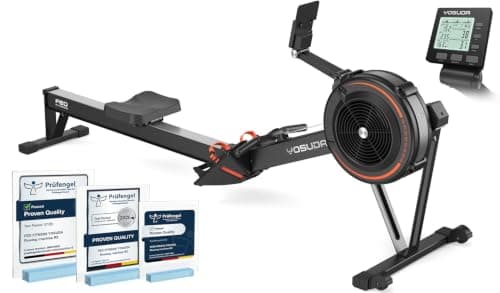
Our YOSUDA R2 air rowing machine review covers the 32-blade fan, 10-level damper, self-powered monitor, 158kg limit and how it compares with a Concept2.
Best Exercise is a participant in the Amazon EU Associates Programme, an affiliate advertising programme designed to provide a means for sites to earn advertising fees by advertising and linking to Amazon.co.uk. As an Amazon Associate we earn from qualifying purchases. This comes at no extra cost to you and never influences our independent reviews or rankings.