Rowers under £250 mostly split into two camps: hydraulic machines with a piston either side that feel nothing like rowing, and basic magnetic ones with a monitor that counts strokes and invents a calorie number. Sunny has owned this end of the market for years, largely because it got there first and its hydraulic rower range sells on price alone.
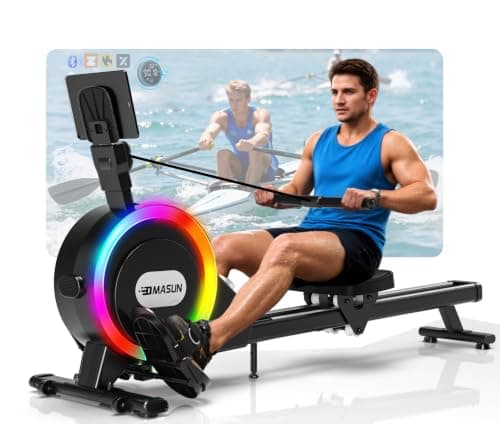
The DMASUN at around £210 is trying something different, and two of its decisions are worth taking seriously. The flywheel generates the electricity that runs the monitor, so the machine has no mains lead and no battery compartment, which nothing else at this price does. And the monitor reports a 500m split, the one metric that turns a cardio machine into something you can train on properly.
How we review
This review draws on DMASUN's published Amazon UK listing specifications, the manufacturer's own performance claims (flagged as claims where we use them), and repeated themes across verified owner reviews. We have not rowed this machine ourselves and we do not pretend otherwise, so where a figure is unmeasured or unpublished we say so rather than filling the gap.
Buy this if you want to row three or four times a week in a flat or a shared house, you care about pacing your sessions rather than just sweating through them, and £210 is the ceiling. The quiet electromagnetic drive suits upstairs rooms and thin floors, and the self-powered monitor means one less thing to fail.
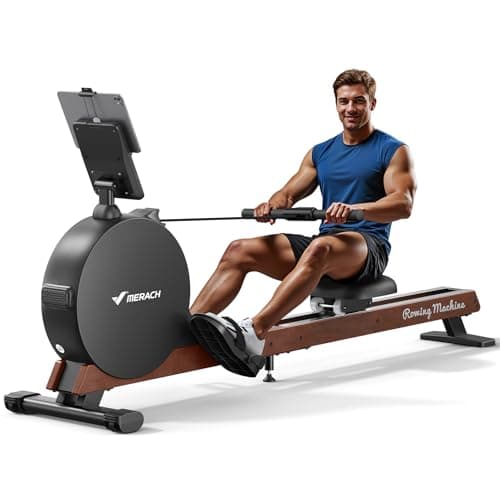
Skip it if you are chasing the feel of a real boat, in which case an air or water machine like the MERACH R50 Pro is the honest answer even though it costs more than twice as much. Skip it too if you are over roughly 190cm, at least until the seller confirms the rail length, because cramped compression at the catch will ruin the stroke no matter how good the resistance system is.
Pros
Electromagnetic flywheel powers its own monitor, so no mains lead and no batteries to replace
Reports a genuine 500m split, which budget rowers almost never do
32 resistance settings give steps fine enough to actually use, rather than four vague ones
Bluetooth 6.0 with FitShow, Kinomap and Zwift for app-driven sessions
160kg user weight capacity on a thickened dual-track rail
Arrives about 85 percent assembled and stands upright against a wall afterwards
Cons
Magnetic resistance stays flat however hard you pull, so it never loads like air or water
No published slide rail or inseam length, which matters above about 190cm
Roughly 1,300 ratings behind it, against tens of thousands for Sunny's equivalents
UK spare parts availability three or four years out is an open question
The colour-changing light strip is decoration presented as a feature
DMASUN rowing machine key specs
Resistance
Electromagnetic dual-resistance drive
Levels
32 settings (marketed as 16/32 levels)
Peak resistance
45kg, manufacturer claim, unverified
Power
Self-generating flywheel, no mains cable
Monitor
HD LCD, 8 live metrics, dual-core chip
Metrics
Speed, time, distance, calories, strokes, SPM, 500m split, resistance level
Connectivity
Bluetooth 6.0
Apps
FitShow, Kinomap, Zwift
Rail
Slide Rail 2.0, thickened bionic dual-track
User weight capacity
160kg
Dimensions
162 x 52 x 63cm
Storage
Stands upright
Assembly
85 percent pre-assembled, around 20 minutes
Service
3 year manufacturer service
The resistance system, and what DMASUN is not telling you
Thirty-two electromagnetic settings is a lot of granularity for £210, and granularity is the point. Most budget magnetic rowers give you eight positions on a tension knob, which means the gap between level four and level five is often the difference between too easy and too hard, with nothing usable in between. Thirty-two steps let you find a load you can hold for twenty minutes rather than one you abandon after eight.
DMASUN claims the current motor produces 40 percent more resistance than the version it replaced, and quotes a 45kg peak. Both figures come from the manufacturer, neither has been independently measured as far as we can find, and a peak resistance number in kilograms is not a standardised measurement across brands anyway. Treat them as an indication that this sits at the stronger end of budget magnetic rowers, not as a spec you can compare directly with anything else.
Where the marketing genuinely overreaches is the suggestion that the feel mirrors water. It doesn't, and no magnetic system does. A fan or a water tank pushes back harder the faster you move it, so a sloppy stroke feels light and an aggressive one feels heavy, which teaches you something about your own rowing. Electromagnetic resistance holds whatever level you dialled in, so a rushed stroke and a powerful one feel identical, and the machine can't tell you off. That is fine for fitness. It is not the same thing as rowing, and if learning to row properly is the goal then the technique work matters more here than on an air machine, because the machine won't correct you.
The self-powered flywheel is the real trick
Plenty of cheap rowers run their monitor on two AA batteries that die halfway through a session, and the mid-range ones want a socket. This one takes the kinetic energy of your stroke and runs the display off it, which sounds like a gimmick until you have moved a rower to the only sensible wall in a spare room and found the nearest plug is on the opposite side.
The practical effects are small but real: no cable to trip over, no trailing extension lead in a room where you are also sliding back and forth, and nothing to replace. The monitor comes alive on the first stroke. At £210, alongside a 160kg capacity frame and a dual-track rail, that is more engineering than the price suggests.
The RGB strip that shifts between blue, green, red and yellow as you change resistance is the opposite. It is decoration, it will look dated in eighteen months, and DMASUN pushes it harder in the listing than it deserves. The one accidental benefit: you can see roughly what level you are on from across the room without squinting at the display.
The monitor earns its keep
Eight live metrics on an HD LCD, with Bluetooth 6.0 driving FitShow, Kinomap and Zwift, is a stronger data package than the Sunny SF-RW5515 and most other machines at this money offer.
The 500m split is what matters. It converts your current pace into the time you would take to cover 500 metres, and every structured rowing session you will find online is written in those terms: eight by 500m at 2:15, twenty minutes at 2:30, that sort of thing. Without a split you are reverse-engineering pace from a distance readout mid-stroke, which nobody does. With it, you can hold an even effort, compare Tuesday with Saturday, and tell whether you are actually getting fitter. That single number is the clearest reason to spend the extra over a cheaper Sunny, and it's why this machine belongs on any shortlist of budget rowers worth buying.
App support is a secondary bonus rather than a headline. Kinomap gives you scenic routes and structured intervals; Zwift's rowing support remains thin across the industry, so don't buy on that basis alone.
Fit, rail and the measurement DMASUN left out
The frame is quoted at 162 x 52 x 63cm, it takes 160kg, and it stands upright against a wall when you are done. If storage is the main reason you're shopping, compare it with the other foldable rowing machines we rate before you commit. What the listing doesn't give is the slide rail length or the inseam, and that omission matters more than any of the numbers it does publish.
Inseam is the distance the seat can travel, and it decides whether a tall rower can bring their shins to vertical at the catch. Run out of rail and you end up rowing with a shortened stroke, which wastes the leg drive that supplies most of the power and pushes the work into your lower back. Trunk muscle behaviour during ergometer rowing already differs measurably between rowers with and without a history of low back pain (Journal of Clinical Medicine, 2023), and a compressed catch position is exactly the kind of compromise that aggravates it. Low back pain is the most commonly reported complaint in rowing generally (scoping review, 2023), so this is worth a message to the seller rather than a shrug.
If you are under about 185cm this almost certainly isn't an issue. Above that, ask first.
The brand question
DMASUN has roughly 1,300 ratings on this listing. Sunny's comparable machines carry tens of thousands, accumulated over a decade, and that gap is the single biggest reason to hesitate.
It isn't that DMASUN builds badly; the specification here is better than most of what Sunny sells at the price, and the three year service commitment reads well. The problem is that 1,300 ratings can't tell you what a rower looks like at year four, when a seat roller has worn or a monitor cable has frayed, and an Amazon-native brand can quietly stop supplying UK spares without announcing it. A Sunny or a Concept2 you can still get parts for. This one, in 2030, is a guess.
Weigh that against the £210. If a rower needs to last fifteen years, spend more elsewhere; if you want a good machine now and would replace it in five years regardless, the risk is priced in.
Will it actually make you fitter?
Yes, and the evidence for indoor rowing specifically is decent. Ten weeks of indoor rowing training produced measurable cardiorespiratory improvements in post-menopausal women, a group where that kind of adaptation is often assumed to be harder to achieve (2023 trial). Four sessions a week of 30 minutes clears the NHS guideline of 150 minutes of moderate activity without the joint loading that running brings, which is the main argument for a rower over a treadmill in a home gym.
The caveat is the one every rowing review should end on: a machine that doesn't punish a bad stroke won't teach you a good one. Spend the first fortnight on legs, then body, then arms, in that order, before you start chasing splits.
No, and that is one of the better reasons to buy it. The electromagnetic flywheel generates its own electricity as you row, so the monitor wakes up when you take the first stroke and there is no cable trailing across the floor and no AA batteries to replace. The practical upside is that you can put the machine anywhere in the room rather than within reach of a socket.
How does DMASUN's magnetic resistance compare with a water or air rower?
It is quieter and far more consistent, but it does not respond to effort the way moving air or water does. On an air rower, pulling harder makes the stroke heavier because the fan meets more resistance; on any magnetic system, including this one, the load stays where you set it regardless of how hard you pull. DMASUN's marketing talks about mirroring the feel of water, and that claim should be read as marketing rather than physics.
Is the DMASUN rower suitable for tall users?
That depends on a number DMASUN has not published. The listing gives an overall length of 162cm and a 160kg user weight capacity, but no slide rail length and no inseam figure, which is the measurement that decides whether a rower over roughly 190cm can reach full compression at the catch. Message the seller and ask for the rail and inseam before you order if you are tall.
What does the 500m split on the monitor actually tell you?
It projects how long 500 metres would take at your current pace, and it is the standard unit that structured rowing programmes are written in. Without it you are guessing from raw distance and time, which makes it hard to hold an even effort across intervals. Very few machines at this price report it, and on this one it is the single feature most worth the money.
How long does the DMASUN rowing machine take to assemble?
It ships around 85 percent built, and most owners describe finishing the job in roughly 20 minutes with the supplied tools. The main tasks are attaching the front stabiliser, the seat rail section and the monitor arm. Unbox it in the room where it will live, since carrying a built rower through a doorway is more awkward than carrying a flat box.
Is DMASUN a trustworthy brand?
It is an Amazon-native brand with a few years of history and roughly 1,300 ratings on this listing, against the tens of thousands behind established names like Sunny. The machine itself is well specified and DMASUN offers a three year service commitment, but there is not yet enough long-term owner data to say how these hold up at year four, and UK spare parts availability that far out is unproven.
What an air rowing machine is, how fan resistance and the damper really work, why gyms use them, the downsides (noise, size) and what to look for before you buy.
What a magnetic rowing machine is, how eddy-current resistance works, the real pros and cons versus air and water, and what to check before you buy one.
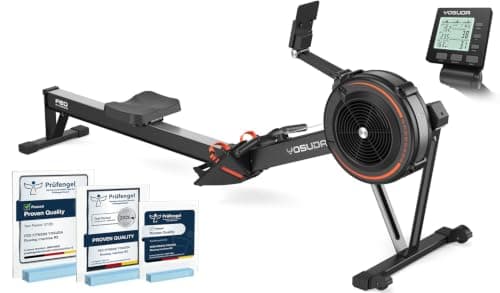
Our YOSUDA R2 air rowing machine review covers the 32-blade fan, 10-level damper, self-powered monitor, 158kg limit and how it compares with a Concept2.
Best Exercise is a participant in the Amazon EU Associates Programme, an affiliate advertising programme designed to provide a means for sites to earn advertising fees by advertising and linking to Amazon.co.uk. As an Amazon Associate we earn from qualifying purchases. This comes at no extra cost to you and never influences our independent reviews or rankings.