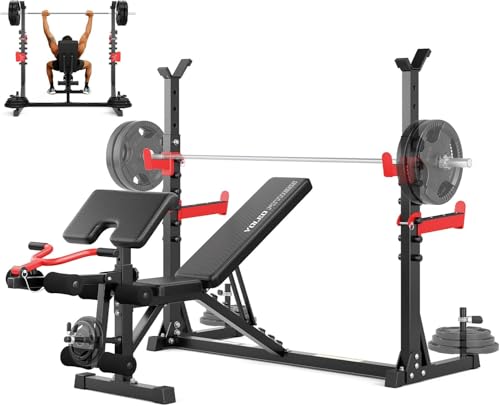
The YOLEO 10 in 1 Weight Bench Set is a reasonable buy for a beginner who wants a single piece of kit that does bench pressing, preacher curls, leg extensions and light rack work, and it costs £209.99 on Amazon UK (in stock when we checked on 20 November 2026). It's not the bench to build a serious squat routine around. The headline "1980lbs" capacity is three ratings added together, the rack is the kind of add-on upright that rarely matches a standalone rack for stability, and the listing leaves out details you'd want before spending £200.
We rate it 3.8 out of 5. You get a lot of functions for the money and the backrest range (decline to upright) is genuinely useful. It loses marks for the inflated capacity figure, an unsupported "ASTM" claim, and missing specs on seat adjustment and upright heights.
How we review
This review is based on research, not hands-on testing. We worked from YOLEO's Amazon UK listing and product data, compared the bench against the racks, benches and leg machines we've already reviewed, and read the research on bench angle and strength training. We haven't assembled or lifted on this bench. Where YOLEO doesn't publish a spec, we say so rather than guess.
Who it is for
This is a starter home gym in one frame. If you've got a spare room, a barbell and a modest set of plates, and you want to bench, curl and train your quads and hamstrings without buying three separate machines, the YOLEO covers a surprising amount of ground. The adjustable backrest also works as a plain dumbbell bench when you take the bar out of the equation.
It suits people pressing light to moderate weights with a barbell. Somebody benching 40 to 80kg and curling with an EZ bar is the sweet spot.
Who should skip it? Anyone who squats seriously, or plans to. Once you're loading a bar to bodyweight and beyond, you want uprights bolted to a dedicated frame with long safety arms, and our half rack guide explains why that matters more than any number of extra functions. Skip it too if your room is tight, because a bench with uprights and a leg developer bolted on takes up more floor than a plain bench and doesn't fold away.
10 functions in one frame for £209.99, cheaper than buying a bench, preacher bench and leg developer separately
Backrest runs from minus 30 degrees (decline) to 90 degrees (upright) across 8 settings
About 47.5in wide rack takes 6 to 7ft bars, so a standard Olympic bar fits
4 bar catch heights plus a safety pin
Built-in plate storage keeps the floor clear
Cons
The 1980lbs (900kg) headline is three ratings added together, not one load figure
Listing claims ASTM compliance but we found no published certificate
No information on seat adjustment or the upright height range
Combo uprights aren't a substitute for a standalone squat rack for heavy squats
Around 40kg in total, which is light for a bench, rack and leg developer combined
The 900kg claim, broken down
Here's the figure that'll catch your eye on the listing: 1980lbs, which works out at roughly 900kg. Read further down and YOLEO explains where it comes from. The bench is rated to 400kg, the rack to 300kg and the leg frame to 200kg; add them up and you get 900kg.
That's not how anyone uses a weight bench. You never load the bench, the bar catches and the leg developer to their limits at the same time, and the total tells you nothing about how any single part behaves. The useful numbers are the individual ones: 400kg on the bench (your bodyweight plus whatever you're pressing) and 300kg on the catches. Those are fine for most home lifters. A 90kg person pressing 100kg puts 190kg through the bench, well inside the rating, though dropping into a rep adds dynamic force on top of the static weight.
The listing also says the bench meets an ASTM standard. ASTM publishes standards for fitness equipment, but YOLEO doesn't name the standard number or link a test certificate, so treat it as marketing until the seller shows otherwise. We'd rather a brand published a plain, verified capacity per component than a big summed number with an unverified badge next to it.
Rack and bar catches
The uprights give you 4 squat bar catch heights and a safety pin, and the rack measures about 47.5in (YOLEO's product data says 47.44in, roughly 120.5cm) between the outer edges. That width suits a 7ft Olympic bar with plenty of sleeve to load, and a 6ft bar will fit with less overhang.
What YOLEO doesn't publish is the height range of those catches. That's a real gap. For bench pressing you want the bar a few centimetres below your locked-out arms when you're lying down, and for squats you want it around mid-chest height when standing. Without the measurements, you can't check whether the lowest catch suits a shorter lifter on the bench or whether the highest catch works for a taller lifter's squat. Ask the seller for the numbers before you buy.
Then there's stability. Benches that combine uprights, a seat and a leg developer in one frame make a trade: everything shares the same base, and the base has to stay small enough to fit a spare room. A standalone squat rack or half rack has a wider footprint and uprights that are the main structure rather than an add-on, which is why it feels steadier when you walk a loaded bar out. At around 40kg for the whole set (88lb in the product data), the YOLEO is lighter than the METIS adjustable bench, which weighs about the same on its own with no rack at all. For heavy squats, buy something from our best squat rack UK guide and treat the YOLEO catches as a bench press and light-squat convenience.
YOLEO 10 in 1 Weight Bench Set key specs
Price
£209.99 (Amazon UK, 20 November 2026)
Functions
10: adjustable bench, squat and bench rack, preacher curl, leg extension and curl, ab station, split-squat stand, plate storage
Backrest
8 settings, minus 30 to 90 degrees
Seat adjustment
Not stated in the listing
Rack width
About 47.5in (47.44in, roughly 120.5cm), fits 6 to 7ft bars
Bar catches
4 heights plus a safety pin
Upright height range
Not published
Rated capacity
Bench 400kg, rack 300kg, leg frame 200kg (advertised as a combined 900kg / 1980lbs)
Standards claim
ASTM claimed; no certificate published
Weight
About 40kg (88lb)
Bench and backrest
The backrest is the best part of this bench on paper. Eight settings from minus 30 degrees to 90 degrees means you get a proper decline for decline presses and sit-ups, a flat position, several inclines and an upright position for seated shoulder pressing. Plenty of benches at £150 to £250 don't decline at all.
Why bother with a range of inclines? A 2020 study had 30 trained adults bench press at 0, 15, 30, 45 and 60 degrees while recording muscle activity, and found upper chest activation peaked at 30 degrees while the front delts took over most at 60 degrees (Rodríguez-Ridao et al., 2020). A bench with several notches lets you pick the angle for what you're training, and our incline bench press guide covers how to use that.
YOLEO doesn't say whether the seat adjusts, though. On steep inclines a raised seat stops your hips sliding forward, so if you plan to do a lot of incline work, check before you order. The listing also doesn't give pad thickness or the flat bench height, which matters for leg drive on the bench press.
Leg developer and preacher pad
The leg developer at the front of the bench handles seated leg extensions and leg curls, and it's rated to 200kg. That's a generous figure for a plate-loaded leg attachment; in practice your limit will be how comfortable the roller pads feel on your shins, not the frame. It's a real step down from a dedicated machine like the LIONSCOOL leg extension and curl machine, which costs £429.99 on its own, but for a beginner who wants some quad and hamstring isolation alongside squats, it does the job. Our leg extension guide explains how to set it up so the knee lines up with the pivot.
The preacher curl pad is a nice extra that most people will use more than they expect. A standalone preacher bench runs roughly £60 to £300 (see our preacher curl bench guide), so getting one bundled in is part of the value case here. The listing doesn't give the pad angle or whether it adjusts for height.
The ab station and split-squat stand round out the "10 in 1" count. They're useful, though neither would be a reason to buy this bench on its own.
At £209.99, the arithmetic is in YOLEO's favour if you'd actually use most of the functions. A decent adjustable bench alone costs around £100 to £250, a preacher bench £60 or more, and a leg developer attachment adds more on top. Budget half racks start around £200 by themselves, according to our half rack guide, but those are dedicated racks with proper safeties; the YOLEO's catches aren't the same thing.
So the honest pitch is this: the YOLEO is good value as a do-everything bench for moderate weights, and poor value as a squat rack. If you mainly want to squat and press heavy, a separate rack and a plain bench will serve you better and last longer as you get stronger. For a general starting point on how often to train, the NHS strength exercises page suggests working your major muscle groups at least twice a week, and this bench gives you enough variety to do that at home.
What is the weight capacity of the YOLEO 10 in 1 weight bench?
YOLEO advertises 1980lbs, roughly 900kg, but that's three separate ratings added together: 400kg for the bench, 300kg for the rack and 200kg for the leg frame. No single part of the bench is rated to 900kg. The figure that matters for pressing is the 400kg bench rating, and for the bar catches it's 300kg.
Can you squat on the YOLEO weight bench rack?
You can take a bar off the catches for light to moderate squats, and the 4 catch heights plus a safety pin give you some flexibility. We wouldn't plan heavy squatting around it, though. Combo benches with uprights and a leg developer are rarely as stable as a standalone squat rack or half rack, and YOLEO doesn't publish the upright height range, so you can't check the catches suit your height before buying.
What size barbell fits the YOLEO 10 in 1 bench?
The rack is about 47.5in (120.5cm) wide, and YOLEO says it fits 6 to 7ft bars. A standard 7ft Olympic bar will sit on it with sleeve room to spare, and a 6ft bar will fit but leaves less overhang on each side for loading plates.
Does the YOLEO bench have an adjustable seat?
The listing doesn't say. It describes the backrest in detail (8 settings from minus 30 to 90 degrees) but gives no information about seat adjustment. If you plan to do a lot of steep incline pressing, where a raised seat stops you sliding down, ask the seller before you order.
Is the YOLEO 10 in 1 weight bench worth £209.99?
For a beginner who wants to bench, curl, do leg extensions and some ab work in one footprint, it's decent value, because buying a separate bench, preacher bench and leg developer would cost more. If you're mainly interested in squatting heavy or pressing near your limit, put the money towards a proper rack and a plain adjustable bench instead.
How Apple Watch estimates VO2 max (Cardio Fitness), where to find it in the Health app, how accurate it is against lab tests, how to raise it and how it compares to Garmin.
Fitbit Charge 6 vs Inspire 3 compared: built-in GPS, ECG, Google Wallet, battery, size and price. Our clear verdict on which tracker suits you in the UK.
Fitbit Charge 6 vs Versa 4 compared on screen, ECG, heart rate broadcast, calls, battery, GPS and price, with a clear verdict on which one UK buyers should pick.
Fitbit Versa 4 vs Sense 2 compared: same design, GPS and 6+ day battery, but the Sense 2 adds ECG and a cEDA stress sensor. Which is worth the extra £45?
Best Exercise is a participant in the Amazon EU Associates Programme, an affiliate advertising programme designed to provide a means for sites to earn advertising fees by advertising and linking to Amazon.co.uk. As an Amazon Associate we earn from qualifying purchases. This comes at no extra cost to you and never influences our independent reviews or rankings.