Magnetic Rowing Machine: How It Works, Pros, Cons and What to Buy
By Paul Kendrick, Cardio & Endurance Editor · Updated 26 October 2026
A magnetic rowing machine uses magnets positioned near a spinning metal flywheel to create resistance, and you change the level by moving those magnets closer or further away. It's the quietest, most compact and usually cheapest type of serious home rower, though the resistance stays fixed at each setting instead of rising as you pull harder, so it feels less connected than air or water.
That one trade-off decides most buying decisions. Below is how the mechanism works, where magnetic rowers win and lose, and what to check on a spec sheet before you spend £200 to £400 on one. If you want the full breakdown of every rower type (including hydraulic and elastic), our guide to what type of rowing machine is best covers that; this page sticks to magnetic.
How magnetic resistance works
Inside the front housing there's a metal flywheel, usually aluminium or a steel disc with an aluminium rim. When you drive with your legs and pull the handle, a strap or chain spins that flywheel.
Close to the rim sits a bracket of permanent magnets. As the conductive metal moves through their field, it generates small circulating electrical currents (eddy currents), and those currents create their own magnetic field that opposes the motion. You feel that opposition as drag on the handle. Nothing physically touches the flywheel, which is why magnetic rowers stay quiet and barely wear.
Turning the dial, or pressing a button on motorised models, shifts the magnet bracket. Closer magnets mean a stronger field across the rim and more drag. Further away means less.
The key detail is this: at any given level, the magnet gap is fixed. Air and water rowers behave differently because their resistance comes from pushing a fluid, and fluid drag climbs steeply with speed. Pull twice as hard on an air rower and the fan fights back far harder; on a magnetic rower, the drag does go up a little with flywheel speed, but the setting you chose stays the main factor. That's what owners mean when they say magnetic rowers feel "flat" or less responsive.
What the levels actually change
Higher levels don't make a workout harder by default; they make each stroke heavier. Many people row better and burn more energy at a moderate level with a quicker stroke rate. Our guide to rowing machine resistance levels gives starting settings for steady rows and intervals.
The pros
Noise is the big one. With no fan whooshing and no water sloshing, the loudest parts of a magnetic rower are usually the seat rollers and the strap retracting. You can row at 6am in a flat with someone asleep next door, which isn't true of an air rower.
They're also small. Most fold or tip up on end, and the lighter budget models weigh 25kg to 35kg, so one person can wheel them into a cupboard or behind a sofa. A water rower like the WaterRower stands upright too, but it weighs more and you're living with a tank of water.
Price matters as well. A decent magnetic rower costs around £200 to £400, whereas a Concept2 air rower or a wooden water rower generally starts well above £900 in the UK.
And there's no maintenance beyond wiping the rail and checking bolts. No purification tablets, no tank to top up, no fan cage collecting dust.
The cons
Resistance doesn't scale with effort. This is the honest drawback. On air and water rowers, a harder drive meets harder resistance, which feels natural and rewards good technique. Magnetic resistance feels more like a set weight. Plenty of people never notice; former club rowers usually do.
The numbers don't travel. One brand's 16 levels and another's 32 levels tell you nothing about each other, and neither does a "12kg flywheel" claim, since the magnet strength and gap matter as much as the flywheel mass. Calories and split times on cheap monitors are estimates from that brand's own formula. Don't compare your 2,000m time on a budget magnetic rower with a friend's Concept2 score.
Cheap ones can feel notchy at the catch. On some budget models, owners report a slight jerk or slack spot at the start of the drive, often from a strap that winds unevenly or a flywheel that's too light to carry momentum through the recovery. It isn't dangerous, but it's irritating at higher stroke rates. Reading owner reviews for words like "jerky" or "uneven" before you buy saves a return.
Max user weight and rail length on the cheapest machines can also be limiting, which brings us to the checklist.
Short rails cause more regret than anything else. If you can't reach full leg extension without the seat hitting the end stop, every stroke is shortened and your back starts doing the legs' job. Look for a listed maximum inseam rather than overall length. Above about 6ft, aim for a rail with around 120cm of seat travel or more, and read owner reviews from tall buyers.
Max user weight
Budget models are often rated to 100kg to 120kg, while sturdier ones go to 150kg or beyond. Treat the rating as a ceiling, not a target; a machine used near its limit flexes and creaks sooner.
Monitor metrics
At minimum you want time, distance, strokes per minute and a 500m split. Calorie counts are rough on any rower. A heart rate input (chest strap or Bluetooth) helps if you train by zones.
App support
Many current magnetic rowers connect over Bluetooth to apps such as Kinomap or the maker's own app. Apps make long rows less boring, but some lock features behind a subscription, so check before you count on it.
Folding and footprint
Measure your storage space with the machine folded or upright, then add a little clearance for the handle. Transport wheels at the front are close to essential on anything over 30kg.
Two magnetic rowers worth a look
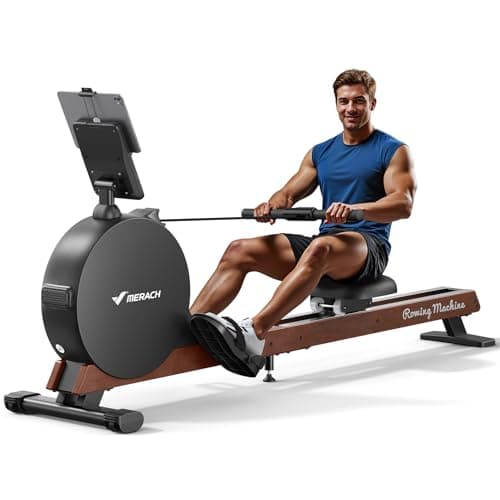
The MERACH magnetic rower (ASIN B0D8FM1GQY) sits at the budget end, around £214 at the time of writing. MERACH has a solid track record with owners for quiet running and simple setup, and our MERACH rowing machine review covers the brand's lineup in detail.
If you want a folding design from a UK brand, the JLL folding magnetic rower (ASIN B0FJL822LV) costs around £299 at the time of writing. JLL is a long-standing UK seller, which helps with spares and support, and folding makes it a good fit for flats. Our JLL R200 review gives a sense of how the brand builds its rowers.
Buy one if you live in a flat or a terraced house with thin walls, row early or late, need to store the machine away after each session, or have a budget under £400. That describes most people training at home for general fitness, and indoor rowing does the job well: a 2023 study found measurable cardiorespiratory improvements in post-menopausal women over a course of indoor rowing training. Four 30-minute sessions a week also gets you past the NHS recommendation of 150 minutes of moderate activity.
Skip magnetic if you're training for rowing races or want your scores to line up with gym leaderboards. An air rower is the right tool there, and the extra noise is the price of comparable data. Water rowers suit people who care about feel and looks and have the floor space.
For everyone else, a well-reviewed magnetic rower with a long enough rail is the sensible default.
A metal flywheel spins as you pull the handle, and a set of permanent magnets sits close to its rim. The moving metal passing through the magnetic field creates eddy currents that drag against the spin. Turning the resistance dial moves the magnets closer to the flywheel for more drag or further away for less. Nothing touches, so there's no friction wear and almost no noise.
Are magnetic rowing machines any good?
Yes, for most home users they're the most practical type. They're the quietest rowers you can buy, they fold or stand up for storage, and decent ones start at around £200. The trade-off is feel: the resistance stays fixed at whatever level you choose, so a harder pull doesn't load up the way it does on an air or water rower.
Is a magnetic or air rowing machine better?
Air is better if you want gym-style feel, comparable numbers (a Concept2 is the standard for rowing scores) and resistance that rises naturally as you pull harder. Magnetic is better if noise matters, you live in a flat, or you want something cheaper and smaller. For quiet early-morning sessions in a shared house, magnetic wins easily.
Are magnetic rowers quiet enough for a flat?
They're the quietest type of rower. The main sounds are the seat rolling on the rail and the handle strap, not the resistance itself. Put the machine on a rubber mat to cut vibration through the floor, and check the seat rollers are smooth, because cheap rollers are the usual source of rumble on budget models.
Can you compare resistance levels between magnetic rowers?
No. A level 8 on one brand and a level 8 on another can feel completely different, because each maker uses its own magnet strength, flywheel weight and gap spacing. Claims like a 12kg flywheel or 16 levels don't translate across brands either. Judge by owner feedback and track your own progress on one machine.
How tall can you be to use a magnetic rowing machine?
It depends on the rail. As a rough guide, a usable seat travel (sometimes listed as inseam length) of 120cm or more suits people up to around 6ft 2in, while some budget models with short rails get cramped above 5ft 10in. Check the maximum inseam figure rather than the overall machine length.
What an air rowing machine is, how fan resistance and the damper really work, why gyms use them, the downsides (noise, size) and what to look for before you buy.
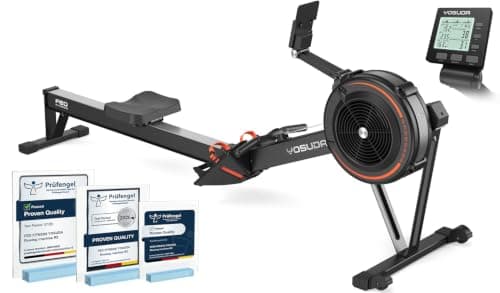
Our YOSUDA R2 air rowing machine review covers the 32-blade fan, 10-level damper, self-powered monitor, 158kg limit and how it compares with a Concept2.
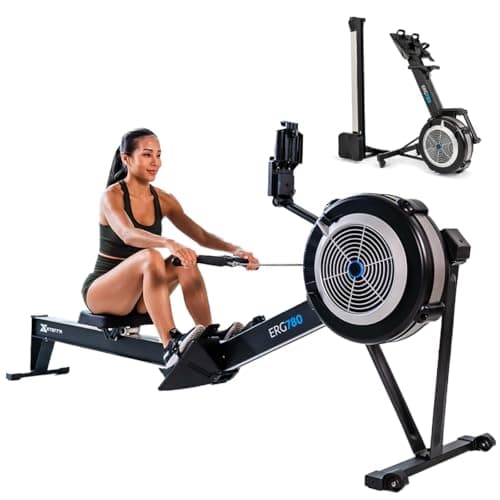
Our Xterra ERG780 air rower review covers the 10-level damper, Bluetooth FTMS app support, noise, monitor accuracy, folding storage and how it compares with a Concept2.
Best Exercise is a participant in the Amazon EU Associates Programme, an affiliate advertising programme designed to provide a means for sites to earn advertising fees by advertising and linking to Amazon.co.uk. As an Amazon Associate we earn from qualifying purchases. This comes at no extra cost to you and never influences our independent reviews or rankings.