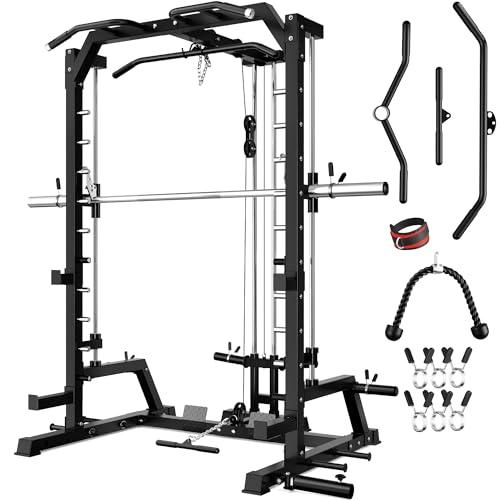
The JELENS SR01 is a compact, plate-loaded Smith station that fits a guided bar, a lat pulldown and low row, a landmine and plate storage into a footprint of about 121cm by 124cm. That's very small for this much hardware, and it's the main reason to buy one. At £1,259.23 on Amazon UK (21 November 2026, with only 15 left in stock), though, you're paying close to stack-loaded money for a half rack with coarse Smith spacing and several specs JELENS simply doesn't publish. It's a sensible pick for a box room or a corner of the garage, but not a bargain.
How we review
We haven't tested the SR01 ourselves. This review is built from the Amazon UK listing for this exact model (ASIN B0GKGFB28C), owner feedback, comparison with the Smith stations we've already covered and published research on Smith machine training. We tried to check the specs against an official JELENS product page, but we couldn't find one online, so every figure here is the seller's own. Where a number isn't published, we say so rather than guess.
Amazon's title calls it a power cage, but JELENS's own description is more accurate: a "vertical semi-frame" with a triangular base, which is a half rack. Two front uprights carry the Smith track, the rear section holds plate storage, and a tower at the top runs the lat pulldown cable down to a low row position. You don't step inside four posts as you would in a full cage, and that's precisely how JELENS keeps the frame to 47.64in by 48.82in (the listing's 16.2 sq ft footprint checks out against those measurements).
The frame is 2in by 2in carbon steel, the usual section for home racks at this price. It's lighter than the 3in tubing on commercial cages; for a home lifter it's adequate.
In the box you get a lat pulldown bar, a straight cable bar, a T-bar for rows, a tricep rope, two safety rods, a 360° landmine and six plate storage posts with clamps, shipped across three boxes. That accessory list is decent, and the landmine plus the T-bar between them give you row variations that many compact Smith frames skip entirely.
What's missing matters as much. There's no weight stack, so the pulldown is plate-loaded. There's no bench, no plates and no separate Olympic barbell on the UK listing. JELENS also leaves out the Smith bar's weight and the pulley ratio, two numbers you'd want before logging progress (our Smith machine bar weight guide explains why the first one changes your numbers more than people expect).
Pros
Very small 121cm by 124cm footprint for a Smith bar plus pulldown
Dual bearings in the Smith carriage for a smoother guided track
Safety hooks at the top and bottom of the Smith travel
Lat pulldown, low row, T-bar row and 360° landmine in one frame
Rear plate storage keeps a starter set off the floor
£280 or so cheaper than the Garvee all-in-one
Cons
Smith hook positions are 4in apart, so setup is coarse
Half rack layout, not the full cage the title suggests
2,000lb is a single static frame rating with no per-station breakdown
Smith bar weight and pulley ratio aren't published
Plate-loaded cable means swapping plates between sets
No plates, bench or Olympic barbell on the UK listing
No official JELENS spec page we could find to verify the listing
The Smith system and its 4in spacing
JELENS makes a point of how the Smith module is built. Instead of hanging the bar's hooks straight on holes drilled through the upright, it welds and bolts ten solid steel pegs to each column, spaced 4in apart, and the carriage runs on what the listing calls upgraded dual bearings. The logic is sound: drilled tube can ovalise over time where a loaded hook bangs into it, whereas solid pegs spread that load. Bearings also beat the nylon bushings on cheaper Smith frames, which tend to stick halfway through a slow squat.
The weak spot is the spacing. Ten positions at 4in (about 10cm) is coarse, and it means you'll sometimes have to choose between unracking from a slight half-squat or from tiptoe. Compare that with the 1in steps on the Garvee Smith machine, where you can set the catch almost exactly at shoulder height. For squats and overhead presses you'll adapt. For bench pressing, where the gap between "can't unrack" and "lowered the bar onto my chest" is small, it's more annoying, and you'll want to fine-tune with bench position instead.
Safety hooks sit at both the top and bottom of the travel, and the two safety rods give you a second catch for free barbell work in the front of the frame. Use them every set. Our guide to using a Smith machine covers setting the stops just below your lowest rep position, which is the habit that makes a Smith bar safe to train alone on.
JELENS SR01 key specs (from the Amazon UK listing)
Frame
2in x 2in carbon steel, half rack (vertical semi-frame)
Dimensions
47.64in x 48.82in x 81.5in (approx 121cm x 124cm x 207cm)
Lat bar, cable bar, T-bar, tricep rope, 2 safety rods, 360° landmine
Storage
6 plate posts with clamps
Plates and bench
Not included
Delivery
3 boxes
Price
£1,259.23 (21 November 2026)
Training on it
The SR01 covers more ground than its size suggests. The Smith bar handles squats, presses, lunges and hip thrusts; the pulldown tower does lat pulldowns, tricep pushdowns and curls; the low row and T-bar take care of horizontal pulling; and the landmine adds presses, rows and rotation work. That's a full-body week without leaving the frame, which is the whole pitch.
Is a guided bar as good as a free one? It depends on what you're after. A small study of six trained lifters found muscle activity averaged 43% higher in the free weight squat than the Smith squat, mostly because the free bar has to be balanced. Activity isn't the same as growth, though. In an 8-week trial where 37 participants trained squats and bench presses either with free weights or on a Smith machine, both groups gained comparable muscle size, and each improved most on the version they'd practised. For building muscle at home, the Smith bar does the job.
The cable side is plainer. There's one central pulldown run rather than two independent columns, so cable crossovers and true single-arm work across the body are out. And because it's plate-loaded with no published ratio, a 10kg plate on the post won't tell you how heavy the handle feels. That won't stop you progressing, since you'll track your own numbers, but it does slow supersets down: going from heavy pulldowns to light pushdowns means unclamping plates.
Two to three strength sessions a week on a machine like this is enough to meet the NHS guideline of muscle-strengthening work on at least two days, and the compact frame makes that easier to stick to when the gym is a door away.
Space, assembly and the real cost
At about 207cm tall, the SR01 fits under a typical 240cm UK ceiling with roughly 33cm spare. Fine for Smith work. Tall lifters doing strict pull-ups on the top bar may clip their head, so measure first. Leave room in front for a bench and to step back for low rows, and plan for something like 2m by 2m of clear floor in total, which is still less than most stations with cables need.
Assembly is a two-person job spread over three boxes. Build it in the room it'll live in, because a finished frame over 2m tall won't tilt through a doorway easily.
Then there's the bill beyond £1,259. You'll need Olympic plates for the Smith bar and the pulldown, plus an adjustable bench for pressing and seated rows. Expect another £300 to £600 depending on how much you buy, which puts the realistic total near £1,600 to £1,850.
Buy the SR01 if floor space is the hard limit. Few Smith stations with any cable work fit in a 121cm by 124cm square, and if you train alone and want a guided bar to squat and press without a spotter, this one does it in a box room. It also makes sense if you already own Olympic plates, since the plate-loaded design then costs you nothing extra.
Skip it if you'll do as much cable training as barbell work. The single plate-loaded pulldown is the limiting factor, and the Strongway 265kg Smith machine gives you three selectorised stacks, a rear pulley and a butterfly station for about £1,400, provided you've got the 215cm of width it needs. Skip it as well if precise bar setup matters to you; the 4in Smith spacing is the compromise you'll notice most often.
Alternatives
The Garvee is the closest like-for-like rival: a full cage, two independent cable columns, 1in adjustment and a landmine, but around £280 more and 180cm wide. The Strongway 265kg costs more than the SR01 but includes the weight stacks, which narrows the real gap once you price up plates. If you want a guided bar and don't need cables at all, our best Smith machine UK guide includes compact frames for around £300, and the JELENS M12 there adds a cable crossover for roughly £1,800. More options for strength kit at home live in our home gym section.
The Amazon UK listing doesn't include plates. Its accessory list names a lat pulldown bar, a cable bar, a T-bar, a tricep rope, two safety rods, a 360° landmine and six plate storage posts with clamps, and nothing else. Some overseas retailer pages bundle a bench and a weight set, so check the exact listing you're buying from, but on the UK ASIN you should budget for Olympic plates and a bench on top.
Is the JELENS SR01 a full power cage?
No. Despite the word cage in the title, JELENS describes it as a vertical semi-frame with a triangular base, which is a half rack layout. You get uprights, a Smith track, safety rods and a pulldown tower, but not four posts enclosing you. That's why the footprint is so small, and it's also why it won't feel like training inside a commercial cage.
How much ceiling height does the JELENS SR01 need?
The listing gives the height as 81.5in, which is about 207cm. A standard UK ceiling of roughly 240cm leaves about 33cm above the frame. That's enough to build it and use the Smith bar, but tall users will find strict pull-ups on the top bar tight. Measure at the lowest point of the room, including light fittings and garage door tracks.
Can the JELENS SR01 really hold 2,000lb?
That's the seller's figure, about 907kg, and it's a single static rating for the whole frame. JELENS doesn't say what the Smith bar, the safety rods, the pull-up bar or the landmine can each take, and we couldn't find independent test data. No home lifter will get near 907kg, so treat the number as marketing rather than a per-station limit.
How heavy is the Smith bar on the JELENS SR01?
JELENS doesn't publish it, and it isn't on the Amazon UK listing. Most counterbalanced and bearing-mounted Smith bars weigh less than a 20kg Olympic barbell, so weigh yours with a luggage scale on the safeties if you want accurate training logs.
Is the JELENS SR01 better than the Garvee Smith machine?
It's cheaper and smaller. The SR01 costs £1,259.23 against about £1,542 for the Garvee and takes up roughly 121cm by 124cm rather than 122cm by 180cm. The Garvee gives you two independent cable columns, a full cage and 1in adjustment spacing, while the SR01 has a single central pulldown and coarse 4in Smith spacing. Pick the SR01 for space and price, the Garvee for cable variety.
How Apple Watch estimates VO2 max (Cardio Fitness), where to find it in the Health app, how accurate it is against lab tests, how to raise it and how it compares to Garmin.
Fitbit Charge 6 vs Inspire 3 compared: built-in GPS, ECG, Google Wallet, battery, size and price. Our clear verdict on which tracker suits you in the UK.
Fitbit Charge 6 vs Versa 4 compared on screen, ECG, heart rate broadcast, calls, battery, GPS and price, with a clear verdict on which one UK buyers should pick.
Fitbit Versa 4 vs Sense 2 compared: same design, GPS and 6+ day battery, but the Sense 2 adds ECG and a cEDA stress sensor. Which is worth the extra £45?
Best Exercise is a participant in the Amazon EU Associates Programme, an affiliate advertising programme designed to provide a means for sites to earn advertising fees by advertising and linking to Amazon.co.uk. As an Amazon Associate we earn from qualifying purchases. This comes at no extra cost to you and never influences our independent reviews or rankings.