Home Gym
Dumbbell Set With Rack: Sizes, Real Costs and What to Buy
Buying a dumbbell set with rack in the UK: what 2.5 to 10kg, 2.5 to 25kg and 5 to 30kg bundles actually weigh, cost per kg, rack styles and delivery.

By Jack Atkins, Home Gym Equipment Specialist · Updated 1 November 2026
We may earn a commission from qualifying purchases made through links on this page, at no extra cost to you. This never affects our ratings.
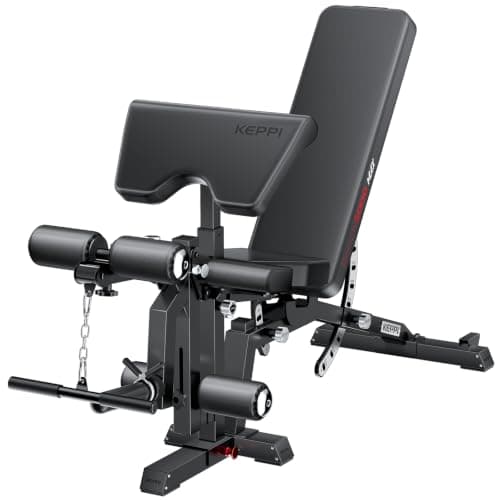
The Keppi 3000 V2 is a heavy-duty adjustable bench with a decline setting, a leg extension and curl attachment and a preacher curl pad, and it costs £299.99 on Amazon UK (1 November 2026). We rate it 4.2 out of 5. If you'd otherwise end up buying a separate preacher bench or leg station, it's one of the better ways to fold three pieces of kit into one footprint. If you only press and row, it's more bench than you need.
What makes it stand out on paper is how much adjustment Keppi has packed in: 12 backrest angles from minus 20 to 90 degrees, 3 seat angles, and an attachment system that comes off with a magnetic pin rather than a spanner. The EN20957 certification is the other headline. That's the European standard for stationary training equipment, and it's not something most bargain benches can point to.
How we review
We haven't trained on the Keppi 3000 V2 ourselves. This review is built from the Amazon UK listing data (pulled through Amazon's product API), Keppi's published specifications, the wording of retailer listings for the closely related Bench3000 Max, and the patterns in verified owner feedback. Where the listing contradicts itself, we say so rather than picking whichever number looks better.
This bench makes most sense for someone building a home gym in a garage or spare room who wants to train legs and arms properly without a cable stack. Leg extensions and preacher curls are both isolation lifts that are awkward to replicate with dumbbells alone, and dedicated machines for either cost real money and eat floor space. Bolting both onto a bench you'd buy anyway is the whole pitch.
It suits people who press with a barbell too. A 600kg flat rating and a 93lb steel frame put it well above what a typical home bencher will ever load, and the decline setting opens up decline pressing and decline sit-ups that cheaper flat-to-incline benches can't do.
Who shouldn't buy it? Anyone short on space, for a start. At roughly 195cm long with the attachments fitted, it's noticeably longer than a plain bench. And if you'll never touch the leg or preacher attachments, you're paying close to £100 over a decent standalone bench for parts that will sit in a corner.
Keppi lists the frame as 8-gauge and 16-gauge steel with some aluminium parts and PVC upholstery. The thicker 8-gauge steel will be doing the structural work, and that's the reason the bench can carry a 600kg rating. Keppi gives the frame weight as 93lb, which works out at about 42kg, but the listing's item weight says roughly 34.5kg. We can't tell which is right from the listing alone. Either figure is heavy for a home bench, and weight is what stops a bench walking across the floor when you drive your feet into it during a heavy press.
The backrest has 12 positions from minus 20 degrees to 90 degrees. That's a wider spread than either of the other benches we've reviewed recently: the JOROTO MD85 runs 7 positions from flat to 90 with no decline, and the METIS adjustable bench has 10 angles with no decline mentioned. More stops matter more than you'd think for incline pressing, because the jump between, say, 30 and 45 degrees changes which part of the chest and shoulder takes the load.
Then there's the seat, which has its own three settings at 0, 10 and 20 degrees. Tilting the seat up as the backrest climbs stops you sliding down the bench mid-set, a small thing that cheap benches often skip.
| Price | £299.99 (Amazon UK, 1 November 2026) |
|---|---|
| Certification | EN20957 |
| Max load (flat) | 600 kg / 1200 lb (static) |
| Frame | 8 and 16-gauge steel, aluminium parts, PVC upholstery |
| Frame weight | 93 lb listed (item weight listed as approx 34.5 kg) |
| Backrest | 12 positions, minus 20 to 90 degrees |
| Seat | 3 positions: 0, 10 and 20 degrees |
| Leg attachment | Extension and curl, 5 ROM angles, 5 arm lengths, slot-adjustable rollers |
| Preacher pad | 5 height settings |
| Attachment removal | Tool-free magnetic pin, approx 30 seconds |
| Dimensions | Approx 195 x 58 x 129 cm |
| Support | 5 years technical support (listing wording) |
This is where the 3000 V2 earns most of its price. Lots of benches come with a leg attachment, and plenty of them are an afterthought: a fixed-length arm, rollers that sit in the wrong place for anyone who isn't average height, and no way to limit the range of motion. Keppi gives you 5 arm lengths and slot-adjustable rollers, so you can line the pivot up with your knee and put the pads on your lower shin rather than halfway up your calf. The 5 ROM angles let you set the start position, which helps if a deep knee bend aggravates an old injury.
Is it worth training the lift at all? For quads, yes. A 2021 study that put 16 recreationally active men through leg extension training found that both rectus femoris and vastus lateralis thickness increased, whether they used drop sets or ordinary sets. Squats tend to under-train the rectus femoris because it crosses the hip as well as the knee, and that's the gap a leg extension fills. A later trial in the Journal of Sports Sciences found more rectus femoris growth when the hip was less flexed (40 degrees rather than 90), so if you can recline the backrest slightly while sitting at the attachment, it's worth trying. We can't confirm from the listing how far back you can lean with the leg arm fitted, so check the product photos.
For form and programming, our leg extension guide covers the setup, and the leg curl guide does the same for the hamstring side. Plate-loaded bench arms don't move as smoothly as a selectorised machine, so start light, learn where the rollers want to sit, and check the bolts after the first couple of sessions.
The preacher pad has 5 heights, which matters because a pad set too low pulls your shoulders forward and lets your lats help, while a pad set too high cramps the bottom of the curl. With 5 settings most people should find a position where the armpit sits snugly over the top edge. Pair it with an EZ bar or a single dumbbell and you've got a proper preacher curl station without buying a separate preacher curl bench.
The magnetic pin system is the practical win. Keppi says you can switch setups in about 30 seconds, and attachments that are a faff to remove tend to stay fitted permanently or stay in the box permanently. Quick removal means you'll actually use the bench as a bench.
Price is the obvious one. £299.99 puts the 3000 V2 above both the JOROTO MD85 (£218.49 when we reviewed it) and the METIS (£249.99), and you can buy a perfectly good flat-incline-decline bench for well under £200. You're paying for the attachments, and that only makes sense if you'll use them.
The listing itself needs a tidy-up. Besides the weight mismatch, the support bullet refers to the KEPPI 1000 Pro, which looks like a copy-paste slip from Keppi's other bench. It's probably harmless, but "5 years of technical support" isn't the same promise as a 5-year parts warranty, so get the seller to confirm what's covered before you buy.
Size is the last catch. At roughly 195 x 58 x 129cm it's long and tall with everything fitted, and it doesn't fold. Measure the room, and remember you need clearance either side for barbell plates.
See today's Keppi 3000 V2 priceAgainst the JOROTO MD85, the Keppi wins on adjustment range (12 positions with decline versus 7 without), load rating (600kg versus 450kg) and the leg and preacher attachments. The JOROTO has built-in storage and a pulling arm, and it's cheaper. The METIS is the plain, heavy option: around 40kg, 10 backrest angles and 3 seat positions, but no attachments and a weight capacity that the listing doesn't state. If you just want a bench that won't wobble, the METIS is simpler. If you want the most exercises from one piece of kit, the Keppi is the stronger buy. Our best weight bench UK guide lays out the wider field.
The NHS advises adults to do muscle-strengthening activity on at least 2 days a week, and a bench that covers pressing, rows, quads, hamstrings and biceps makes that easier to stick to at home.
Yes. Keppi lists 12 backrest positions running from minus 20 degrees to 90 degrees, so you get decline, flat, several inclines and an upright seated setting. The seat has its own 3 positions (0, 10 and 20 degrees), which helps stop you sliding down the pad on steeper inclines.
Keppi rates it at 600kg (1200lb) in the flat position. Treat that as a static figure, meaning weight resting on the pad. Lowering and driving a heavy barbell puts dynamic load through the frame, so your real working limit is lower, though few home lifters will get anywhere near it.
Both come off without tools. The listing describes a magnetic pin system and says you can swap between bench, leg and preacher setups in roughly 30 seconds. The leg attachment has 5 range-of-motion angles, 5 arm lengths and slot-adjustable rollers, and the preacher pad has 5 heights.
The listing calls it a leg extension and curl attachment, so the same lever arm is meant for both. Seated or lying leg curls on a plate-loaded bench attachment won't match a selectorised gym machine for smoothness, but they're a reasonable way to train hamstrings at home.
The figures on the listing don't quite agree. One spec line gives the steel frame as 93lb (about 42kg), while the item weight is listed at around 34.5kg. Either way it's heavier than most budget benches, so plan to assemble it close to where it'll live.
The listing promises 5 years of technical support, but that bullet names the KEPPI 1000 Pro, which looks like copy carried over from another Keppi listing. Ask the seller to confirm in writing what's covered on the 3000 V2 and keep your order details.
Buying a dumbbell set with rack in the UK: what 2.5 to 10kg, 2.5 to 25kg and 5 to 30kg bundles actually weigh, cost per kg, rack styles and delivery.
Should you buy a folding weight bench or a fixed FID bench? How folding benches work, what you give up, and the specs to check before you buy one in the UK.
What a free standing pull up bar is, when it beats a wall or doorway bar, the three main types, and how to check height, footprint and wobble before you buy.
How to set up an outdoor pull up bar in a UK garden: galvanised vs powder coat, concreting posts in, tree and wall mounts, ground cover and wet-weather grip.
Best Exercise is a participant in the Amazon EU Associates Programme, an affiliate advertising programme designed to provide a means for sites to earn advertising fees by advertising and linking to Amazon.co.uk. As an Amazon Associate we earn from qualifying purchases. This comes at no extra cost to you and never influences our independent reviews or rankings.