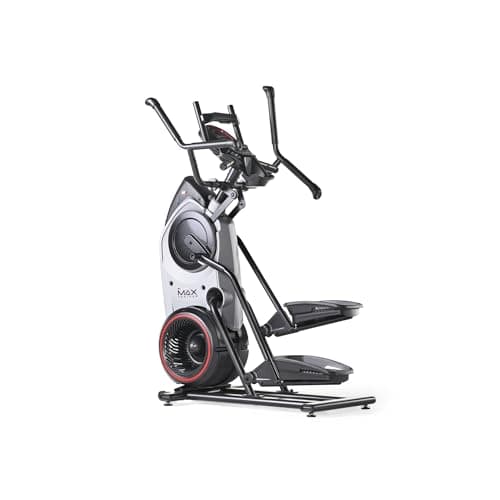
The Bowflex Max Trainer M6 is a compact cardio machine that sits somewhere between a stepper and a cross trainer, and it is built around one specific idea: that most people do not have an hour to give to cardio. The motion is steeper and more vertical than a conventional elliptical, which drives your heart rate up quickly and makes short interval sessions genuinely hard work. Bowflex leans on that with a signature 14-minute Max Interval programme. The headline verdict is that the M6 delivers exactly what it promises, a demanding workout in a small space and a small amount of time, but it is expensive for what is a fairly simple machine, and the steep motion will not suit everyone.
This is the mid-range model in the Max Trainer line. It keeps the same frame, the same 16 resistance levels and the same movement as the pricier models, and saves money by using a straightforward backlit LCD console instead of a large built-in touchscreen. In practice that means you prop your own phone or tablet on the media shelf. For most home users that is the sensible trade, because the workout does not change and the saving is significant.
How we review
This review is based on close research of verified owner reviews, Bowflex's published specifications and testing write-ups from trusted expert outlets. We have not run our own months-long endurance test of this exact unit, so we report only the findings that come up consistently, both the praise and the complaints, rather than one-off opinions. Prices and specs are correct at the time of writing and can change.
Who it is for
The M6 makes most sense for someone with a spare room rather than a spare garage, and twenty minutes rather than an hour. Time-pressed office workers, people returning to training after a long break, and anyone who wants low-impact cardio that still feels like real effort are the natural fit. It also suits households where a treadmill is out of the question because of noise or ceiling height.
It is a poor fit for two groups. If you like long, gentle, steady-state sessions, the steep motion becomes tiring in a way that is more about local leg fatigue than cardiovascular work, and a plain exercise bike is a better buy. And if you are chasing maximum machine for your money, the M6 is expensive next to a well-specified conventional cross trainer. Our best cross trainer UK guide covers the alternatives at various budgets.
Pros
Genuinely compact footprint for a cardio machine, around 122 x 79cm
Steep, stepper-like motion raises heart rate fast, so short sessions count
Low impact with no jarring through ankles, knees or hips
16 resistance levels give real range from easy warm-up to very hard
Quiet magnetic resistance, fine for flats and shared houses
Works fully without any subscription
Solid, stable frame that does not creak or rock under effort
Cons
Expensive for the specification compared with a conventional cross trainer
Steep knee bend does not suit everyone, including some with knee pain
Basic LCD console feels dated next to touchscreen rivals
Does not fold, so it occupies its space permanently
Best features sit behind the paid JRNY subscription
Heavy and awkward to move once assembled
Build and assembly
The frame is the best part of the machine. It is heavy, wide-footed and does not rock or creak even when you are pushing hard out of the saddle, which is more than can be said for a lot of cardio kit at this price. The moving arms are solid, the pedals are large and grippy, and the whole thing feels like it will take years of use rather than months.
Assembly is the usual story for a machine of this size. Expect somewhere between one and two hours, and it is far easier with a second pair of hands because of the weight of the main frame. The instructions are adequate rather than good. Once built, it is heavy and there are transport wheels, but moving it between rooms is a two-person job you will want to do once.
Bowflex Max Trainer M6 key specs
Type
Compact elliptical and stepper hybrid
Resistance
16 levels, magnetic
Console
Backlit LCD with media shelf
Built-in programmes
Manual, Max Interval, Calorie Burn, Fat Burn and more
Signature workout
14-minute Max Interval
App
JRNY, Bluetooth, subscription optional
Footprint
Approx 122 x 79 cm
Max user weight
Approx 136 kg / 300 lb
Heart rate
Contact grips, plus Bluetooth chest strap support
Power
Mains adapter
The workout, and why it feels hard
This is the part that separates the Max Trainer from an ordinary cross trainer. Instead of a long, flat oval, your feet travel a much steeper and more vertical path, so every stroke asks more of your glutes and quads while your arms drive the handles. The practical result is that your heart rate climbs quickly and stays there. Level 6 on this machine is not level 6 on a typical elliptical.
That plays directly into interval work, and the built-in 14-minute Max Interval programme is a well-judged use of it: short, hard bursts against easier recovery periods. The evidence behind that style of training is good. Interval work produces comparable or greater improvements in aerobic capacity than longer moderate sessions while taking substantially less time (review of high-intensity interval training). If your barrier to cardio is genuinely the clock, this machine is designed around that problem.
The honest caveat is that "low impact" and "easy on the joints" are not the same thing. There is no jarring, which is the real benefit, but the steep path puts the knee through a deeper bend than a flat elliptical. Most people are fine. A minority, including some with existing knee trouble, find it uncomfortable and would be better served by a conventional cross trainer or a rowing machine. It is also worth remembering that a hard 15 minutes does not replace the broader target of at least 150 minutes of moderate activity a week set out in the NHS physical activity guidelines, though vigorous work counts at roughly double the rate.
Console, app and value
The LCD console is functional and no more. It shows the numbers you need, the backlight is clear, and the media shelf holds a phone or a tablet at a sensible angle. Nobody will call it exciting, and if you want a large integrated screen you are looking at the step-up models. For a lot of buyers the M6 is the smarter purchase precisely because you already own a better screen than any machine will give you.
The JRNY app connects over Bluetooth and adds guided sessions, adaptive coaching and tracking over time. It is a genuine extra if you want structure and someone talking you through the work, and it is a subscription you can happily ignore. The machine's own programmes and manual mode are fully usable without paying anything, which is worth stating plainly because it is not always obvious from the marketing.
Value is where the M6 draws most of its criticism, and fairly. This is a lot of money for a machine with a basic display, no folding mechanism and a modest programme list. What you are actually paying for is the motion, the footprint and the build quality, and those three things are hard to get elsewhere in this combination. If space is your binding constraint, that premium is easier to justify. If it is not, a conventional cross trainer or a spin bike gives you more for less. At the bottom of that range, the Reebok ZR8 cross trainer covers the same low-impact cardio for a fraction of the M6's price, minus the steep motion and the interval programmes. For a fuller picture of the compact cardio options, see our home gym section.
It is worth it if you are short on time and short on space, and you genuinely intend to train hard. The compact footprint and the interval-style motion make it easy to get a demanding session done in 15 to 20 minutes. If you prefer long, steady, low-effort cardio while watching television, a conventional cross trainer or exercise bike gives you far more machine for the money.
What is the difference between the Max Trainer M6 and the M9?
They share the same core motion and build. The M9 adds a larger touchscreen console with a fuller media experience, while the M6 uses a simpler backlit LCD display and leans on your phone or tablet for the app. The M6 is noticeably cheaper and the actual workout you get is close to identical.
Is the Max Trainer M6 the same as an elliptical?
No, though it is related. A standard elliptical moves your feet on a long, flat, oval path. The Max Trainer uses a much steeper, more vertical path that blends a stepper with an elliptical, so it loads your glutes and quads harder and raises your heart rate faster. The trade-off is that it feels more demanding at the same resistance level.
Does the Max Trainer M6 need a subscription?
No. The machine works fully without one, and you can use the manual mode and the built-in programmes forever at no extra cost. The JRNY app adds guided coaching and tracking on a paid subscription, and a trial is usually included. Plenty of owners never subscribe and are perfectly happy.
Is the Bowflex Max Trainer M6 good for bad knees?
It is low impact, so your feet never leave the pedals and there is no jarring through the joints, which is generally kinder than running. That said, the steep, stepper-like path bends the knee more than a flat elliptical does, so some people with knee pain find it less comfortable, not more. If your knees are a concern, speak to a physiotherapist and consider trying the motion before you commit.
How much space does the Max Trainer M6 need?
It has a genuinely small footprint for a cardio machine, roughly 122cm long by 79cm wide, so it fits in a spare room or a corner far more easily than a treadmill or a full-size cross trainer. It does not fold, though, so allow for it staying where you put it, plus clearance above for your head as you step.
Our Neezee 3-in-1 cross trainer review: 16 magnetic resistance levels, the 8kg flywheel, Kinomap and Zwift support, 150kg limit, footprint and what the listing leaves out.
An honest YOSUDA foldable cross trainer review covering the 2 sq ft folded footprint, 38cm stride, 5.5kg magnetic flywheel, 16 resistance levels, the 175cm height guidance and the noise claim we don't believe.
Five cross trainer workouts with exact timings and resistance cues, from a 20 minute beginner session to intervals and a reverse-stride glute session, plus form tips and common mistakes.
An honest pooboo foldable elliptical cross trainer review covering the 39cm stride, 7.3kg flywheel, 16 magnetic levels, folding frame, Kinomap support and the weight capacity figures that don't agree.
Best Exercise is a participant in the Amazon EU Associates Programme, an affiliate advertising programme designed to provide a means for sites to earn advertising fees by advertising and linking to Amazon.co.uk. As an Amazon Associate we earn from qualifying purchases. This comes at no extra cost to you and never influences our independent reviews or rankings.